There is a Persian expression — Esfahan nesf-e jahan — that translates as Isfahan is half the world. It was coined during the Safavid period, when the city under Shah Abbas I had become so cosmopolitan, so dense with trade and art and learning and spectacle, that half the world seemed an understatement rather than an exaggeration. We arrived in the late morning and walked to the square, and by the time we had crossed it once in the afternoon heat and found a vendor selling bastani sonnati — the traditional Persian saffron and rosewater ice cream, pale gold, threaded with pistachios, served between two wafers — we understood the expression without requiring a footnote.
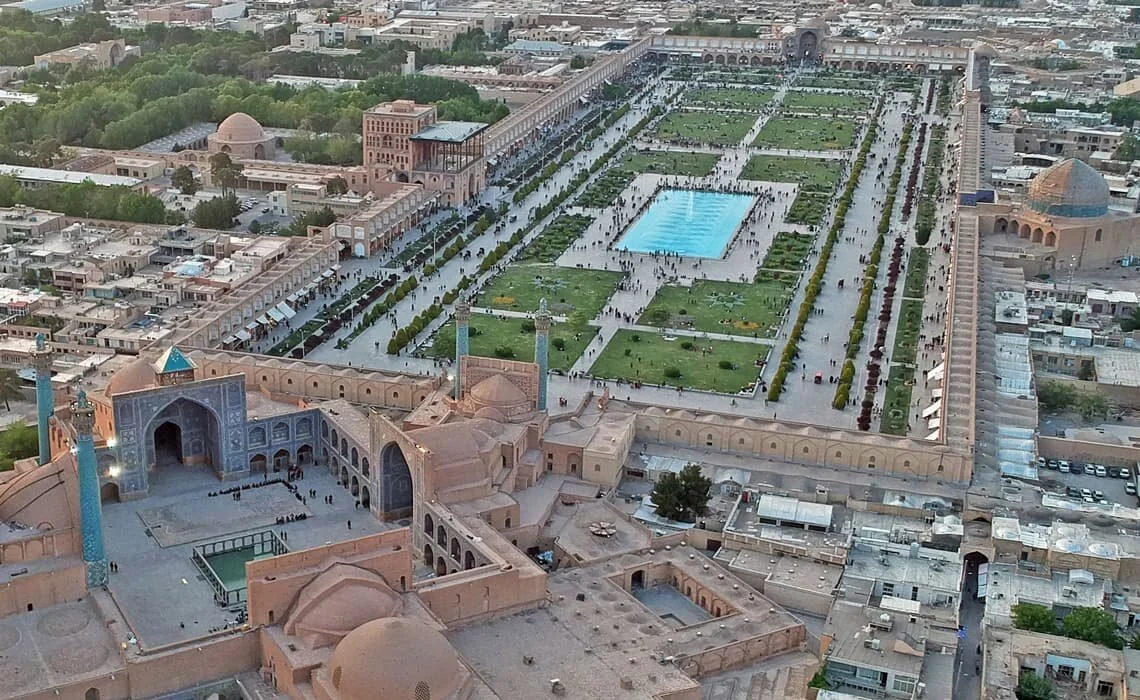
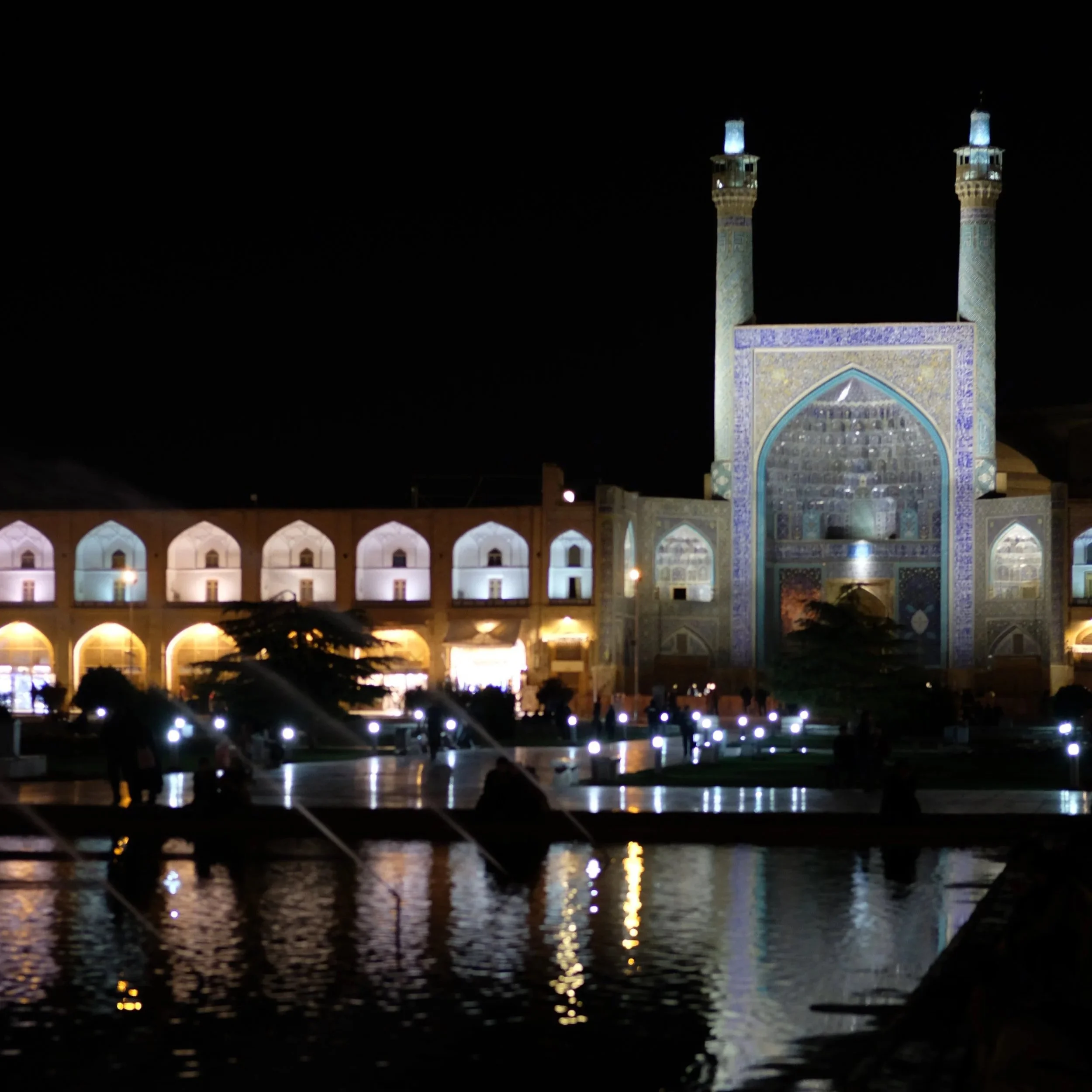
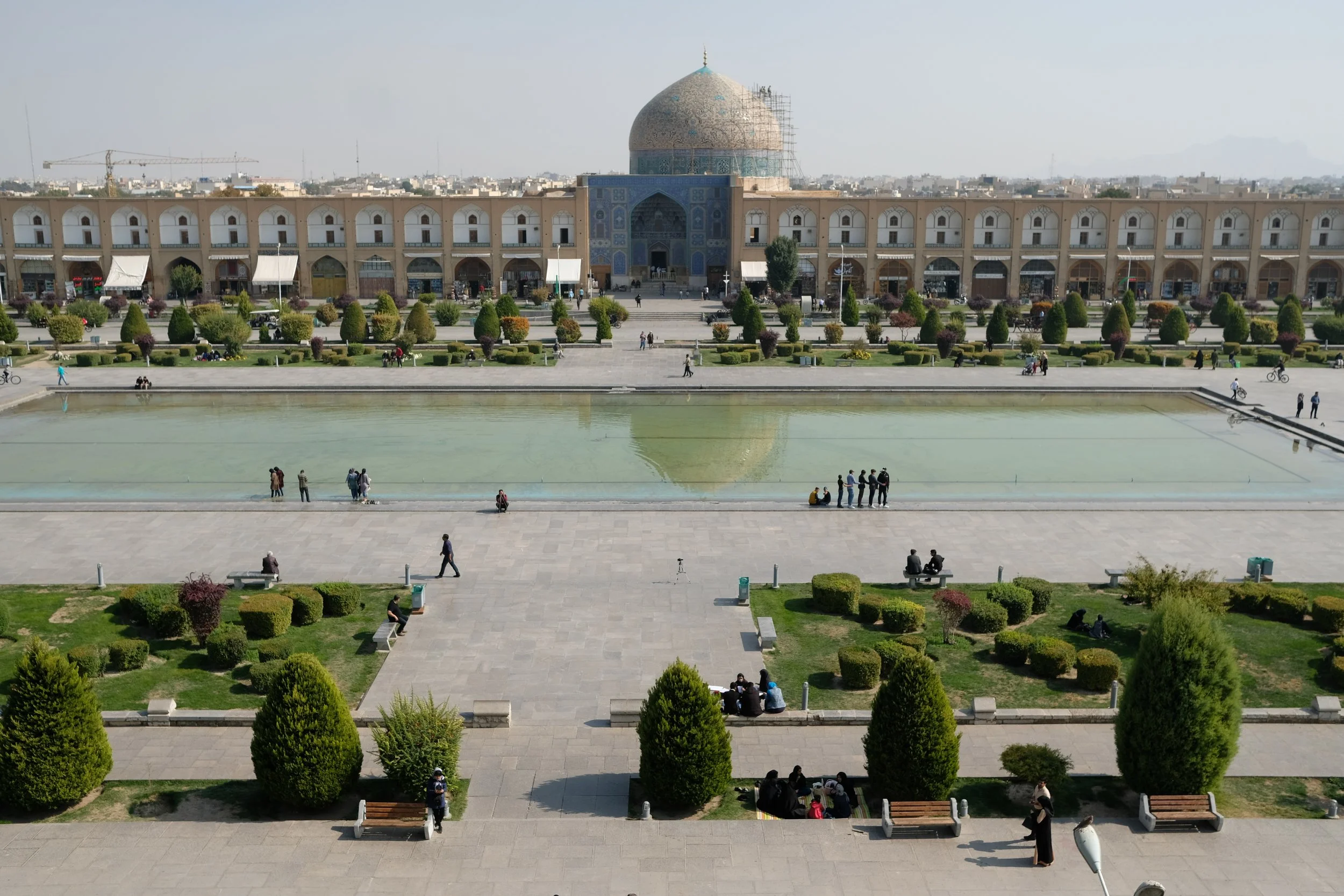
Naqsh-e Jahan square, Isfahan.
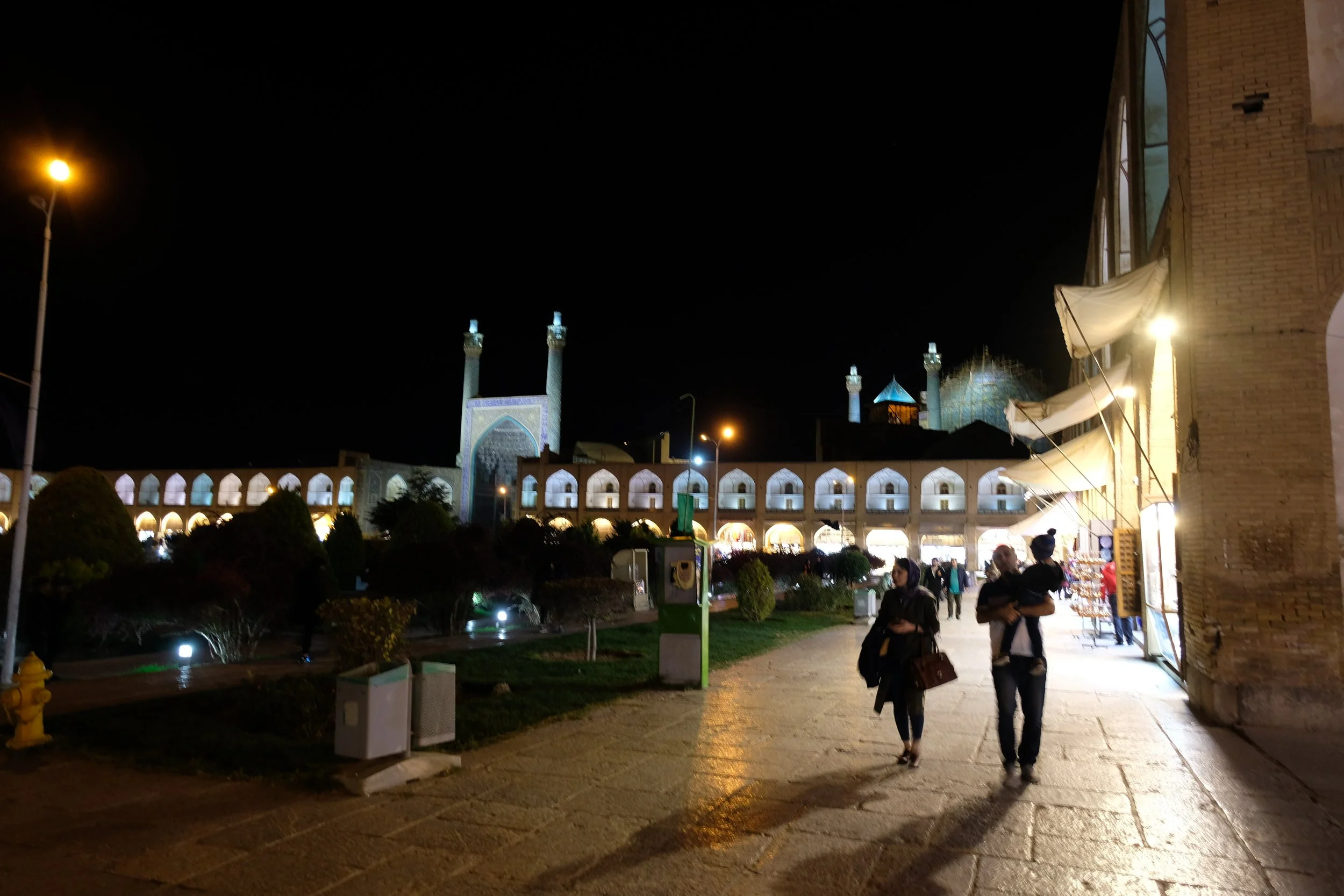
Naqsh-e Jahan: Image of the World. The square is 560 metres long and 160 metres wide, and it is framed on all four sides by two-storey arcades of shops behind which the four great monuments stand: the Shah Mosque to the south, Sheikh Lotfollah Mosque to the east, the Ali Qapu Palace to the west, the Qeysarieh Gate opening north into the Grand Bazaar. The ensemble was laid out between 1598 and 1629 under Shah Abbas I, who had moved his capital from Qazvin to Isfahan specifically to put it beyond the reach of the Ottomans to the west and the Uzbeks to the northeast, while gaining control of the Persian Gulf trade routes that the Dutch and British East India Companies were beginning to make lucrative. The square was designed by the polymath Shaykh Bahai — mathematician, astronomer, poet and architect — who understood that the commission was not simply to build monuments but to express an idea about what Persia was and what it was capable of. He succeeded so completely that Pietro della Valle, an Italian visitor who had seen Rome, declared the square outshone the Piazza Navona. In the shade of the arcades, in the mid-afternoon, we ate the ice cream and tried to take in everything at once, which is not possible. It requires time and repetition, and we had only the afternoon.
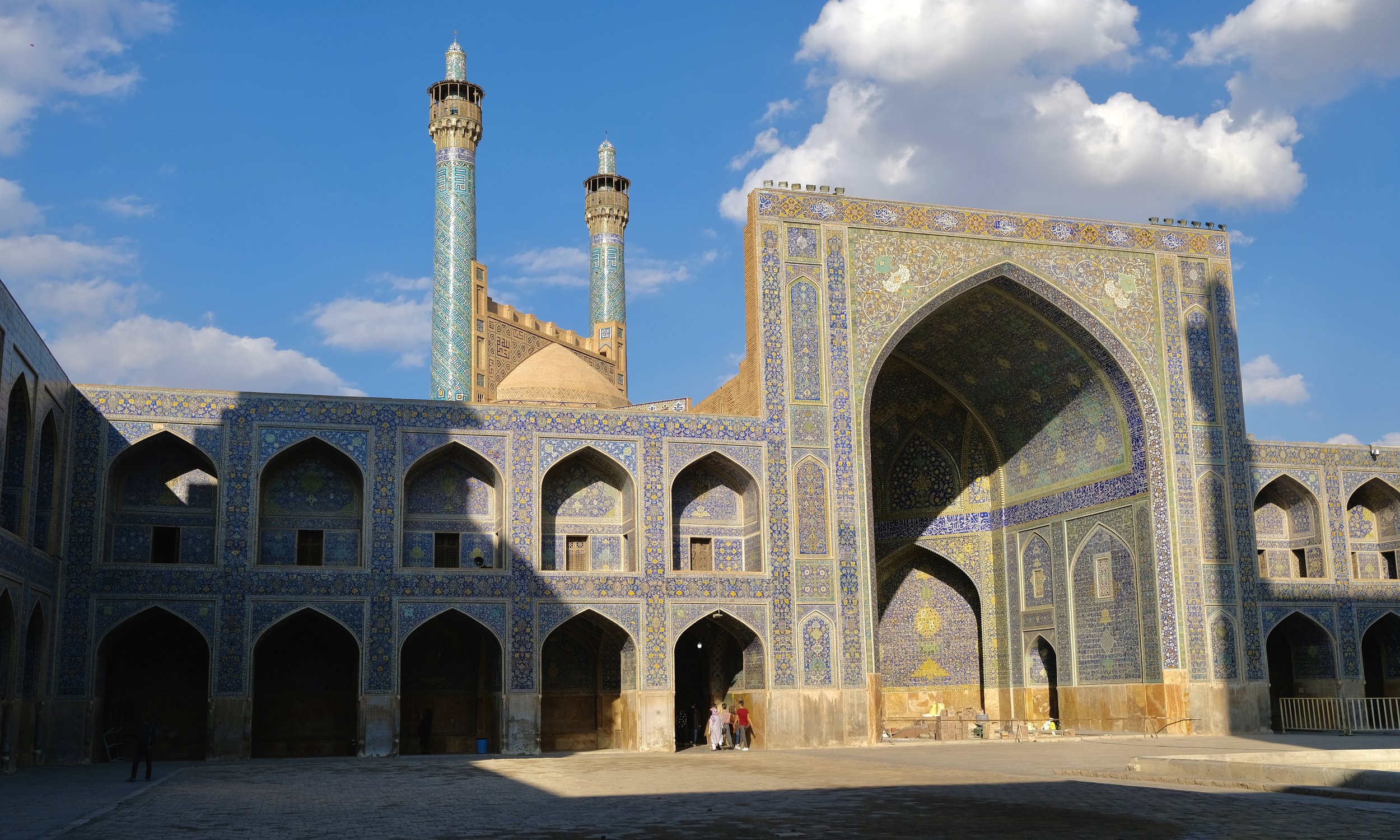
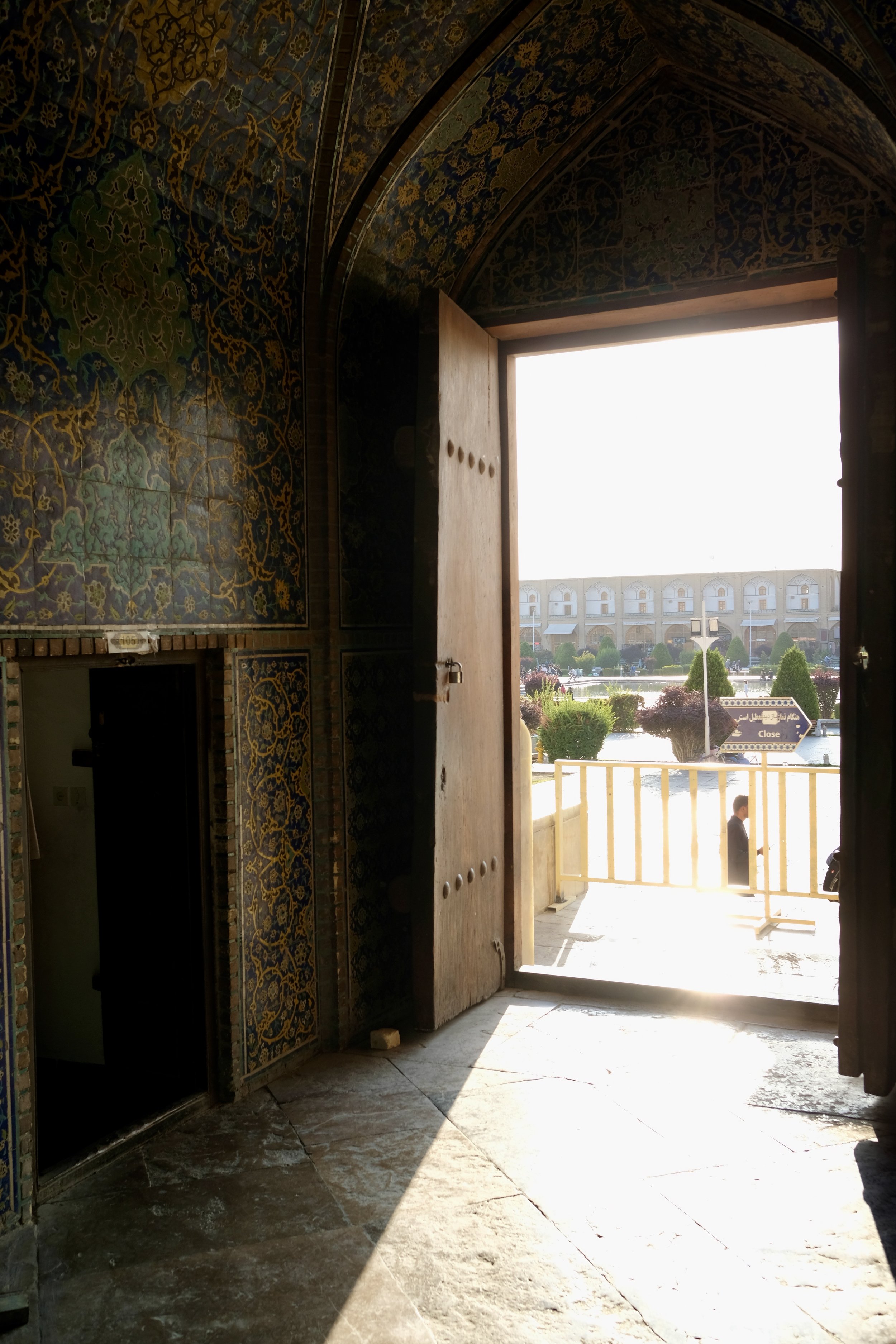
The thing that stops you first, before any specific building, is the tilework. The entire perimeter — arcades, portals, domes, minarets — is covered in it: blues and turquoises and whites, with accents of gold and black and terracotta, in patterns that repeat and interlock across every surface. From across the square the effect is of a continuous shifting field of colour, the buildings shimmering slightly in the heat. Up close, the patterns resolve into a complexity that is difficult to fully process: stars and hexagons and interlaced strapwork and arabesques and calligraphic bands, each element fitting precisely into the next across surfaces that are never flat and never simple. The tilework is not decoration applied to architecture. It is the architecture's argument, rendered in glazed ceramic.
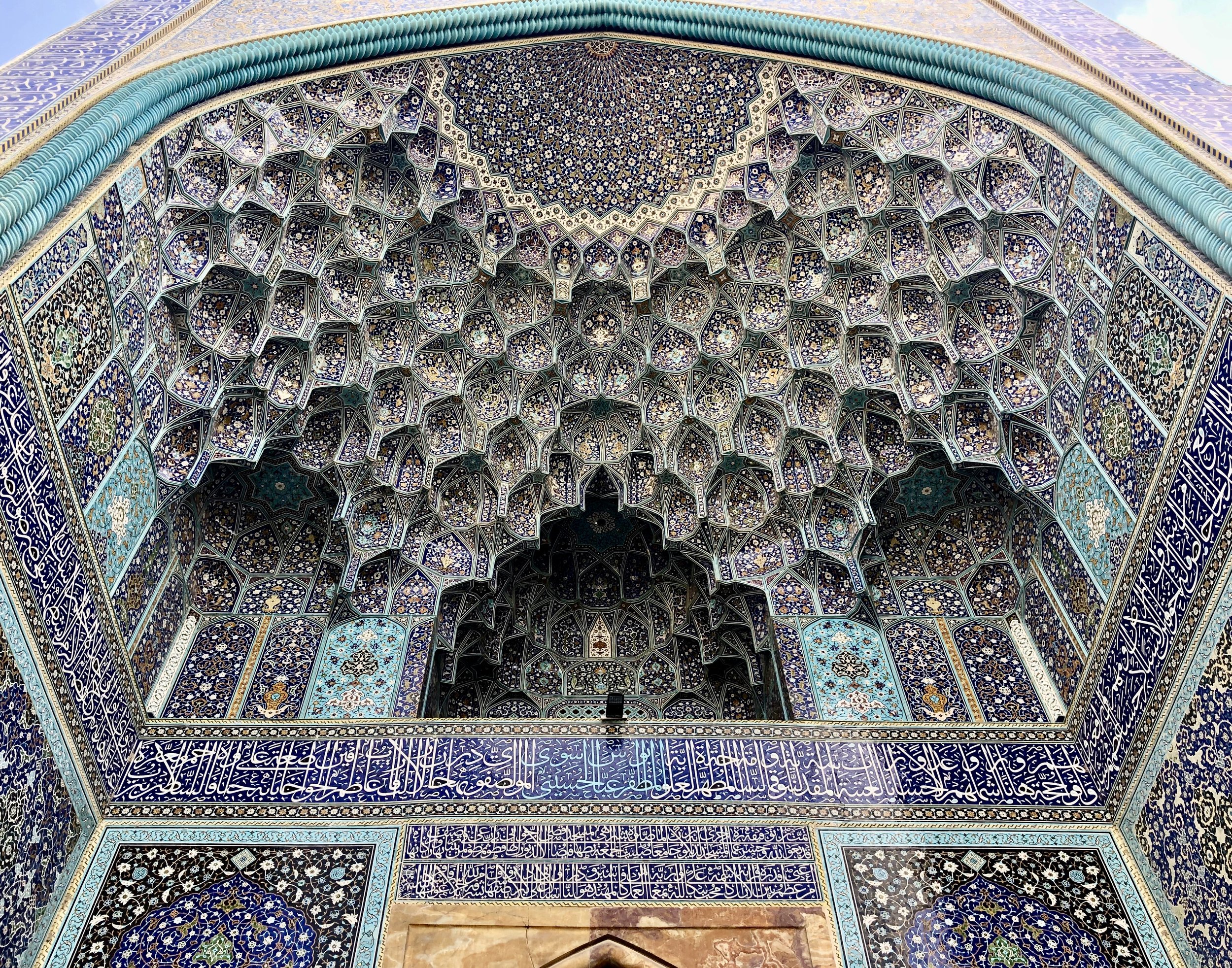
The patterns have a name: girih, from the Persian word for knot. They are built from five standard tile shapes — a regular decagon, an elongated hexagon, a butterfly, a rhombus, and a bowtie — which can be combined to generate patterns of extraordinary complexity without ever repeating. The mathematical property embedded in these combinations is called quasi-crystalline symmetry: patterns with tenfold rotational symmetry that can be extended infinitely without repetition, and that appear perfectly ordered without being periodic. The principles behind quasi-crystalline symmetry were formally described by the Oxford mathematician Roger Penrose in the 1970s. In 2007, physicists Peter Lu and Paul Steinhardt published a paper in the journal Science demonstrating that Islamic artisans had been constructing quasi-crystalline patterns using these five tile types from at least the fifteenth century — five hundred years before Penrose, working with straightedge and compass rather than twentieth-century mathematics, achieving through intuition and craft what the Western mathematical tradition would not formalise for another half-millennium. When you look at the tilework on the portal of the Shah Mosque and feel that something extraordinary is happening in the pattern, you are responding to a mathematical structure that the artisans understood and that their culture had developed specifically to solve. It is not coincidence. It is not accident. It is geometry.
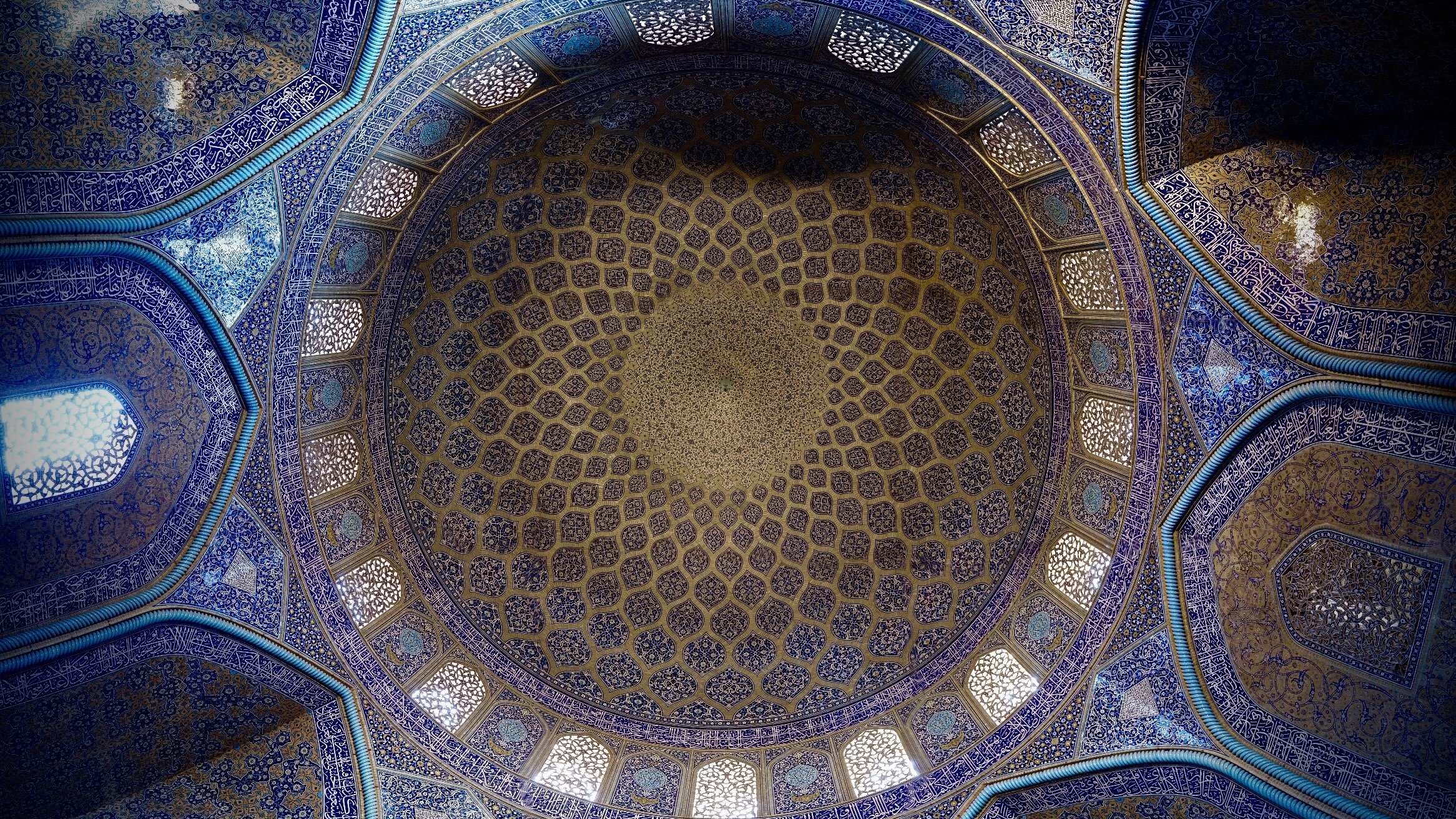
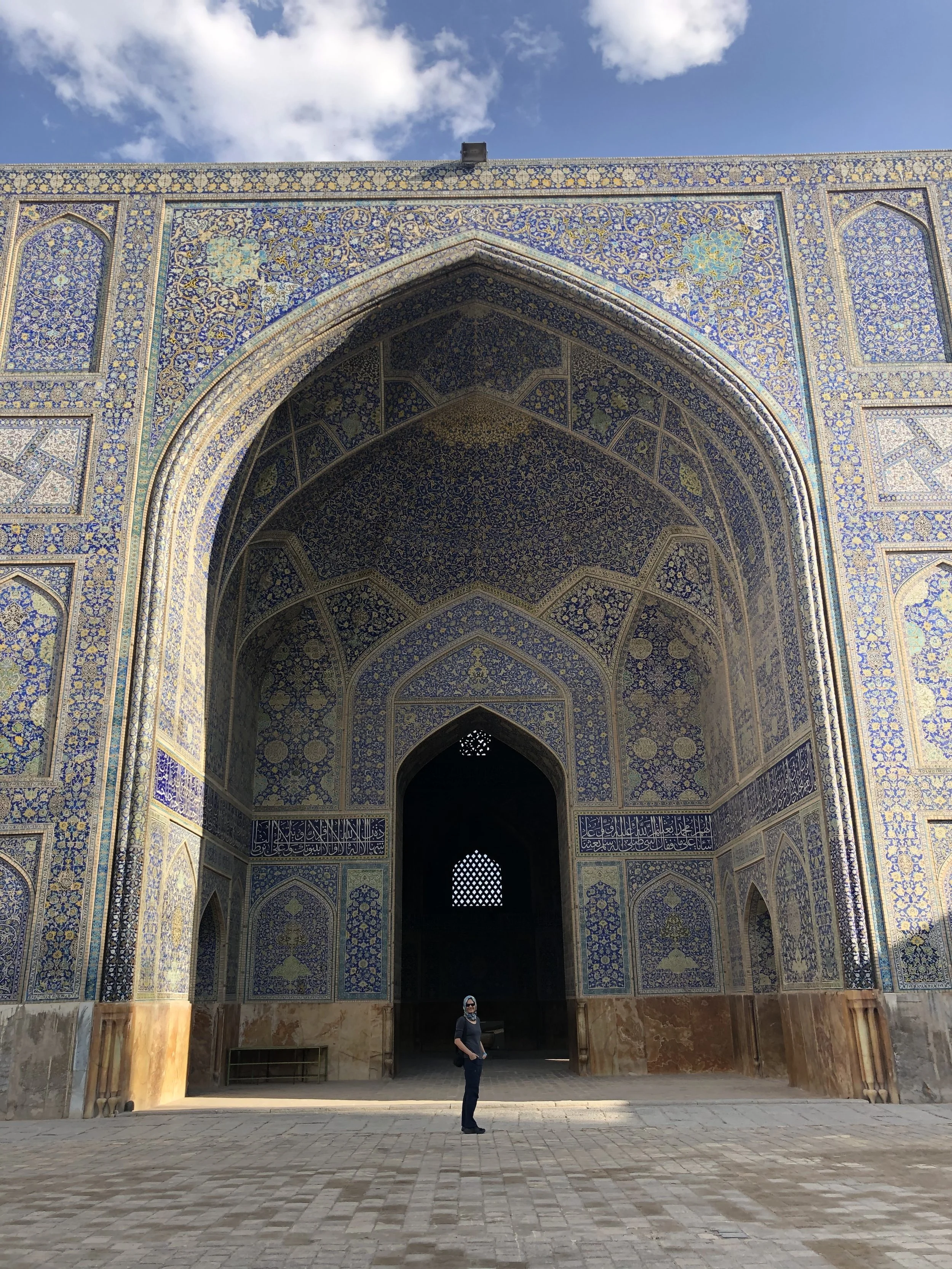
The same applies to the muqarnas — the honeycomb vaulting that fills the interior of every iwan portal on the square, cascading downward from the apex of the arch in tier upon tier of interlocking three-dimensional cells. Stand beneath the entrance portal of the Shah Mosque and look up: the surface above you does not look like masonry. It looks like something grown rather than built, a crystalline formation in the process of becoming, gravity suspended. The muqarnas emerged as a structural solution — a method of transitioning from a square base to a circular dome by subdividing the corner problem into smaller and smaller units — but by the Safavid period it had become something more than structural. It follows fractal geometry: each unit resembles the whole at a smaller scale, self-similar across levels of magnification, producing a surface that the eye reads as simultaneously infinitely complex and perfectly ordered. There is research suggesting that this quality — fractal patterning, which appears throughout the natural world in coastlines and snowflakes and tree branches — has a measurable calming effect on the human nervous system, that the brain processes it with less effort than random pattern and more engagement than simple repetition. The Safavid architects may not have known this in those terms. They knew what they were doing.
Walk south to the Shah Mosque and notice that the entrance portal faces the square directly, then turns. The prayer hall inside is aligned with Mecca, which lies to the southwest. The square runs north to south. These two requirements are geometrically irreconcilable if you want both the portal to face the square and the prayer hall to face Mecca, and the architect's solution is one of the great acts of spatial intelligence in the history of architecture: a large vestibule makes an approximately 45-degree turn between the entrance and the prayer hall, so that the transition is absorbed by the building rather than by the worshipper. The consequence — possibly deliberate, possibly a discovered bonus — is that the great dome of the Shah Mosque becomes visible from the square at an angle. Had the mosque been aligned with the square, the dome would have been partly obscured by its own entrance portal. The constraint, resolved through geometry, produced a better composition than the unconstrained version would have allowed.
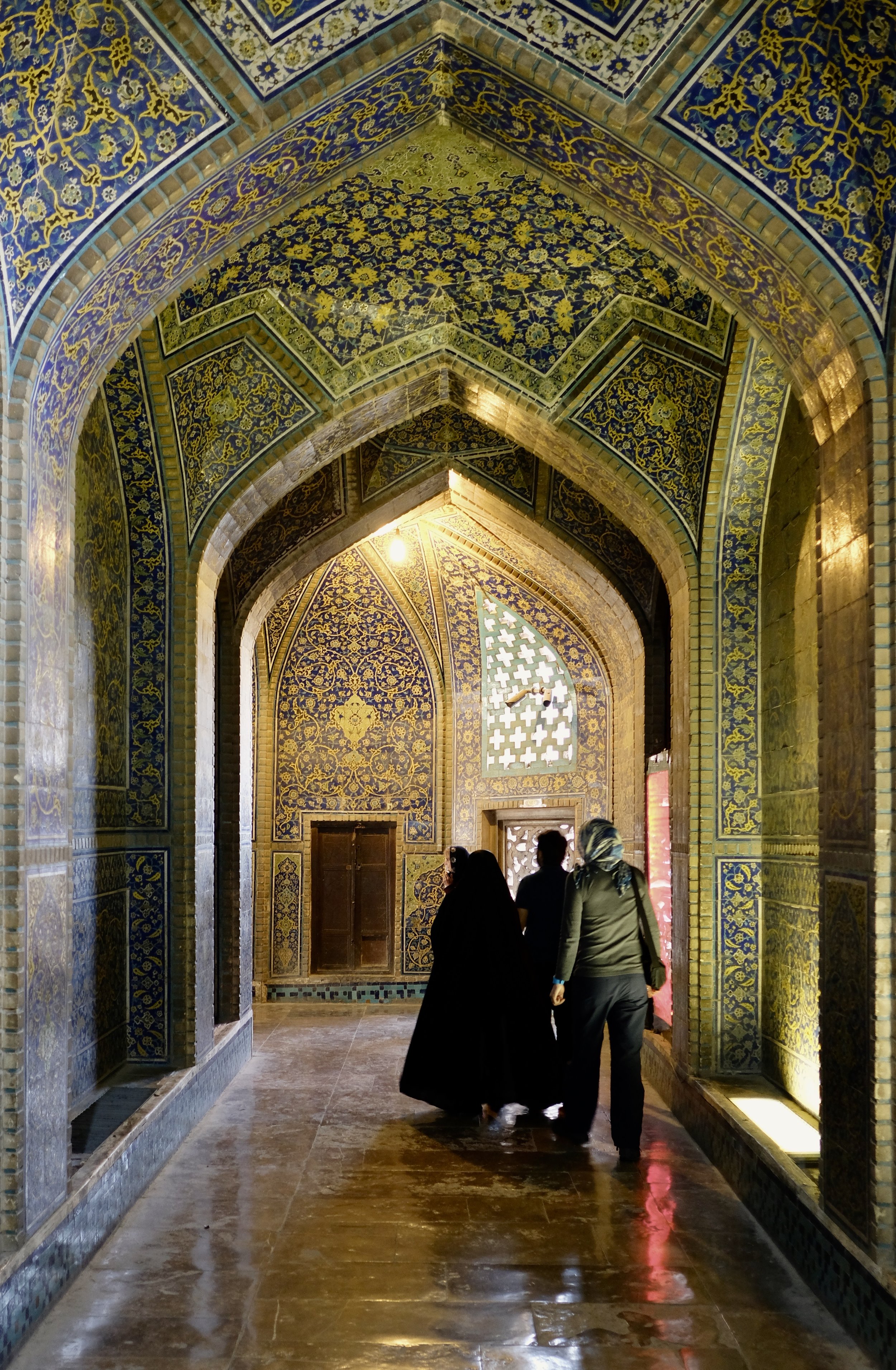
Directly opposite, on the east side of the square, is the Sheikh Lotfollah Mosque — smaller, quieter, more intimate, and in the opinion of many who have studied Persian architecture the more perfect of the two. It was built between 1603 and 1619 as a private mosque for the royal court, connected to the Ali Qapu Palace across the square by an underground tunnel that allowed the Shah and the royal women to attend prayers without crossing the public square. It has no minaret, because it had no need to call a public congregation. It has no courtyard. It is a single domed chamber, 19 metres on a side, preceded by a portal iwan and preceded by that by a winding corridor — the architect's solution to the same qibla problem as the Shah Mosque — which leads you from the brilliant light of the square into a gradual deepening darkness and then into the prayer hall, which arrives like an exhalation.
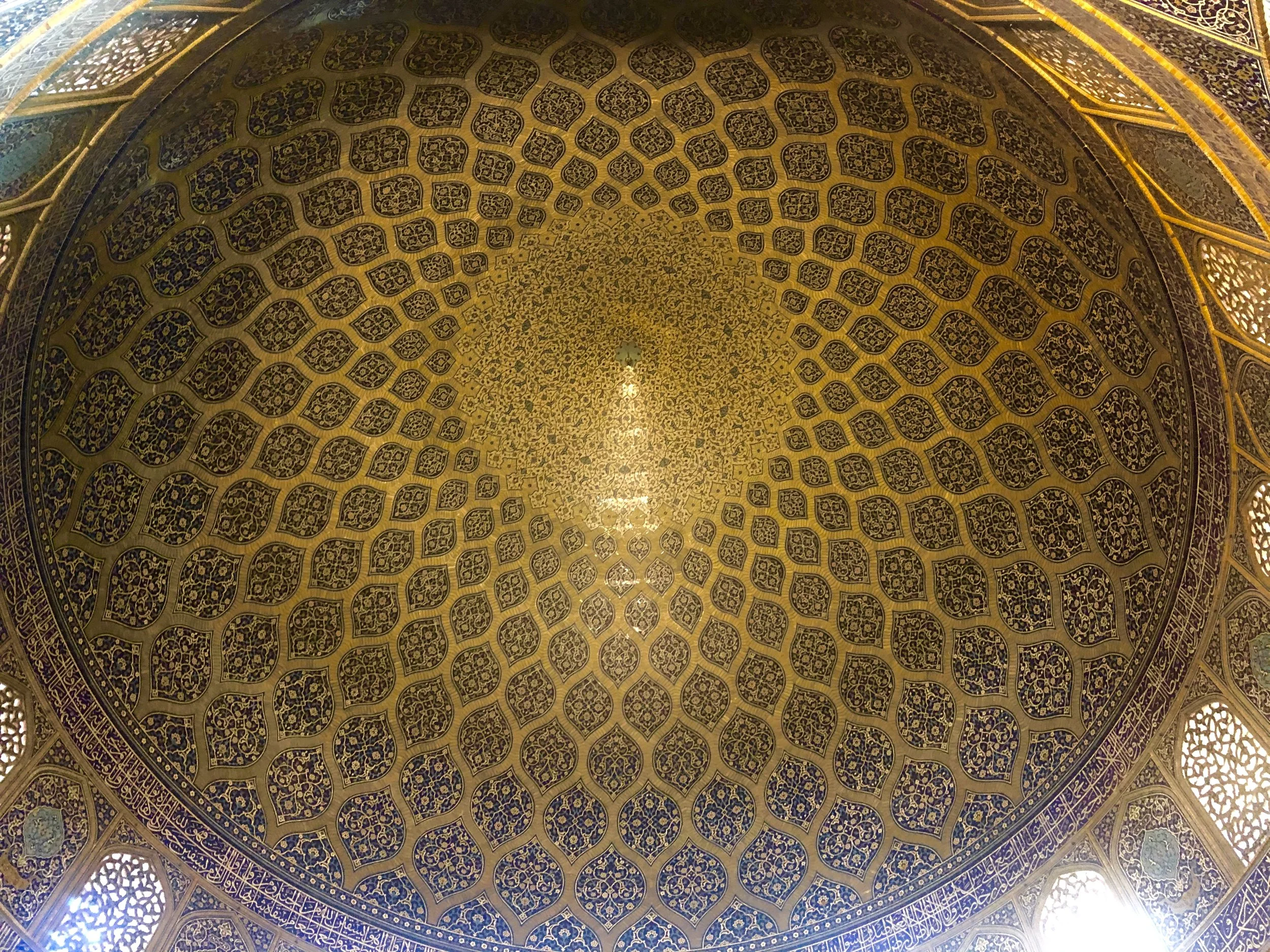
The interior of Sheikh Lotfollah is tiled from floor to apex in arabesques of cream and turquoise and gold, and the dome above you is inset with a network of lemon-shaped compartments that decrease in size as they ascend toward the apex, creating an illusion of greater height in a space that is only 13 metres to the crown. The eye reads the shrinking compartments as distance and translates that into altitude. The dome looks taller than it is, which is to say the architect measured your perception and built to that measurement rather than to the physical dimension.
At the apex, rendered in tilework, is a peacock — without a tail. The tail is made of light. The latticed windows around the drum of the dome are positioned and angled so that sunlight enters at specific trajectories throughout the day, casting luminous rays across the dome's surface in a spreading fan. As the sun moves, the tail moves with it. The peacock is only complete when the light completes it, and it changes across the hours, and it is different in every season because the sun's altitude is different in every season. The architect designed the windows not merely to illuminate the interior but to animate it — to create a moving image whose existence depends on the relationship between the position of the sun, the geometry of the apertures, and the surface of the tilework. This is optics as architecture, a calculated relationship between light and form that required precisely the understanding of angles and reflection and refraction that the Persian scholar Ibn al-Haytham had laid out in his Book of Optics six centuries earlier. The building knows where the sun will be. It was designed around that knowledge.
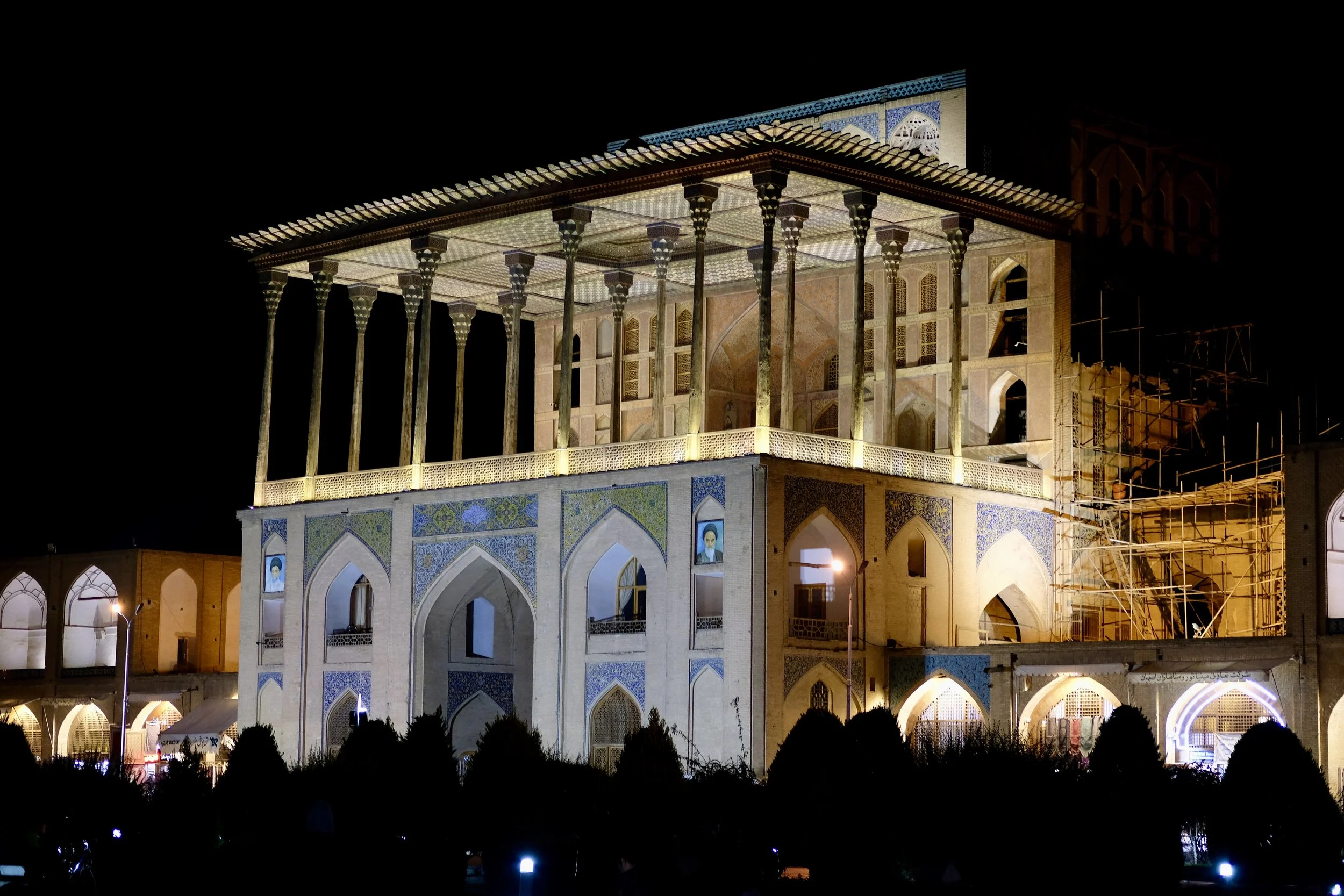
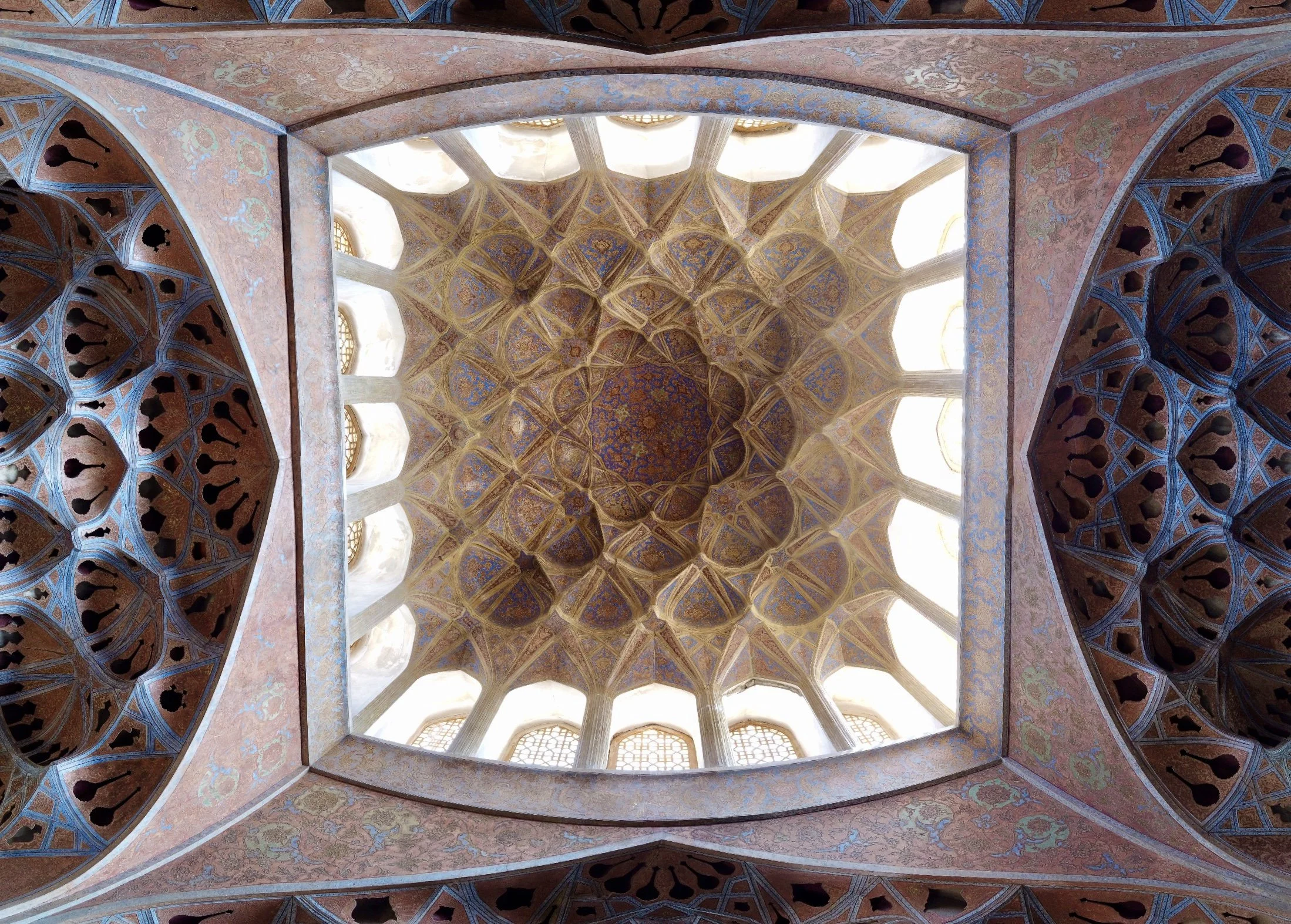
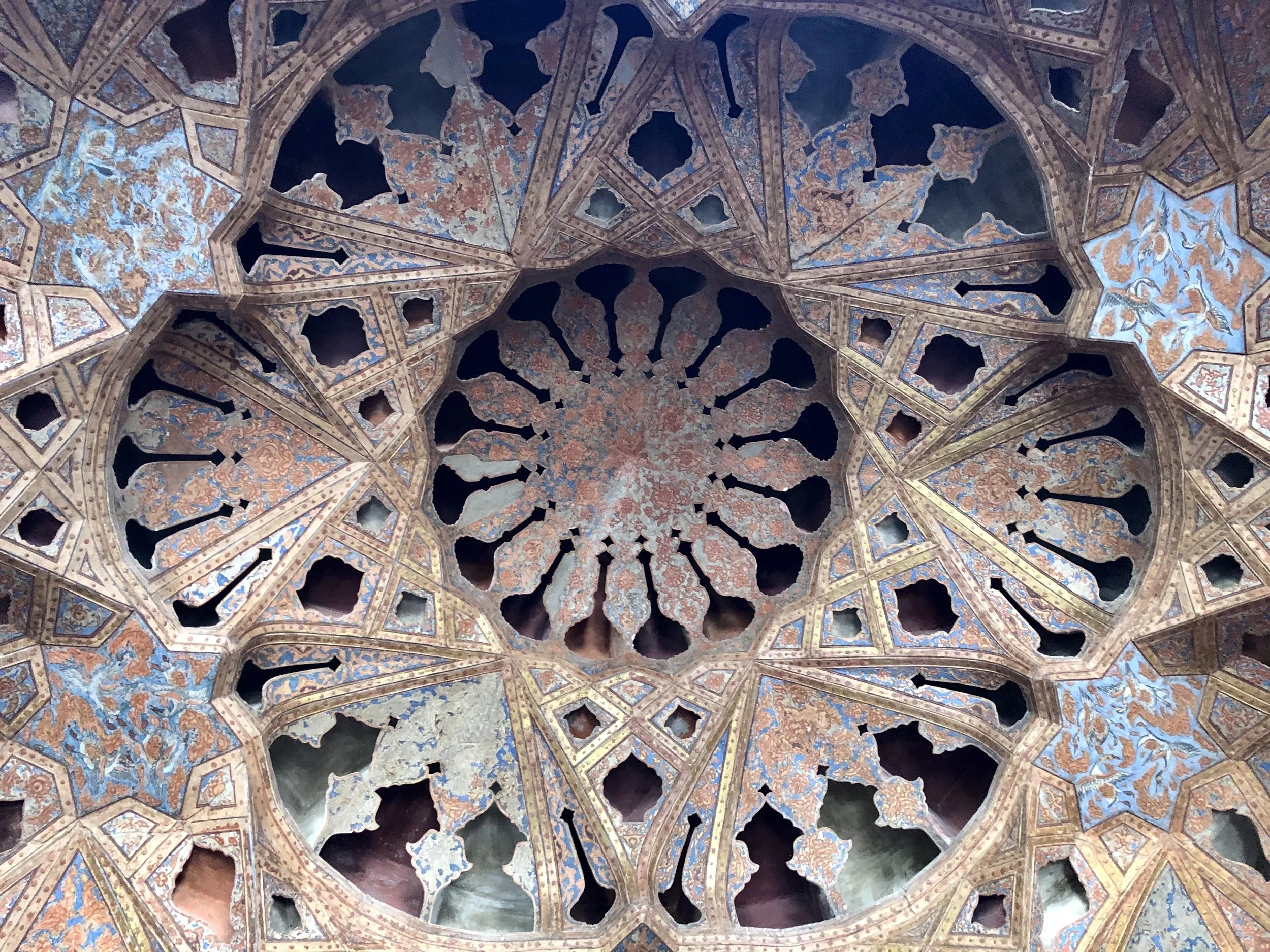
Across the square, on the western side, the Ali Qapu Palace looks outward over everything. Its name combines Arabic and Turkic — Ali for imperial, Qapu for gate — and from its fourth-floor terrace, supported by eighteen slender columns of plane wood, the Safavid shahs watched polo played on the square below, received foreign ambassadors, and looked out at the entirety of what they had made. The palace rises six floors, and the highest is the music room, where the Shah entertained his most privileged guests to performances of setar, kamancheh and daf. The room is small, cross-shaped in plan, approximately 63 square metres, and every surface from the lower walls to the ceiling is panelled in stucco cut into the shapes of vessels — carafes, ewers, thermoses, jugs, hookahs, wine cups — hundreds of them, in varying sizes, their silhouettes covering the walls in a dense, intricate lattice of cut-out forms.
They are not shelves. The stucco is too delicate to bear weight and the shapes too irregular to be functional. They are acoustic chambers. Each vessel-shaped niche is hollow behind the surface, an air cavity of specific volume and shape, and the ensemble functions as what acoustic engineers call a Helmholtz absorber — a system of resonant chambers that absorbs sound energy at specific frequencies, reducing reverberation, clarifying the tone of instruments, and distributing music evenly through the space. Research using three-dimensional acoustic simulation has confirmed that the muqarnas of the ceiling and the vessel niches of the walls work together as a system: the ceiling diffuses, the walls absorb, and the result is a room whose acoustic properties are precisely calibrated for the quiet, intimate instruments it was built to amplify. The Safavid architects understood reverberation time. They built its management into the decorative programme.
The wit of the vessel shapes is not incidental. The room that contains music is panelled with the shapes of things that contain liquid — the containers rhyming across the register of sense, so that the room is simultaneously doing something and saying something about what it is doing. This is characteristic of the Safavid architectural sensibility: the decorative and the functional are not separate categories to be traded off against each other but a single intention expressed in two registers simultaneously. The peacock in Sheikh Lotfollah is both image and optical instrument. The girih tilework is both ornament and theorem. The music room of Ali Qapu is both surface and acoustic device, both decoration and the thing the decoration is about.
Ibn al-Haytham is worth a moment. Working in Cairo in the early eleventh century, he established that vision results from light travelling from objects to the eye — reversing the Greek assumption that the eye emits rays — and in doing so founded the science of optics. He invented the camera obscura. He described the principles of reflection and refraction with mathematical precision. His Book of Optics was translated into Latin in the twelfth century and shaped European understanding of light for five hundred years, influencing Kepler, Descartes and Newton. He is one figure in a tradition that includes al-Khwarizmi, the ninth-century Persian mathematician who invented algebra — the word itself comes from the title of his book, Kitab al-Jabr — and whose name gives us the word algorithm. It includes Omar Khayyam, the eleventh-century Persian polymath who solved cubic equations geometrically and founded analytic geometry, and who is better known in the West as the poet of the Rubaiyat. It includes Avicenna — Ibn Sina — whose Canon of Medicine was the standard European medical textbook for six hundred years. These were not marginal figures. They were the intellectual infrastructure of the medieval world, the people who kept Greek knowledge alive while Europe had mislaid it, extended it further than the Greeks had taken it, and transmitted it westward in forms that made the Renaissance possible.
The House of Wisdom in Baghdad — the great institutional centre of this tradition, founded in the ninth century, destroyed by the Mongols in 1258 — brought together scholars of every background and religion to translate, synthesise and extend the knowledge of Greek, Persian, Indian and Chinese civilisation. Architecture was classified in this tradition as a branch of practical geometry. The muhandis — the Arabic word for engineer, from the same root as handasah, geometry — was required to understand mathematics in order to build. Abu al-Wafa' Buzjani, a tenth-century Persian mathematician and astronomer, wrote a treatise specifically on geometric constructions for craftsmen and artisans, explaining the mathematical principles that govern the patterns they were making. The girih tilework, the muqarnas, the double-shelled dome, the optical engineering of the peacock's tail, the acoustic engineering of the vessel niches — these are not decorative choices applied to buildings. They are the physical expression of a mathematical tradition, the architecture as theorem.
The Shah Mosque contains eighteen million bricks and 475,000 tiles. Its main dome rises 54 metres and, like the dome of Brunelleschi's Florence cathedral, is actually two shells — an inner dome whose proportions are optimal for the interior space, an outer dome whose height and curvature are optimal for the exterior silhouette — with a structural gap between them. The Persian double-shell dome predates Brunelleschi by centuries. It appears in Isfahan's older Friday Mosque, the Masjed-e Jameh, whose construction spans a thousand years of Iranian history. When Brunelleschi solved the problem of the Florentine dome in the fifteenth century, he was solving a problem that Persian architects had already solved, though whether he knew it is a matter of scholarly debate.
We spent the afternoon moving between the square and its buildings, returning periodically to the bastani vendor, who was doing a steady trade. The ice cream is made with saffron from Khorasan, in northeastern Iran, where the world's largest saffron harvest is gathered each autumn by hand — only the stigmas of the crocus flower, three per bloom, dried and concentrated into a spice of extraordinary intensity. The flavour in the ice cream is floral and slightly bitter and warm, and it arrives in the back of the throat with a persistence that wine people would call a long finish. Persian cuisine is a cultural achievement on the same order as Persian architecture — the same precision, the same understanding of how elements combine, the same long tradition of refinement. Both arrived in the same civilisation and express the same values. The saffron ice cream on Naqsh-e Jahan is not a footnote to the architecture. It is the architecture, experienced from a different sense.
By late afternoon the light on the square had shifted. The Shah Mosque's turquoise dome, which reads as blue-green in the midday sun, had moved toward gold. The exterior of Sheikh Lotfollah, whose dome tiles are cream and buff rather than turquoise, had warmed to a deep amber. The tilework on the arcades caught the low sun at angles that made the glazed surfaces pulse. Inside Sheikh Lotfollah, had we been there at that hour, the peacock's tail would have stretched and faded as the sun descended. The building was doing what it had been designed to do, which is to change — to be a different thing in different light, at different times of day, in different seasons — so that no two visits are identical and the building rewards return.
Isfahan was half the world when Shah Abbas built it, and it has been making that case ever since. The case rests not only on the scale of the square or the quality of the tilework or the ingenuity of the architecture, though all of these are extraordinary. It rests on the confidence of a civilisation that had understood mathematics deeply enough to embed it in every surface, that had studied light precisely enough to make it paint a peacock on a dome, that had tuned a room so that music fell from its walls like water from vessels. The ice cream is saffron. The dome knows where the sun will be. Half the world seems, on reflection, conservative.
