We encountered the first flamingo on our journey in January 2025 after a lengthy drive to the northern coast of the Yucatán Peninsula. Arriving at Celestún in the late afternoon and pulling out the binoculars we counted one. A single American flamingo wading through the shallow tidal lagoon, its colour so saturated against the grey-green water and the flat coastal scrub that it looked less like an animal than a product of garden design. We stood in reverent silence. The bird regarded us briefly and returned to its business. Our flamingo mission had begun — our very own Witcher 3 side quest, undertaken at the margins of the main campaign with no prospective reward beyond character development.
The American flamingo — Phoenicopterus ruber, also known as the Caribbean flamingo — is the largest and most vividly pink of its family, and the Yucatán colony numbers around 30,000 birds distributed between the Celestún and Ría Lagartos Biosphere Reserves on the peninsula's northern coast, making it one of the most important populations in the Americas. We had found one of thirty thousand and accepted that this was a reasonable start.
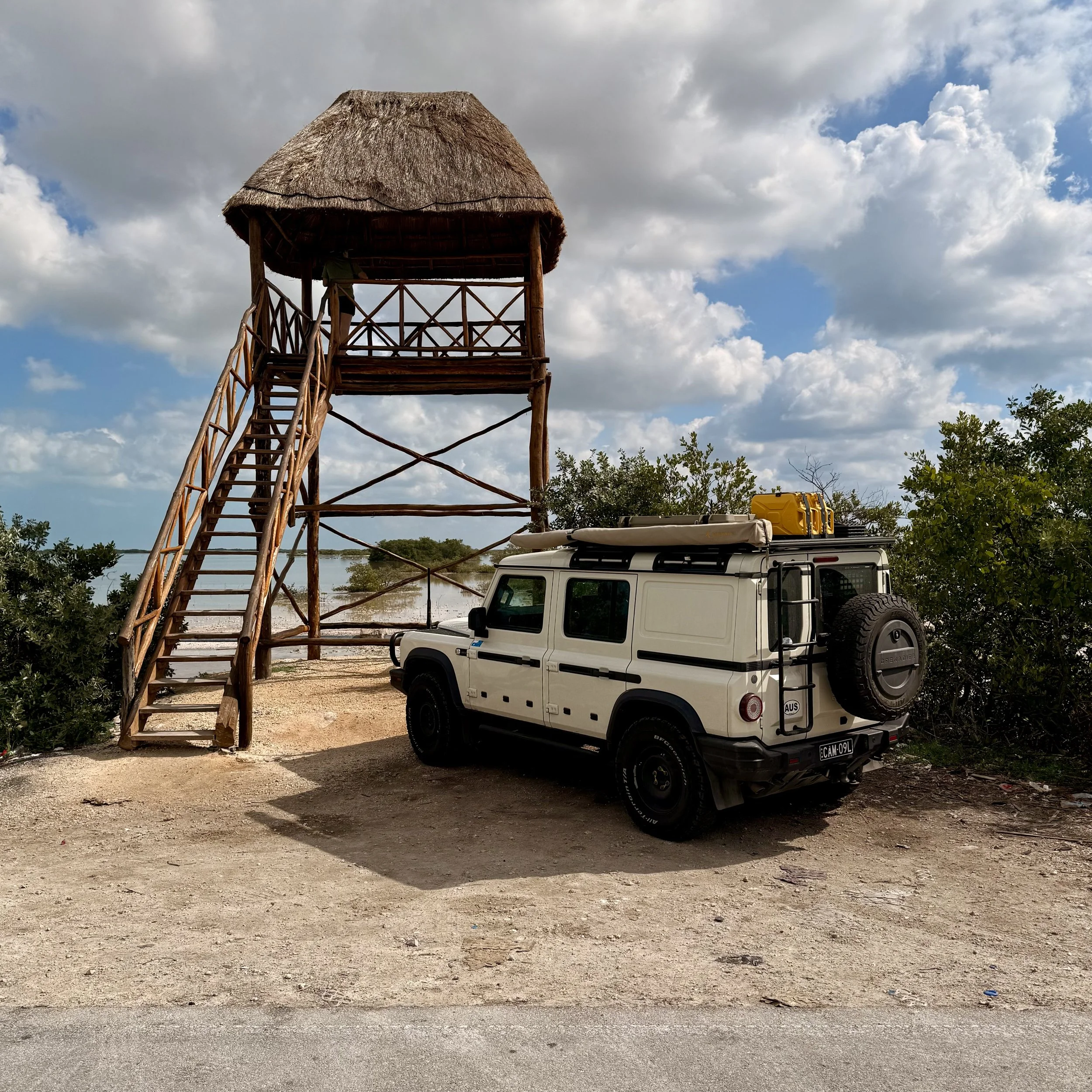
Celestún Biosphere Reserve in Yucatán, Mexico was not an altogether successful first attempt.
There are six flamingo species in the world, found on five continents, on every landmass except Australia and Antarctica. The thing that connects their disparate habitats is not warmth or latitude or vegetation but chemistry: alkaline and saline water, often highly so, in shallow lakes and coastal lagoons where the concentration of salts and minerals makes the environment inhospitable to most other organisms. The flamingo's ecological strategy, pursued independently across millions of years of evolution, is to go where the competition isn't. The hostile place, it turns out, is full of food — if you have the right equipment to get at it.
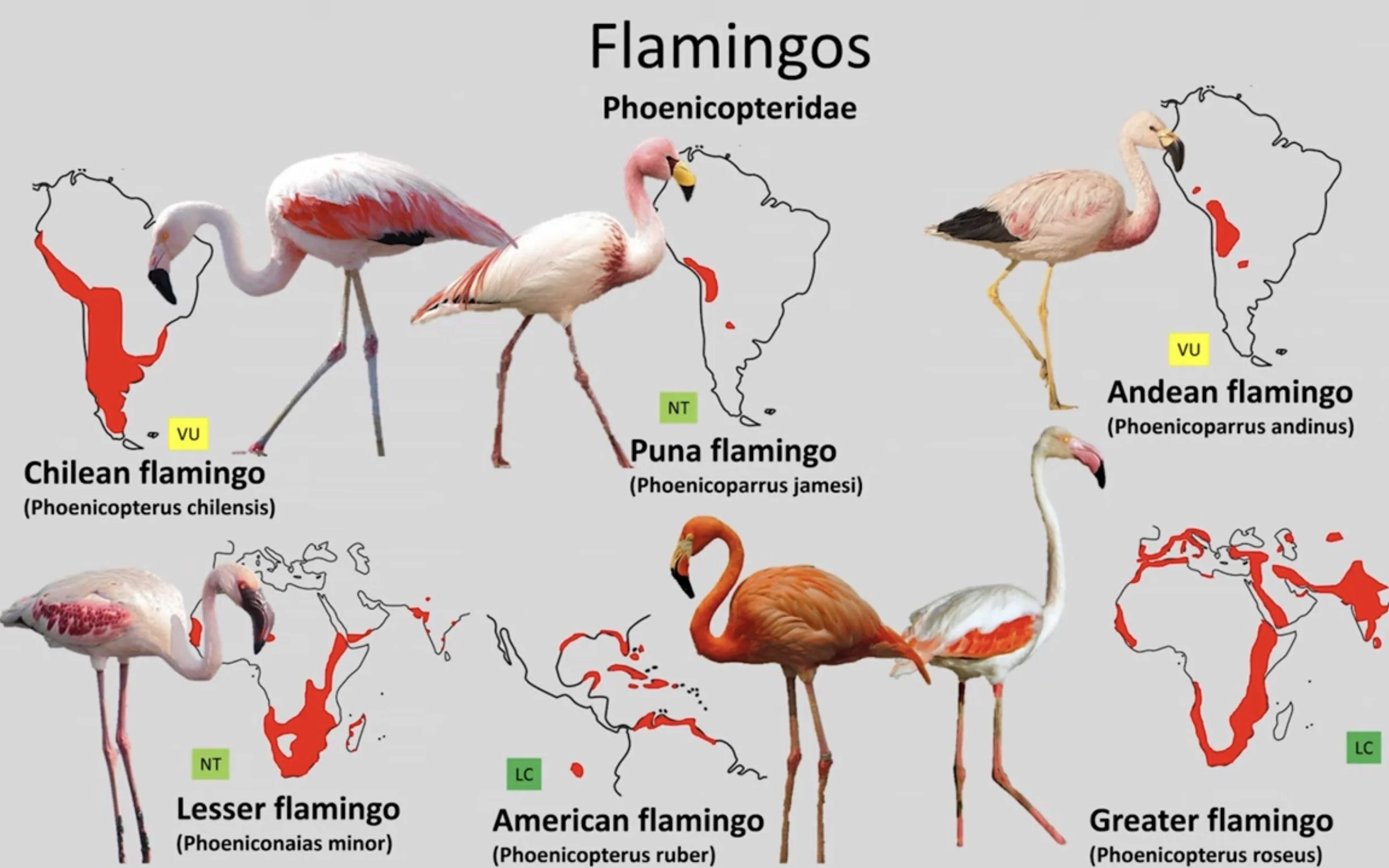
Image credit Diego Carrillo.
That equipment is extraordinary. The flamingo bill is unique among birds: held upside down in the water, the upper mandible fixed and the lower moving, with the tongue functioning as a piston pump that drives water through a filtering apparatus of fine comb-like lamellae along the bill's edges. The tongue pumps several times per second. The lamellae trap food particles — algae, diatoms, brine shrimp, small invertebrates — while water flows back out through the sides of the bill. The whole mechanism operates inverted, the bird's head angled down and rotated so that what appears to be the bottom of the bill is actually functioning as the top. It is, in engineering terms, an elegant solution to a specific problem: how to extract microscopic organisms from large volumes of water efficiently enough to sustain a large-bodied bird. Flamingos do not breathe while feeding. The pump runs, the water flows, the food accumulates, and periodically the bird lifts its head and swallows.
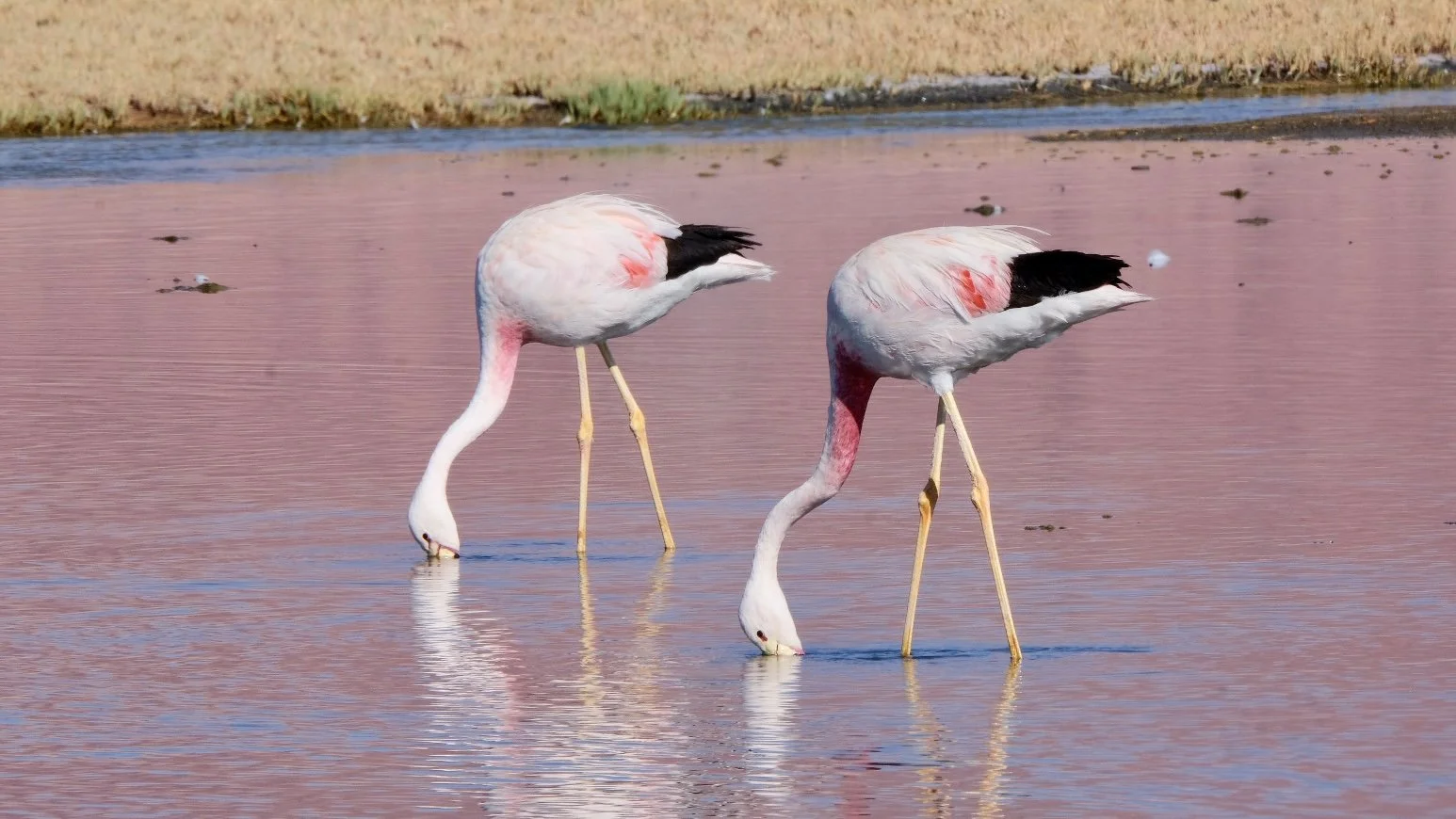
Andean flamingos feeding in the pink water of Laguna Carachi Pampa, Argentina.
The pink colour is a product of this diet and nothing else. Flamingos produce no pink pigment of their own. What colours them are carotenoids — the same family of compounds that colours carrots orange and autumn leaves red — absorbed from the algae and crustaceans they filter and deposited in the feathers during moulting. A flamingo fed a carotenoid-free diet turns white within a year or two. The vivid scarlet-pink of the American flamingo at Celestún reflects the shrimp and algae of the Yucatán lagoons; the paler pink of the Andean species at 4,500 metres in the Catamarca puna reflects the diatoms of a hypersaline lake where almost nothing else survives. The colour is a portrait of the environment, rendered in feather.
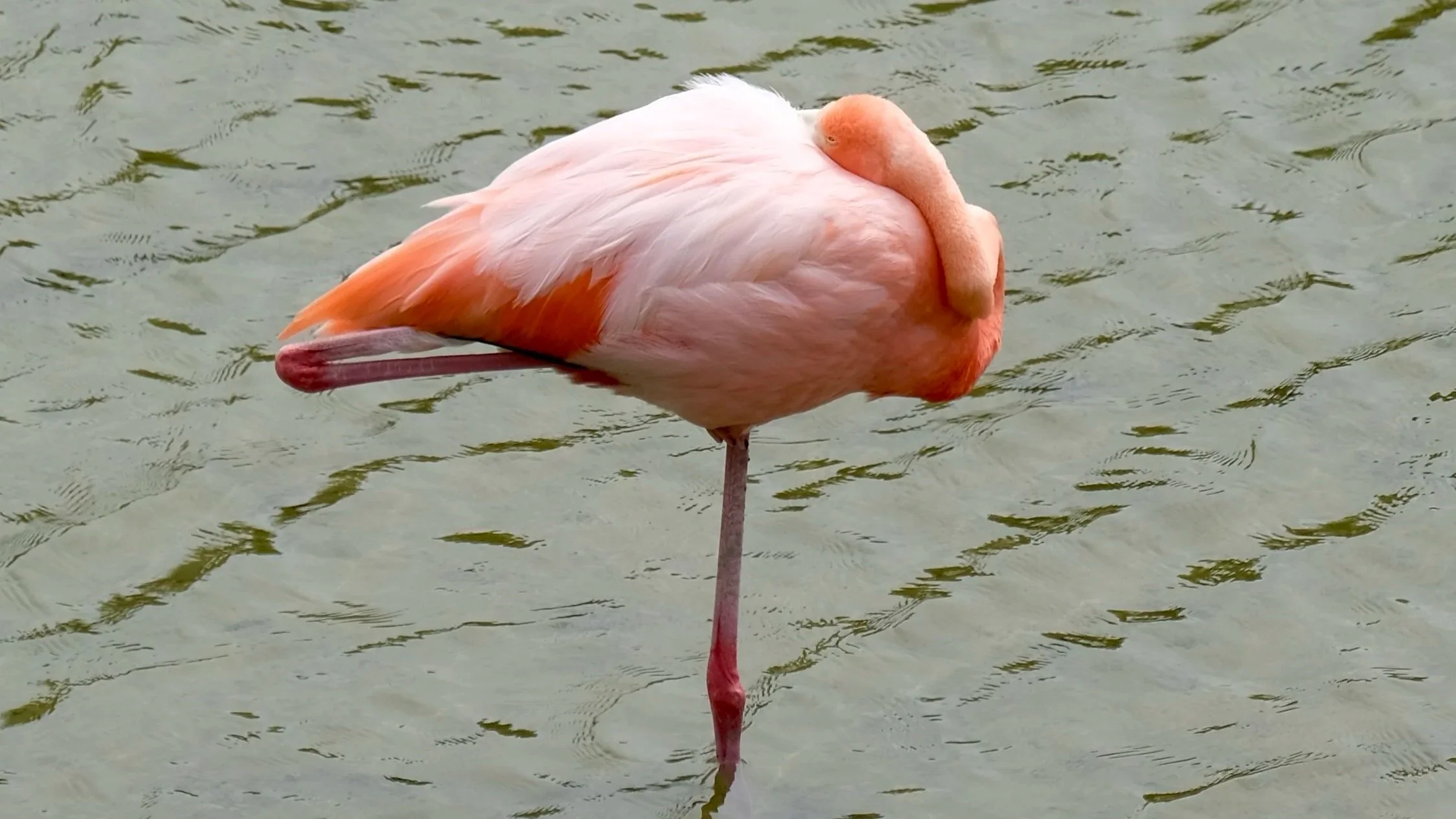
The American (aka Caribbean) flamingo, distinctively the most pink of the six species.
By September we were in the Galápagos. Isabela Island, we were informed, had flamingos. The lagoon was a 3km walk from the dock in equatorial sun, across hot sand that offered no shade and no encouragement. We walked. We arrived at the lagoon, damp and squinting. There were four flamingos. They were, we agreed, very fine flamingos, representing a genuinely interesting genetically distinct island population measurably smaller than their Yucatán relatives, exhibiting differences in body shape between sexes not seen in the mainland population, the product of island isolation acting on a founder population over thousands of generations. We studied them carefully. They did not study us back. We walked 3km back to the dock. Character development continued to accrue.
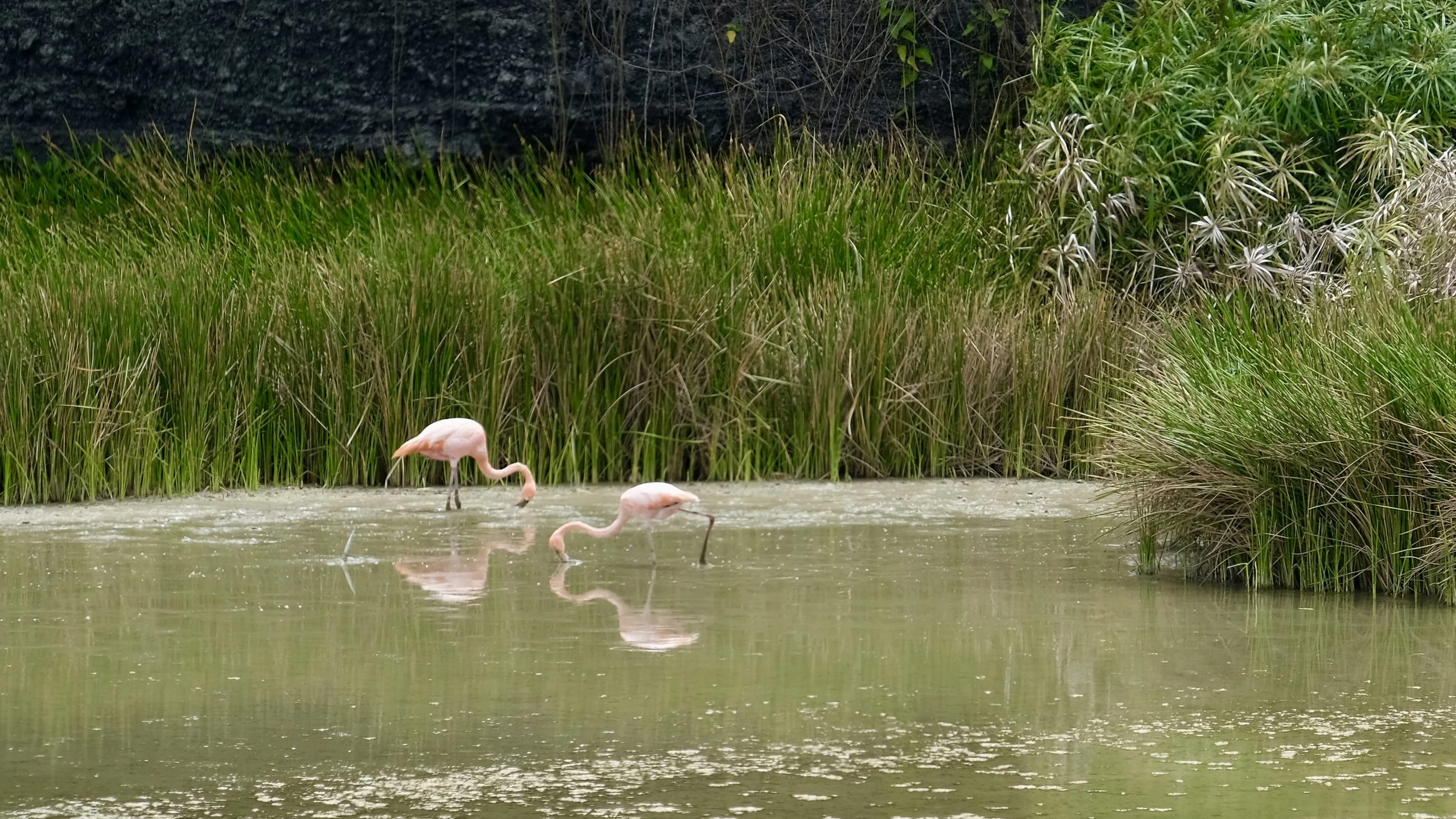
America flamingos at Isabel island in the Galapagos, Ecuador.
The full improbability of the flamingo as an ecological strategy becomes clear on the Andean puna. Driving south through Chile's Atacama in December, the lakes began delivering more generously — hundreds of Chilean and Puna flamingos at the high altitude salares around San Pedro, the birds scattered across turquoise and rust-coloured water against the volcanic backdrop of the altiplano. The universe, it seemed, was beginning to take the quest seriously.
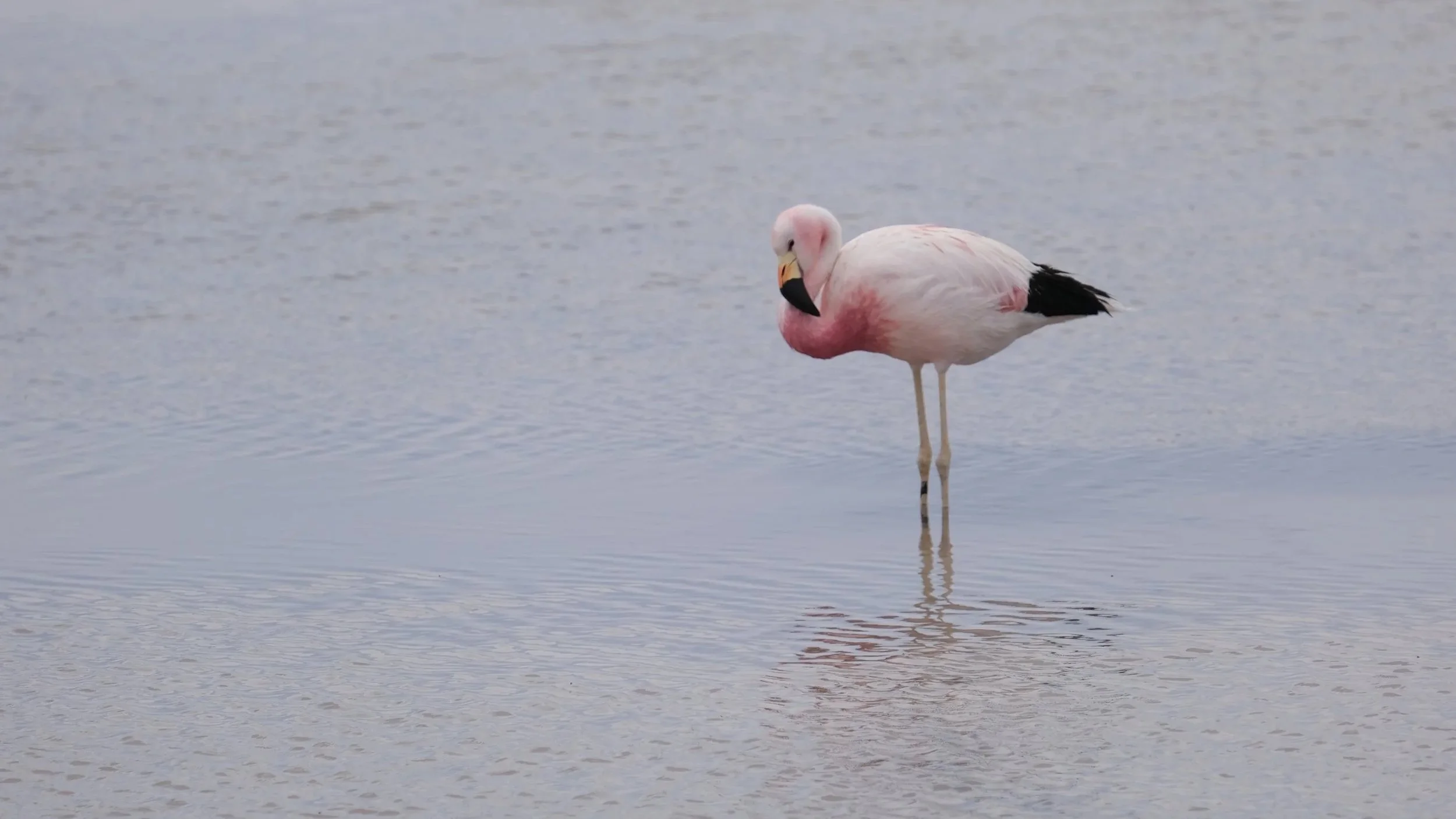
An Andean flamingo catches its breath in San Pedro de Atacama, Chile.
Then Argentina. Specifically, Catamarca. Specifically, a drive from Belén across the salt flats toward Laguna Grande at around 4,200 metres above sea level. The approach is an hour or more of flat grey emptiness — the kind of drive across featureless terrain at altitude that invites existential reflection on one's life choices, the wisdom of the route, and whether there is in fact a lake at all or whether it exists only on the map as a cartographer's optimism. We had been flamingo questers for more than a year. We had accumulated, in total, perhaps a few hundred sightings. We drove across the flats.
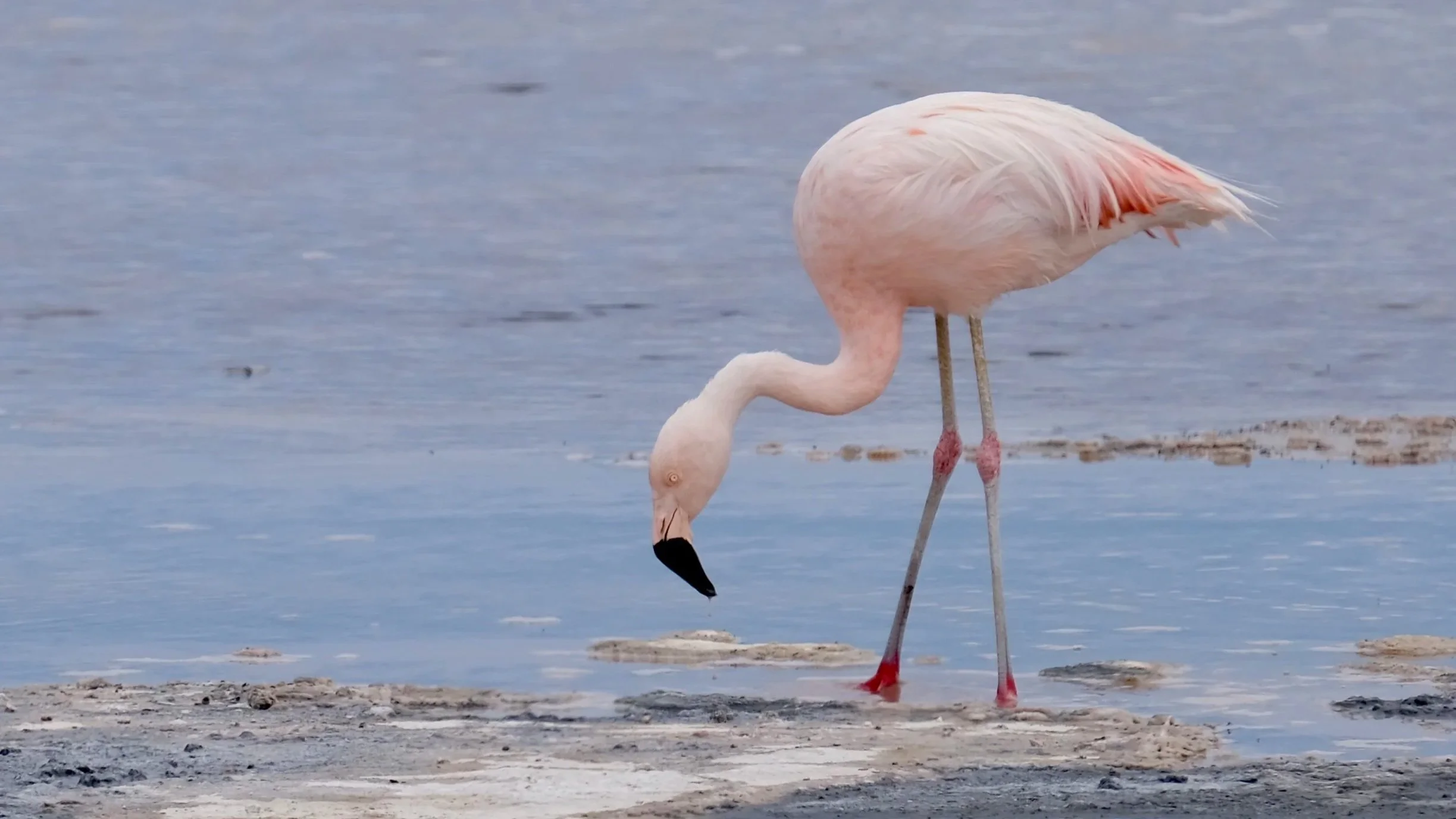
A Chilean flamingo in Reserva Nacional Los Flamencos (Flamingo National Reserve), Chile.
The lake appeared. And on it, in conditions that the word inhospitable fails to fully capture, were perhaps ten to fifteen thousand flamingos. They were not alone. Vicuñas grazed the sparse ichu grass at the lake's margin — the same delicate high-altitude specialists whose domesticated cousins the alpaca we had been seeing since Ecuador. Feral donkeys, descendants of colonial pack animals turned loose at some point in the last five centuries, stood at the water's edge with the philosophical patience of animals that have made their peace with improbable circumstances. And somewhere on the far shore, moving low and purposeful, a culpeo fox was conducting its own assessment of the colony.
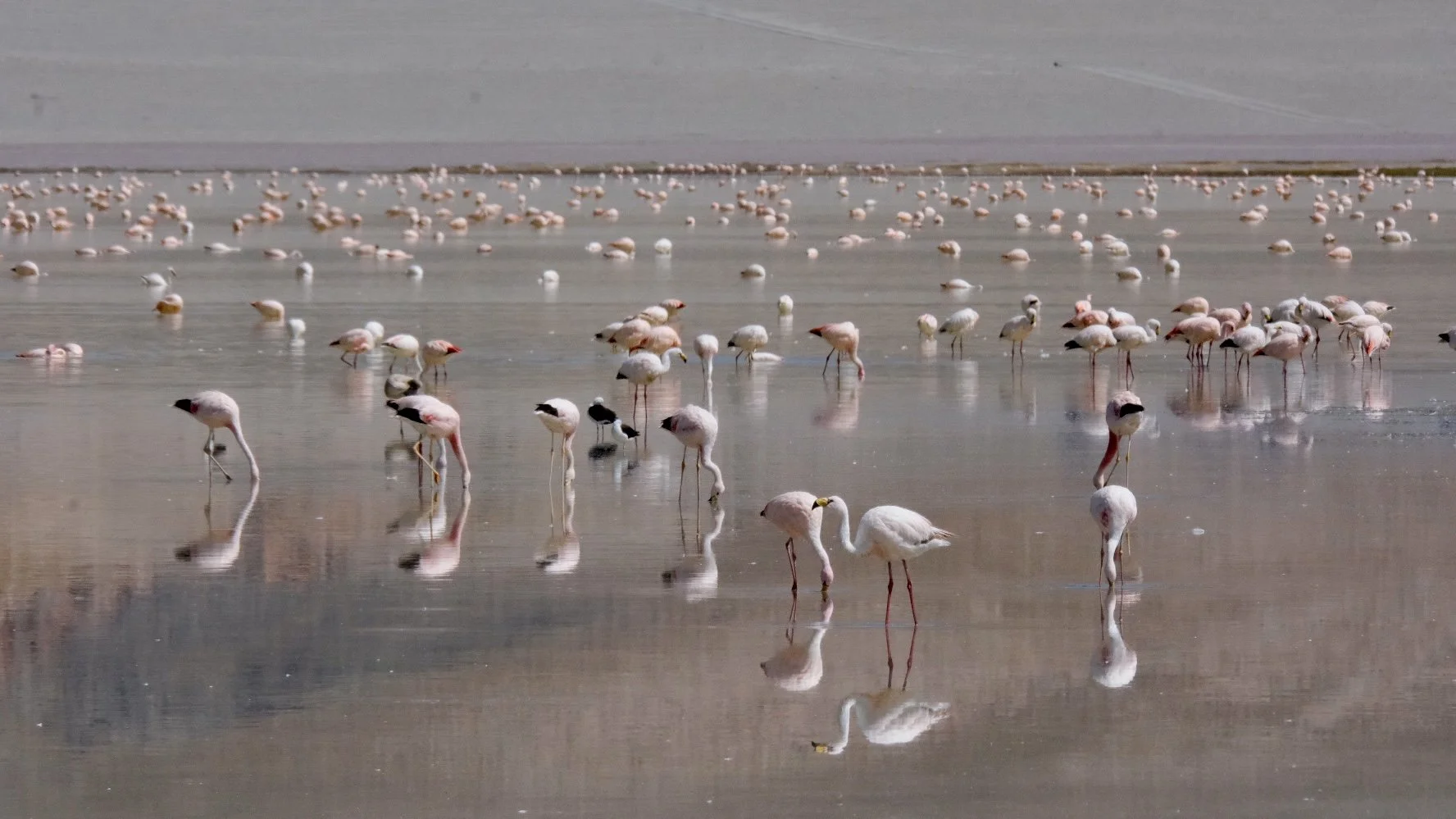
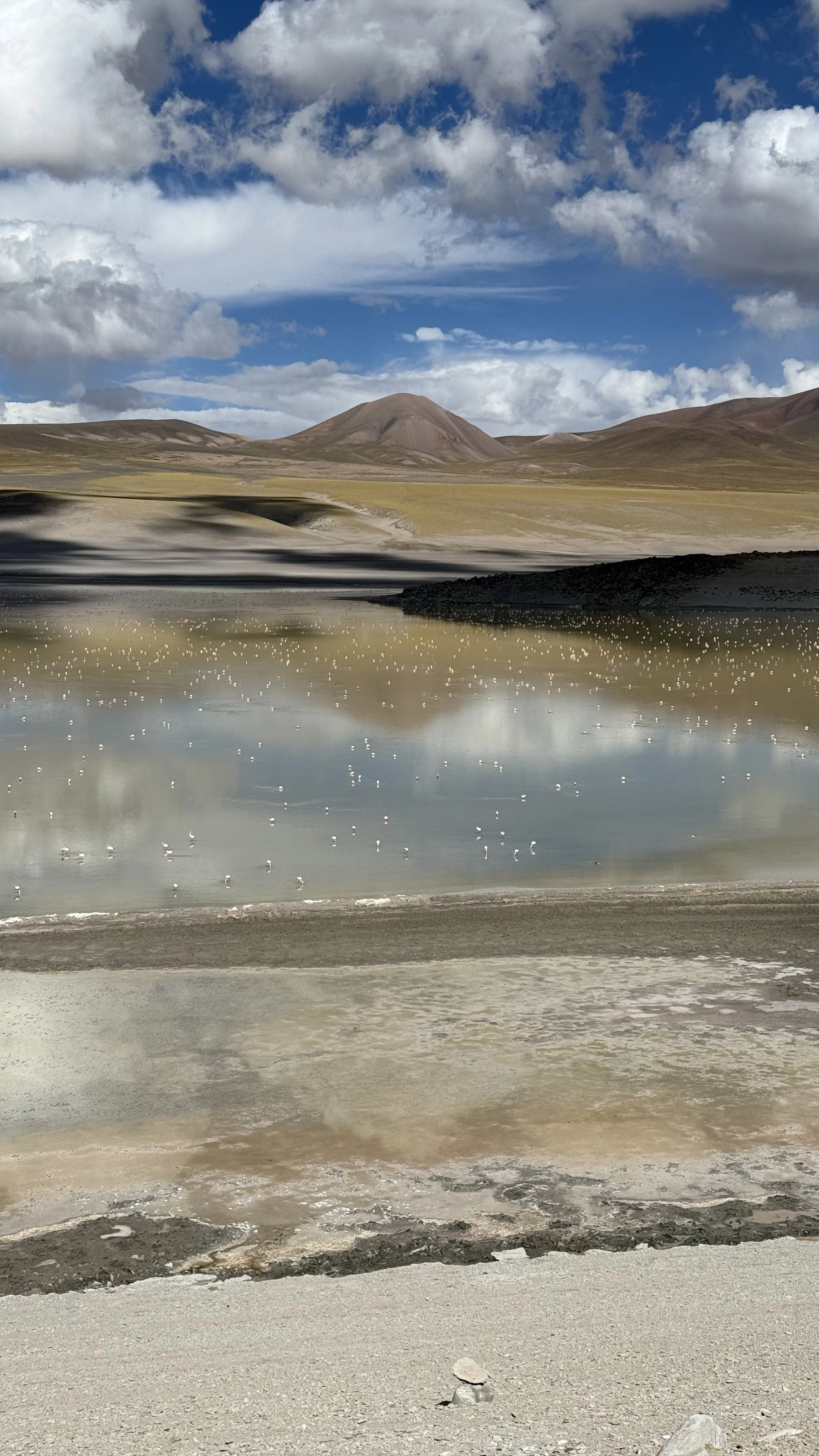
Laguna Grande, Argentina is home to a mixed colony of around 20,000 birds.
There are three flamingo species on the puna, and all three were present. The Chilean flamingo (Phoenicopterus chilensis) is the most widespread, found from the high Andes to the Patagonian coast — the pinkest of the three, with a grey-pink bill tipped in black and legs with conspicuously pink knee joints that give it a slightly battered appearance, as though it has been kneeling on hard surfaces. The Andean flamingo (Phoenicoparrus andinus) is larger and paler, with a striking black wedge in the rear plumage, yellow legs, and a yellow and black bill — the only flamingo in the world with yellow legs and feet, a detail that seems unnecessarily specific until you are standing at the edge of a mixed colony trying to tell them apart. It is also the rarest flamingo in the world, with a total population of around 39,000 individuals, classified as vulnerable and declining. The Puna flamingo (Phoenicoparrus jamesi), also called James’s flamingo, is the smallest and palest of the three — a bright yellow bill with a black tip, crimson streaking around the eye and on the chest, brick-red legs. It was declared effectively extinct by ornithologists after no confirmed sightings from the 1920s until a breeding colony was discovered in a remote Bolivian salar in 1957, which suggests that ornithologists had simply not been driving across the right salt flats.
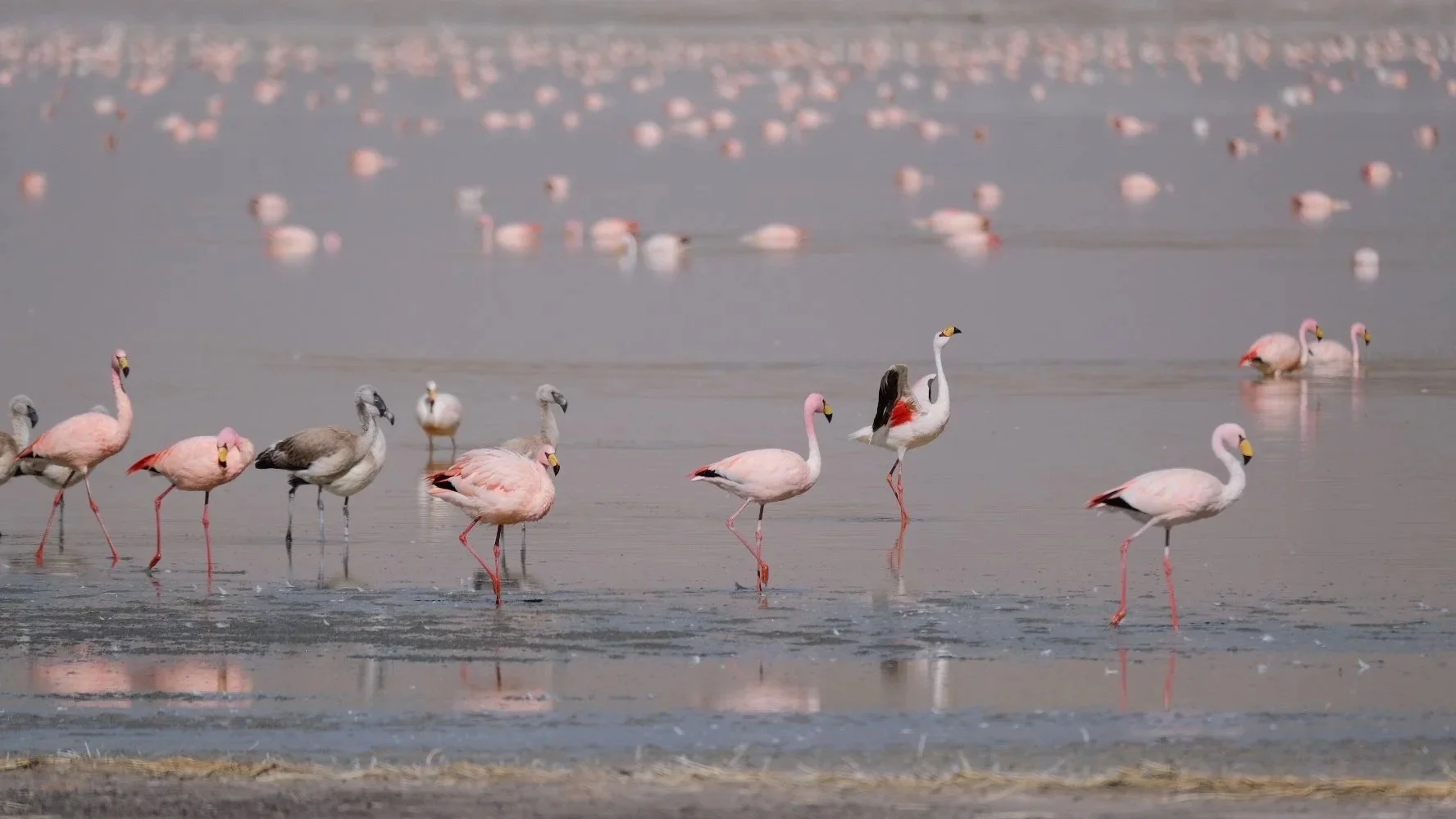
Puna (aka James’s) flamingos and juveniles at Laguna Grande, Argentina.
All three species share the same lakes but are not in direct competition because their bills are calibrated to different food. The Puna flamingo has the finest lamellae, specialised for the smallest particles — diatoms, single-celled algae measuring a fraction of a millimetre — and feeds in the shallowest water at the lake's edge. The Andean takes a broader range of microorganisms at intermediate depths. The Chilean takes the largest particles including small invertebrates and crustaceans in deeper water. Three species, one hypersaline lake at 4,200 metres, three slightly different menus, no meaningful competition. Evolution has partitioned the resource with a precision that a food technologist might envy.
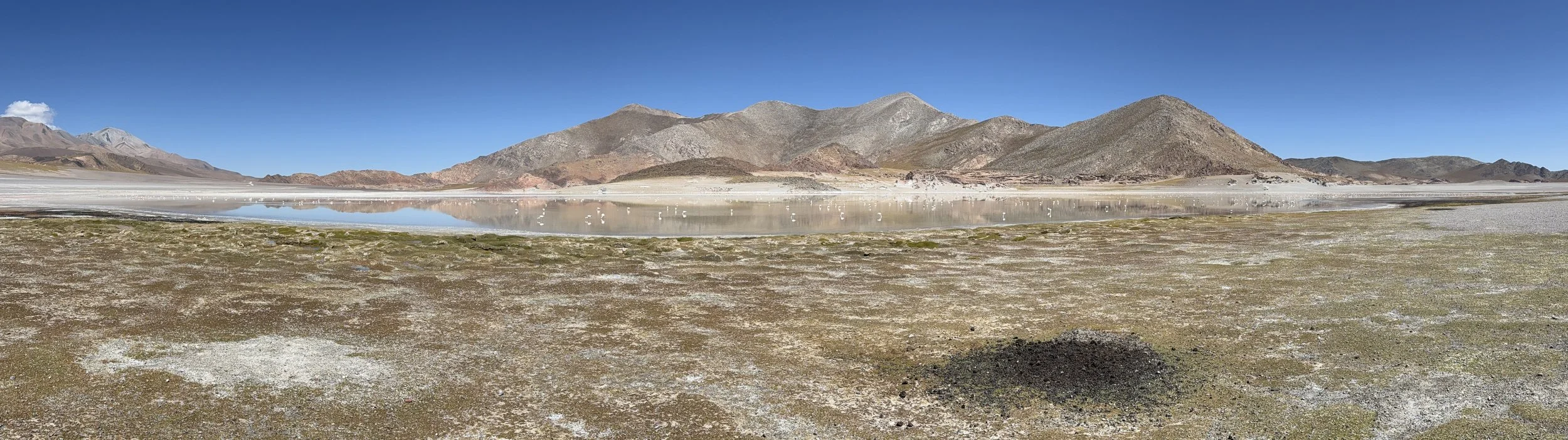
Spectacular Laguna Grande, Argentina.
The lakes they favour are remarkable in themselves. The salares and lagunas of the Catamarca and Jujuy puna are volcanic in origin, fed by mineral-rich springs and concentrated by the intense solar radiation of altitude into saturations of salt, borax, lithium and other compounds that give the water colours from pale turquoise to deep crimson. These are not hospitable places. The borax and lithium mining operations that now extract materials for battery production from the same salares represent the primary conservation threat to all three puna species: the mining drains water, disturbs breeding colonies, and degrades the precise chemical environment on which the birds depend. The Andean flamingo's decline is directly correlated with water availability at breeding lakes, much of which is now being removed for industrial purposes. The birds that are here now are here because the puna has not yet been fully converted into battery components. It is a race that is not going well.
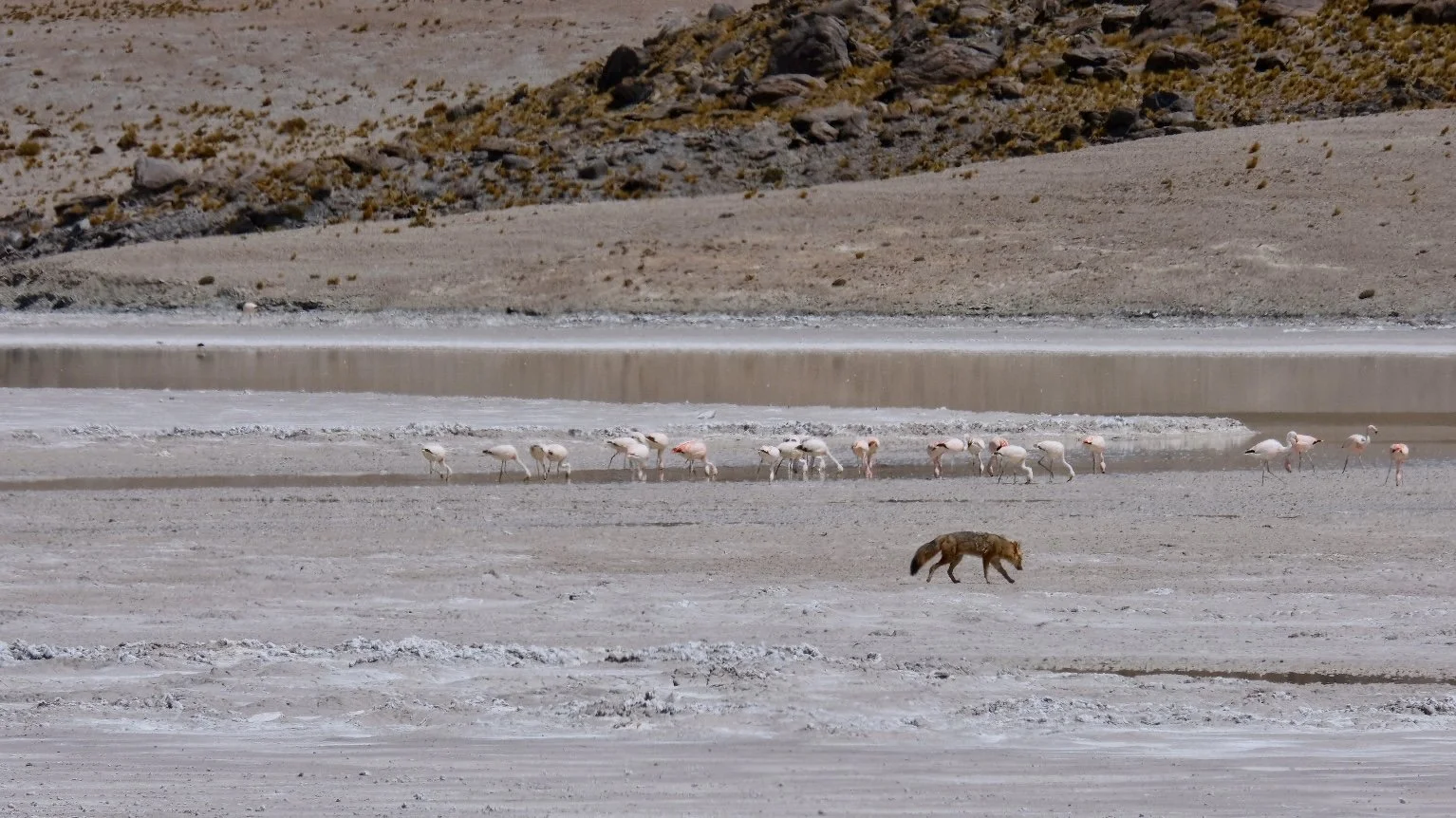
Culpeo foxes prowl the perimeter of the nesting colony.
Standing at the edge of Laguna Grande in the mid-afternoon, the light flat and hard across the salt flat, we could pick out the juveniles among the adults — grey-white birds, not yet pink, their carotenoid account still empty, indistinguishable in shape from the adults but coloured as though assembled from different materials entirely. They would turn pink in a year or two, once the diatoms of the puna had done their work. Around them the vicuñas grazed, the donkeys stood their philosophical vigil, and somewhere the culpeo fox continued its calculations. Ten thousand flamingos moved slowly through water that barely covered their ankles, and the stillness was broken only by the wind and the soft collective murmur of the colony.
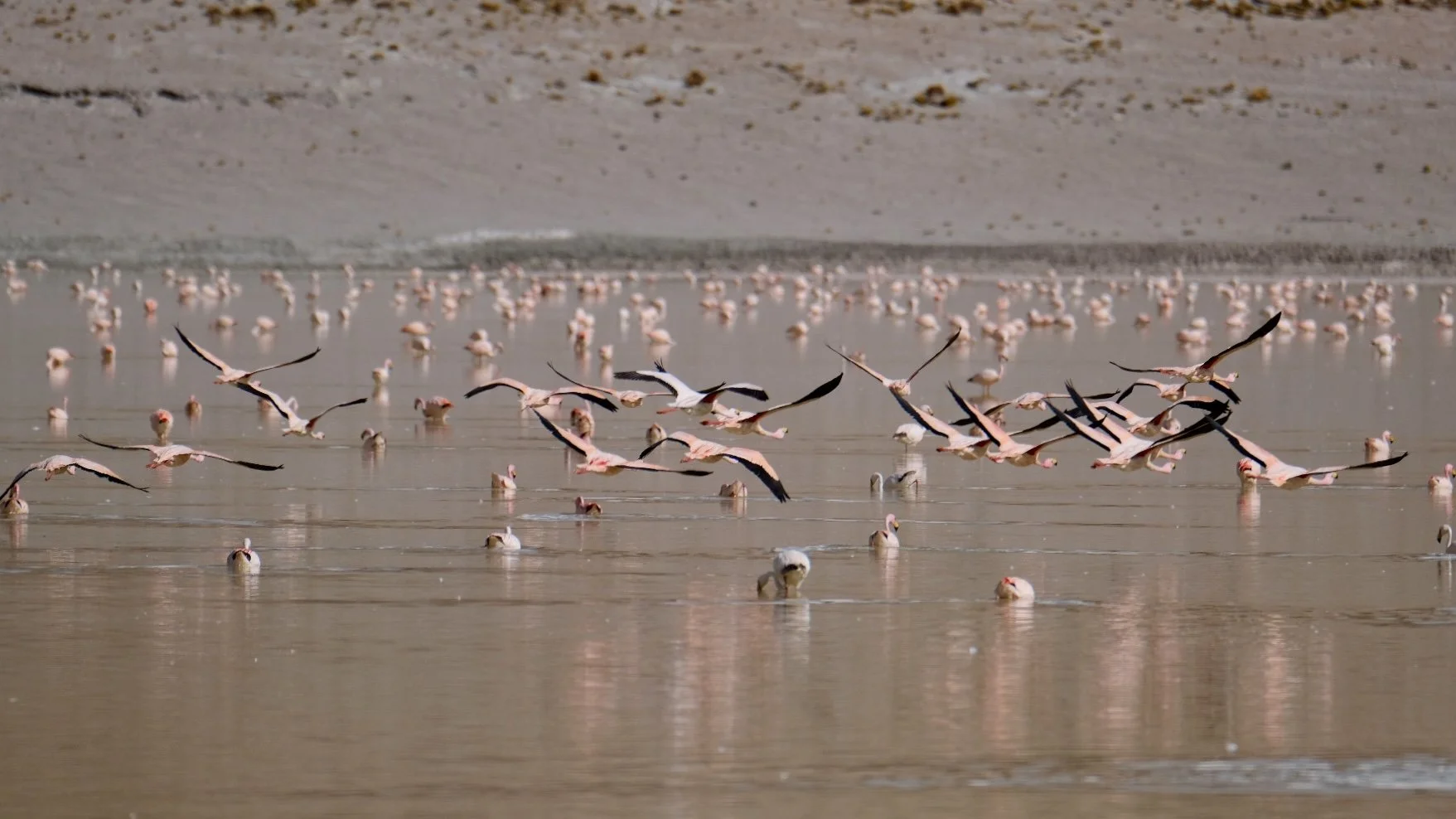
On the wing as activity picks up in the late afternoon.
We had driven from the Yucatán. We had walked 3km across hot sand for four of them. We had crossed the Atacama. We had driven an hour across the salt flats of Catamarca not entirely sure there was a lake at the end. Standing at the edge of Laguna Grande with ten thousand flamingos in front of us, I thought about the ~40,000kms, mountains, mud, fire, ice and snow; the new language we had learned since we saw that first bird at Celestún… and I realised that the character development had, in fact, been the reward all along. We really had levelled up.