In 1890, a criollo man named Eugenio Bustos traded his best horse for French Malbec vines and planted them in the Uco Valley, in the foothills of the Andes south of Mendoza. The winery he built became so central to the region that the national railway constructed a station at its front door. The town that grew around it took his name. He called the estate La Celia, after his daughter, to whom he left it when he died. La Celia is still there — the oldest winery in the Uco Valley, still producing Malbec from vineyards that trace their lineage to that first transaction — and the story of a horse exchanged for a vine is the kind of founding myth that a wine region earns rather than invents.
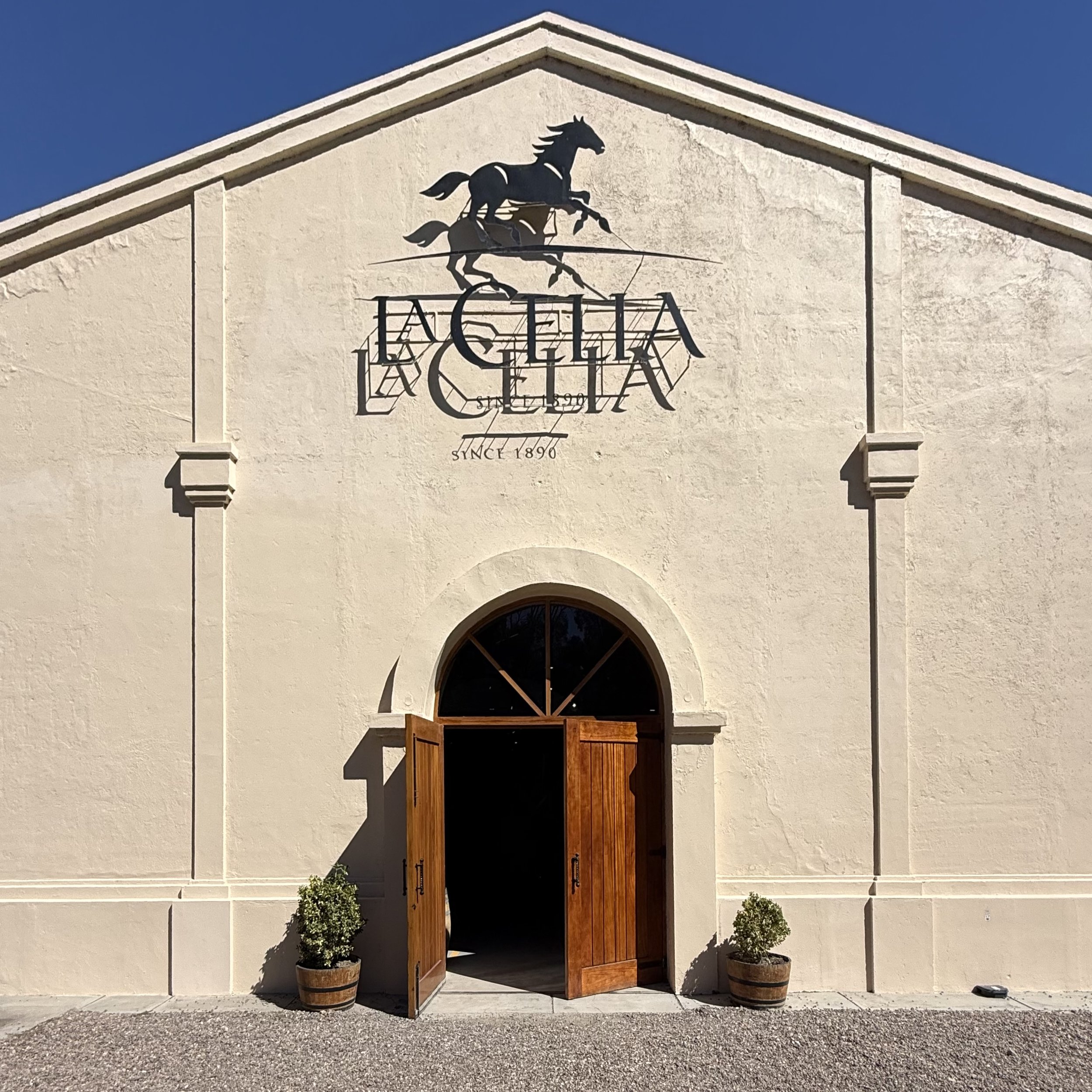
Winemaking at La Celia occurs in a converted equestrian arena on the original estate.
We visited in March, at the end of harvest, and the valley was doing what it does in that light: the Andes enormous and white to the west, the vineyards running in precise rows across alluvial gravel, the air thin and cold by late afternoon. The wine we drank that evening was from Paraje Altamira, the highest and most calcareous section of the estate, fermented in concrete. It tasted of the place in the specific way that certain wines do — not of fruit or oak or winemaking technique, but of altitude and rock and the particular coldness of the night air at 1,100 metres. This is what Argentina has spent 130 years learning to do, and what the Uco Valley now does better than almost anywhere.
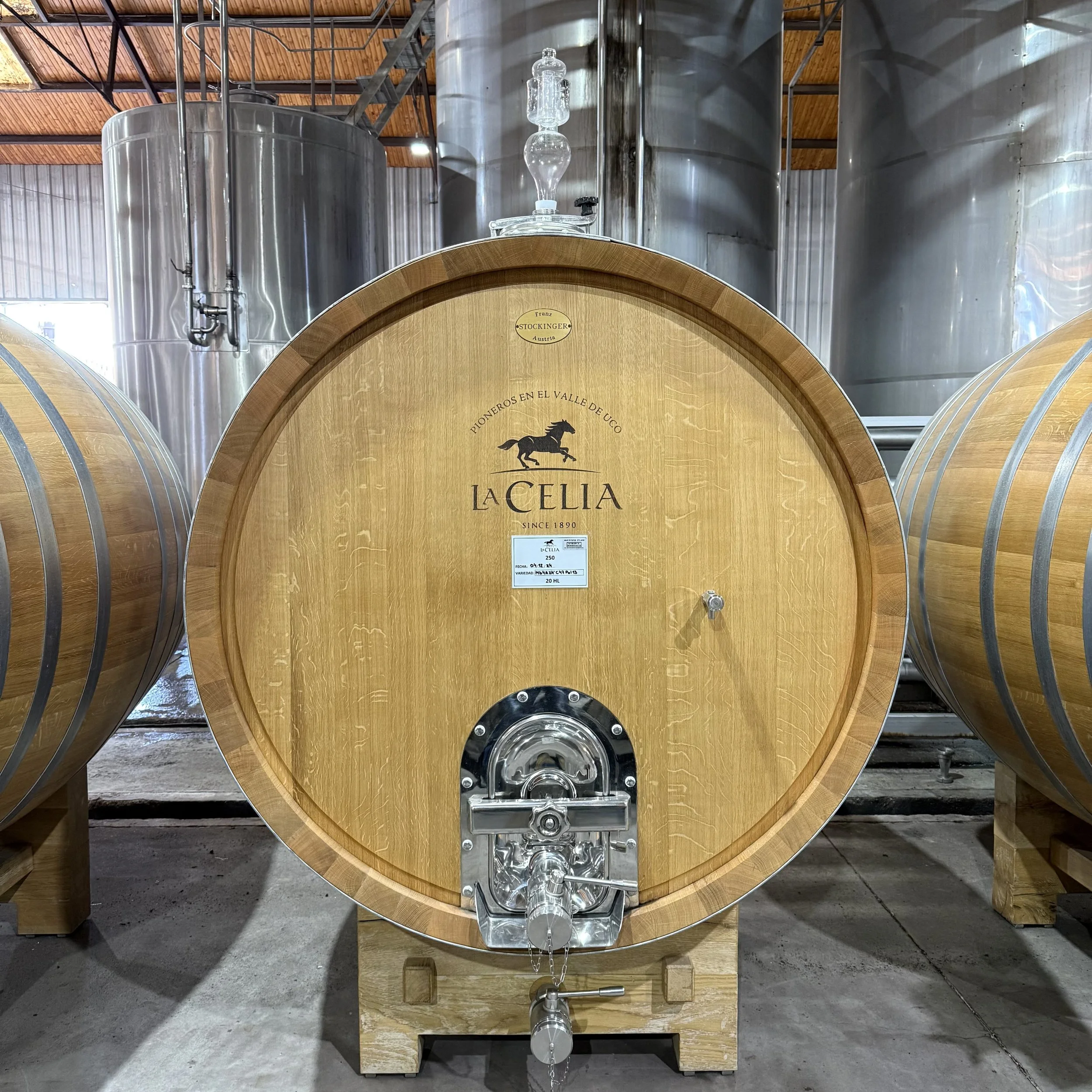
Winemaking in Argentina inherited a rich European tradition.
The concrete is part of the story. Argentine winemaking first used concrete fermentation vessels when Italian immigrants of the early twentieth century built them on site and poured them in place — enormous room-sized tanks that were standard technology before stainless steel arrived in the 1950s and 1960s and swept them aside as emblems of the old, unserious way of doing things. The modernisation push of the 1980s and 1990s, which transformed Argentine wine from a domestic bulk industry into an international export business, reached for stainless steel as the marker of a serious winery. The old concrete tanks were bricked up or repurposed, and a generation of Argentine winemakers learned to think of them as a slightly embarrassing inheritance.
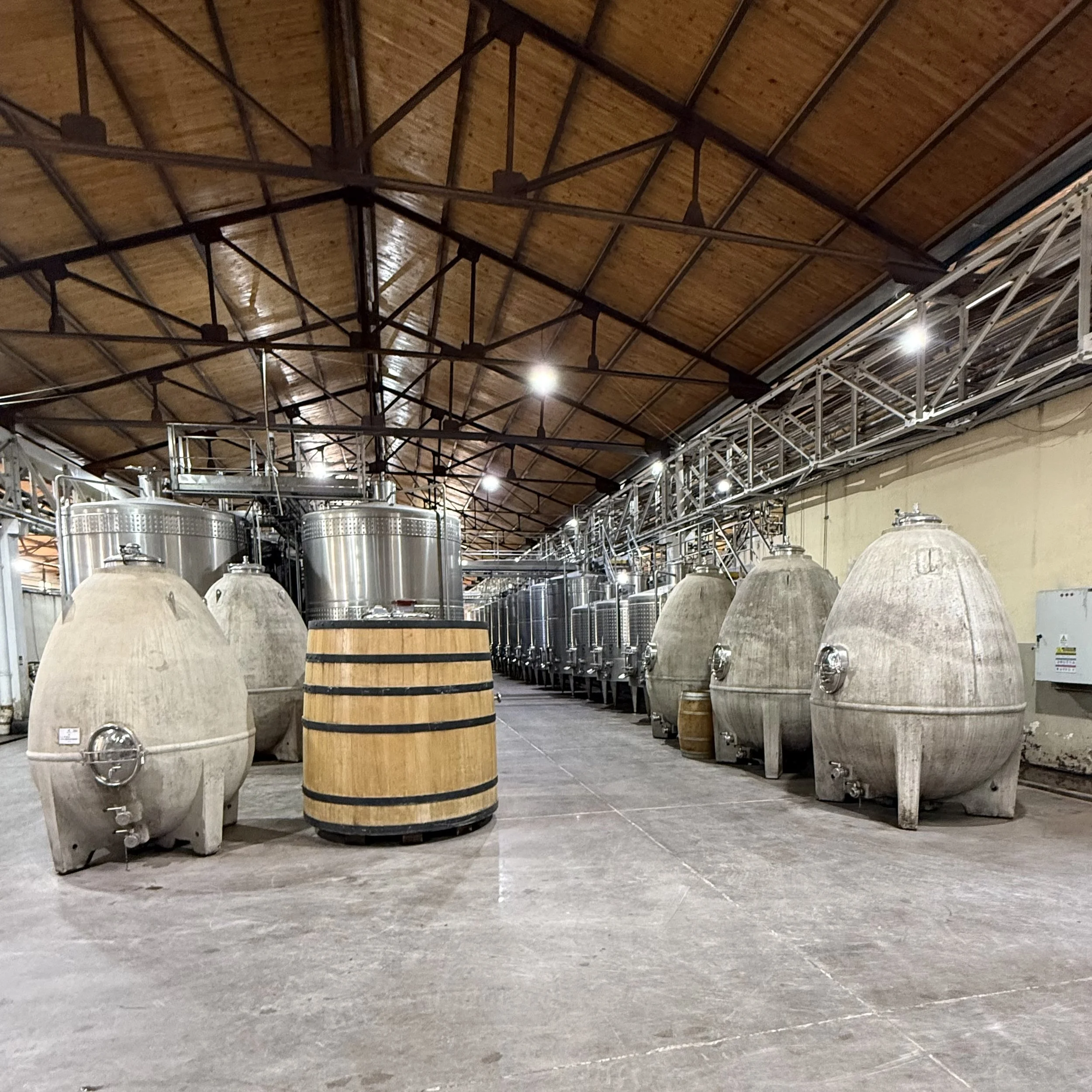
Argentine winemakers following Zuccardi example have made concrete fermentation a distinguishing technique.
Then Sebastian Zuccardi, a third-generation Argentinian of Italian descent, built a new winery in the Uco Valley and filled it with concrete. Sebastian had studied what the concrete did and decided the old Italian immigrants had understood something that the stainless steel revolution had caused everyone to forget. Concrete sits between oak and steel: it imparts no flavour of its own, but unlike inert steel it breathes, allowing a slow and calibrated micro-oxygenation that rounds the tannins of Malbec without softening its structure. The egg-shaped vessels create a natural convection current during fermentation — the wine circulating continuously, lees held in suspension, no mechanical intervention required. The enormous thermal mass of the concrete moderates the extreme diurnal temperature swings of the Uco Valley, where the difference between a summer afternoon and the same night can exceed twenty degrees. The result, as Zuccardi describes it, is wine that shows you simply grape and place, noting that he was reviving a technique common in Argentina in the 1930s.
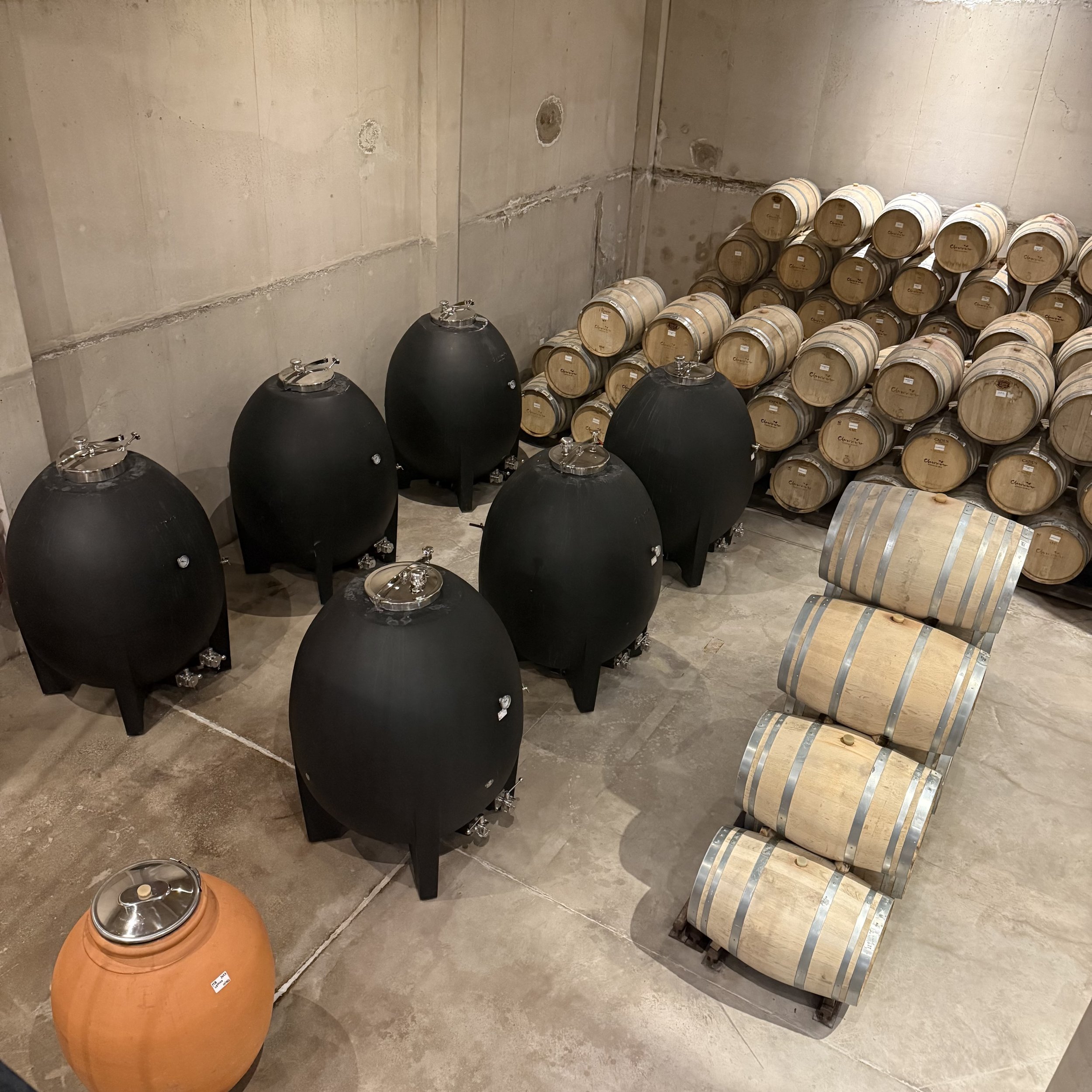
Like other New World winemakers, South American wineries, perhaps less shackled by tradition, tend to experiment and explore technique.
Between 1880 and 1915, six million Italians and Spaniards arrived in Argentina, the largest immigration wave in the country's history, driven by the failure of European agriculture and the particular devastation of the phylloxera epidemic that destroyed vineyards across the continent from the 1860s onward. They came from Piedmont and Veneto, from Calabria and Sicily, from regions where wine was not a lifestyle choice but the substance of daily life, where the knowledge of how to prune a vine and read a fermentation was transmitted from father to child as ordinary domestic competence. By 1910 these immigrants owned approximately eighty percent of Mendoza's vineyards. The names on the labels today — Rutini, Catena, Zuccardi, Giol, Lagarde — are not decorative. They are the surnames of the men who built the industry. Felipe Rutini arrived from Italy in 1889 and established his bodega in 1895. Nicola Catena arrived in 1902. By 1881, before the peak of the migration wave had even arrived, Italian cultural societies had established schools and hospitals in Mendoza. The Italian Hospital and the Dante Alighieri School both still exist.
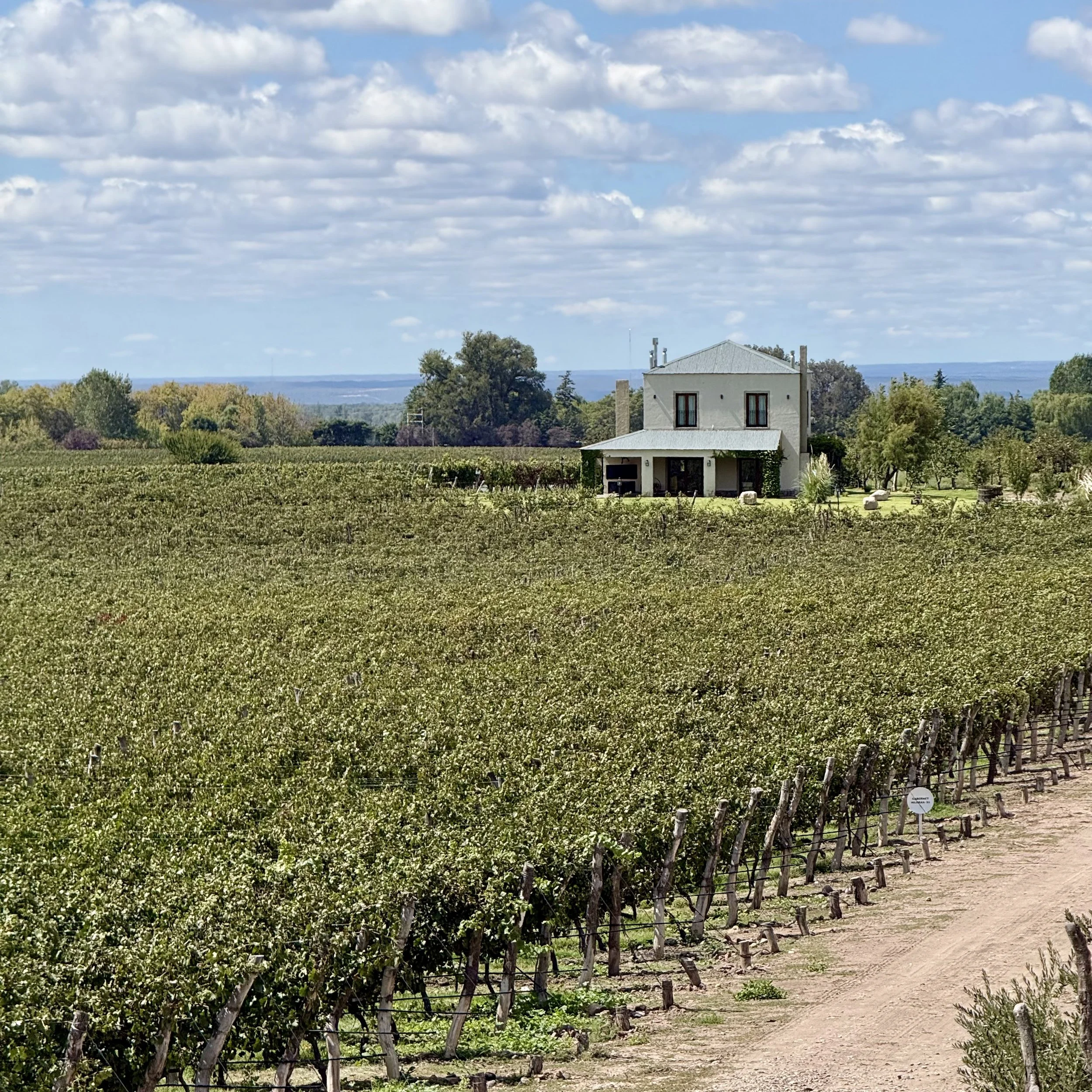
Contemporary Mendoza offers polished and sophisticated wine and gastronomy tourism.
The catalyst that turned Italian know-how into an industry was infrastructure. The Buenos Aires-Mendoza railway opened in 1885, reducing the journey that had taken mule trains a month to a single day by rail. Mendoza's vineyards went from 1,000 hectares in 1830 to 45,000 by 1910. The Malbec grape had arrived earlier — brought by the French agronomist Michel Pouget in 1853, at the instruction of the provincial governor — but it was Italian hands that scaled it and palates that shaped it, even as their descendants’ stubbornness about concrete and oak and the correct temperature for fermentation gave it its character. Malbec is now understood internationally as an Argentine grape.
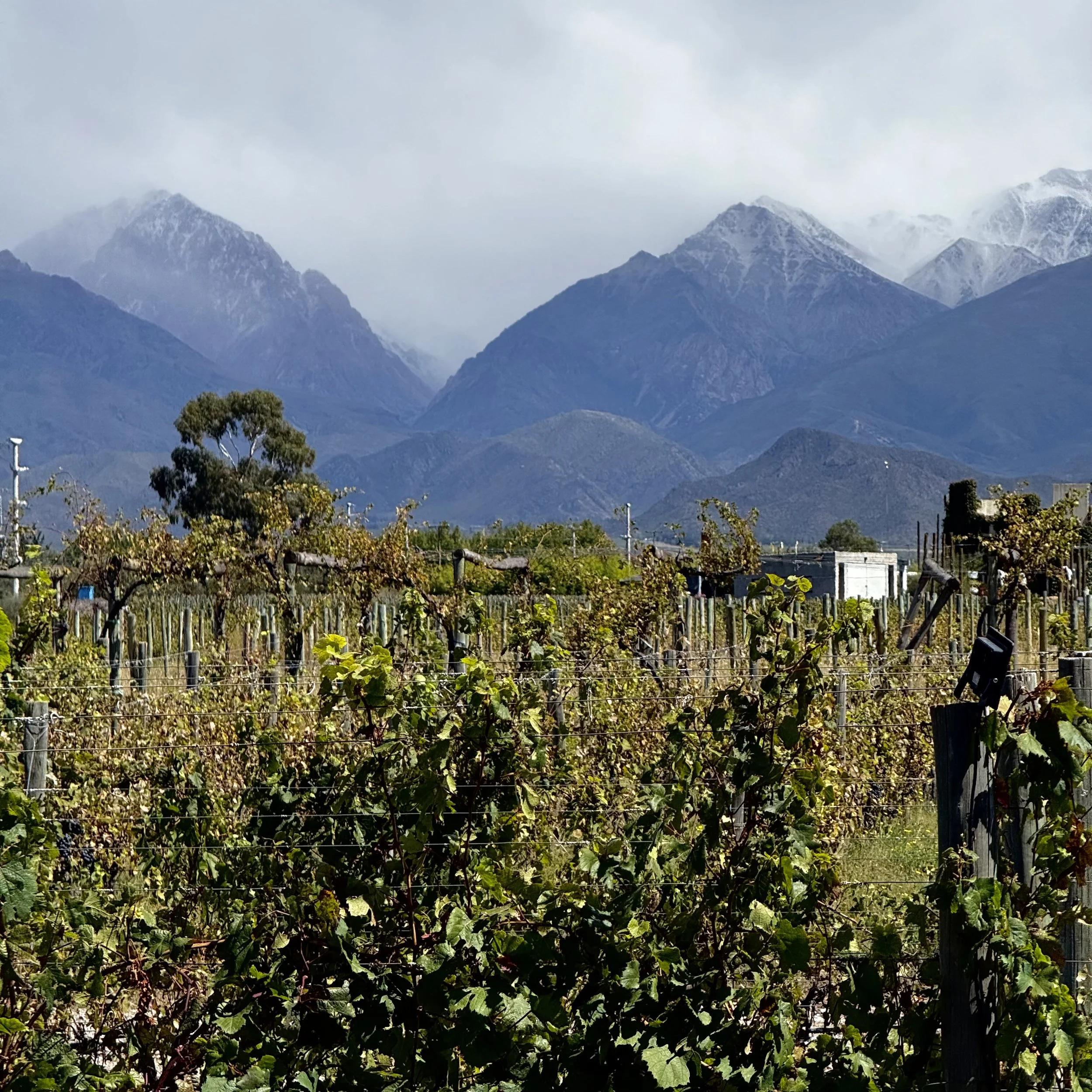
At ~1,200m above sea level, the relatively high altitude of the Uco Valley imparts a distinctive delicacy to it’s products.
A parallel story was unfolding simultaneously on the other side of the Andes, in the lake district of southern Chile, except that here the immigrants were German and the thing they made was beer. From the 1850s onward, in the aftermath of the failed revolutions of 1848, the Chilean government actively recruited German settlers to colonise the forested frontier around Valdivia, Osorno, Puerto Varas and Llanquihue Lake. Between 30,000 and 40,000 Germans arrived over the following decades, clearing land, building farms, establishing schools and churches, and replicating the architecture of the regions they had left — the half-timbered Fachwerk houses, the steep gabled roofs, the Bavarian-style civic buildings that still line the lakeshores at Puerto Varas and Frutillar today. A visitor writing around 1900 described Valdivia as a German town: German signboards alongside the Spanish, a large German school, churches, cultural associations, and, of course, breweries.
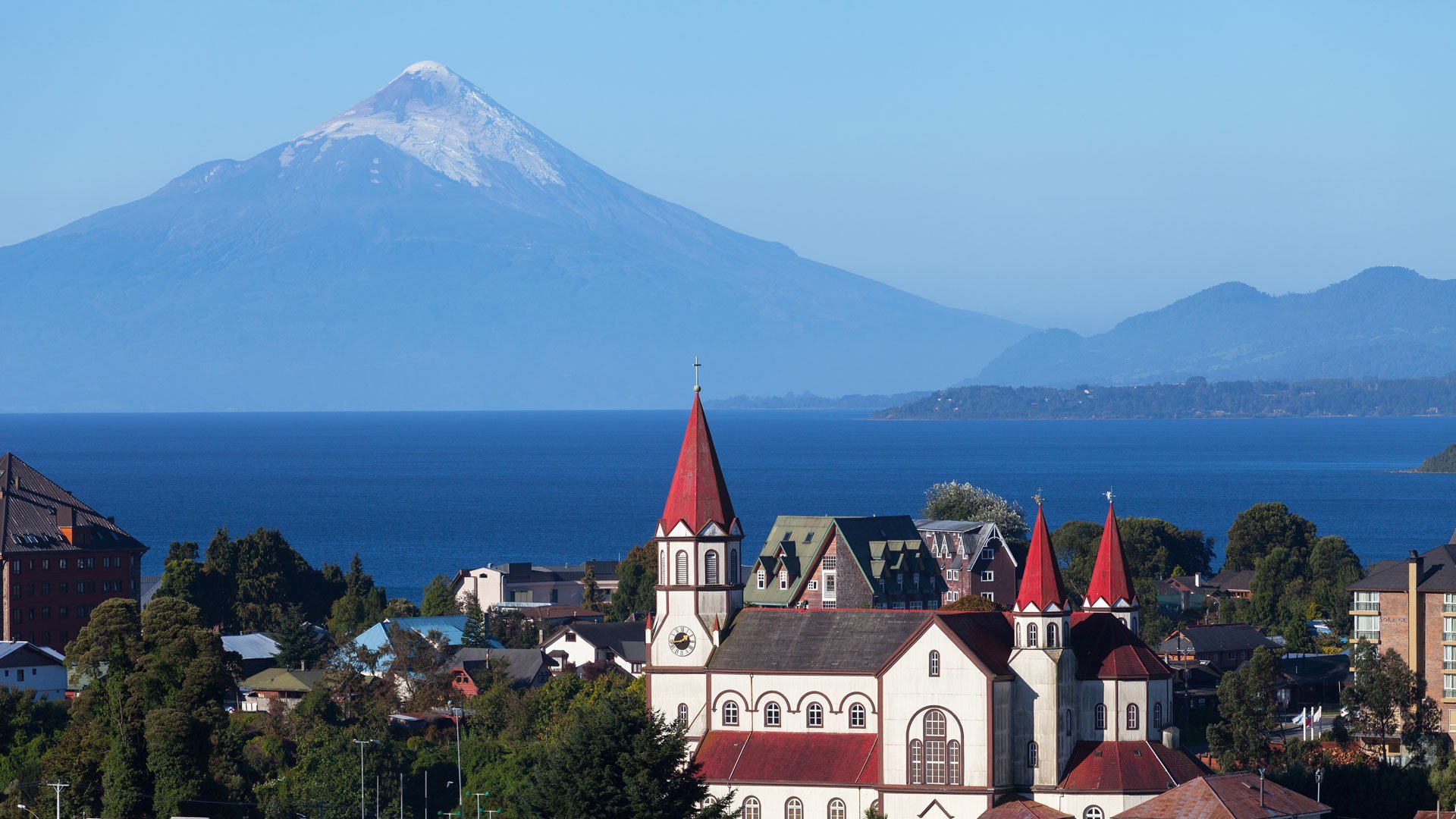
Puert Varas, Chile. Image credit andBeyond.
Karl Anwandter founded Chile's first brewery in Valdivia in 1851, the year after the first settlers arrived. He brewed to the Reinheitsgebot, the German purity law dating to 1516 that permits only water, malt, hops and yeast — the same standard that a Bavarian brewer of his era would have applied without question. The German settlers brought not just the knowledge but the entire cultural framework: beer was to the German south of Chile what wine was to the Italian settlements in Mendoza — not a product but a practice, a form of daily life transplanted from one continent to another and maintained with the stubborn fidelity of people who know what they are doing and why. By 1907, Valdivia was producing twenty million litres of beer annually. The 1960 earthquake, the largest ever recorded, destroyed the city including Anwandter's original brewery. In 1991, Armin Kunstmann Telge — whose family name traces directly to the original settlers — re-established the tradition. Kunstmann is now Chile's most recognised craft beer brand, still brewed in Valdivia, still using German methods, still bearing a surname that arrived in the south of Chile in the 1850s with a family that had never intended to make history.

Anwandter triggered an energetic craft brewing tradition in Chile that continues to this day. Image credit Samantha Demangate.
Then there is Bariloche. On the Argentine side of the same Andean lake district, founded by German and Swiss settlers in the late 19th century, redesigned in the 1930s to resemble an Austrian alpine town and largely succeeding — the Centro Civico built in stone and wood in the style of Bern, the chalets above the lake, the Saint Bernards in the plaza. Bariloche is Argentina's chocolate capital. Avenida Mitre, the main street, is known as the Avenue of Chocolate Dreams. The tradition was established in 1948 by Aldo Fenoglio, who arrived from Turin in northern Italy in 1947 with his wife Inés Secco and opened a shop using traditional Italian recipes, naming it Tronador after the peak visible from the town. The founding families — Fenoglio, Secco, the Swiss families behind Abuela Goye, the German and Italian lineages behind Rapa Nui and Mamushka — are still on the labels today, three and four generations on. Chocolate is the most innocent of the three things this landscape produces. It is also where a shadow is cast over European migration to the region.
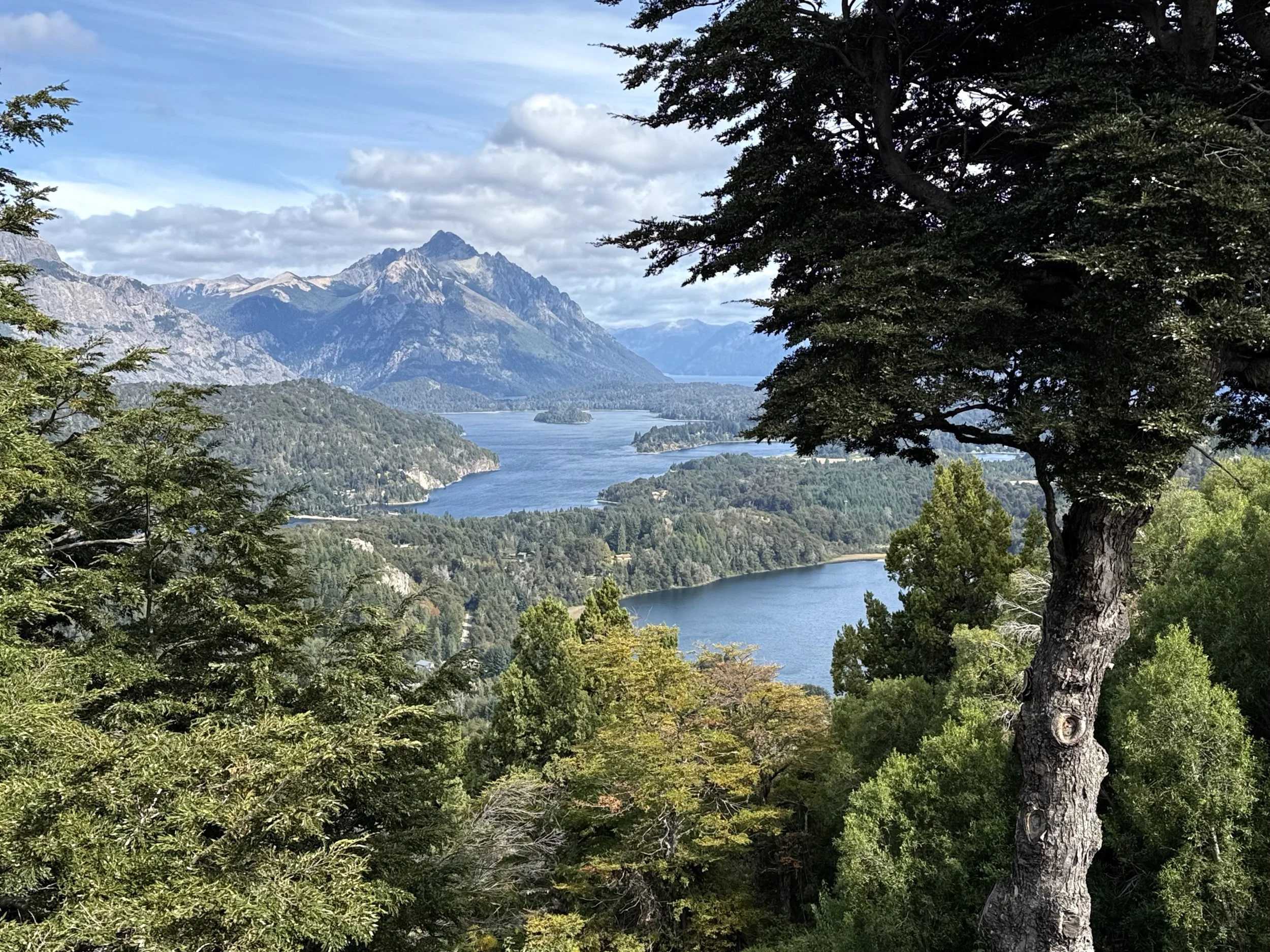
Bariloche and the surrounding Lake District offer somewhat of an ‘alpine’ ambience.
Italian immigrants to Argentina, German immigrants to Chile, a mixture of both to the Patagonian lake district: waves of 19th and early 20th century European settlers who brought specific technical knowledge to specific landscapes, built industries and traditions that outlasted them by generations, and left their surnames on the products their descendants still make. The Uco Valley Malbec, the Valdivia beer, the Bariloche chocolate are all, in the most literal sense, immigrant achievements. They required the displacement of people from places they knew to places they did not, the application of inherited competence to unfamiliar soil, and the particular patience that building something from nothing requires.
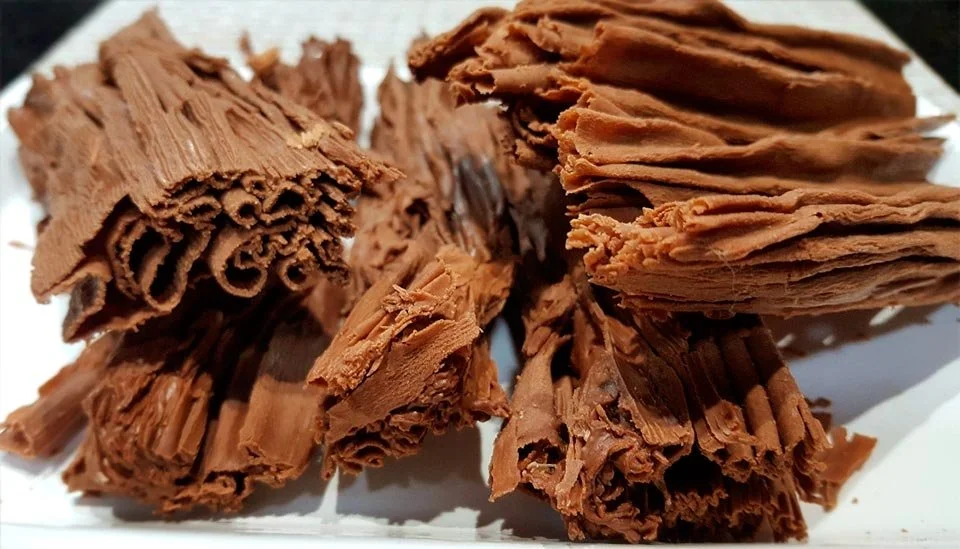
Chocolate en Rama, a Bariloche tradition. Image credit Milenium.
By the time the second wave arrived from Europe, the landscapes were already shaped. Between 1946 and 1950, Argentina became the primary destination for the survivors of every fascist project in Europe — German, Italian, Croatian, Hungarian, Romanian.
Neither Argentina nor Chile was a neutral recipient of post-war Europe's political refugees. Both countries had their own authoritarian traditions — rooted in military nationalism, Catholic conservatism, and a particular anti-communism that predated 1945 by decades. Perón, who came to power in 1946 and would become the primary architect of Argentina's welcome, had admired Mussolini and Hitler since serving as a military attaché in Italy in the late 1930s. He regarded the Nuremberg trials as a disgrace in his own recorded words. An estimated 6,000 war criminals and their collaborators found their way to Argentina and Chile post World War Two in the hope of escaping justice.
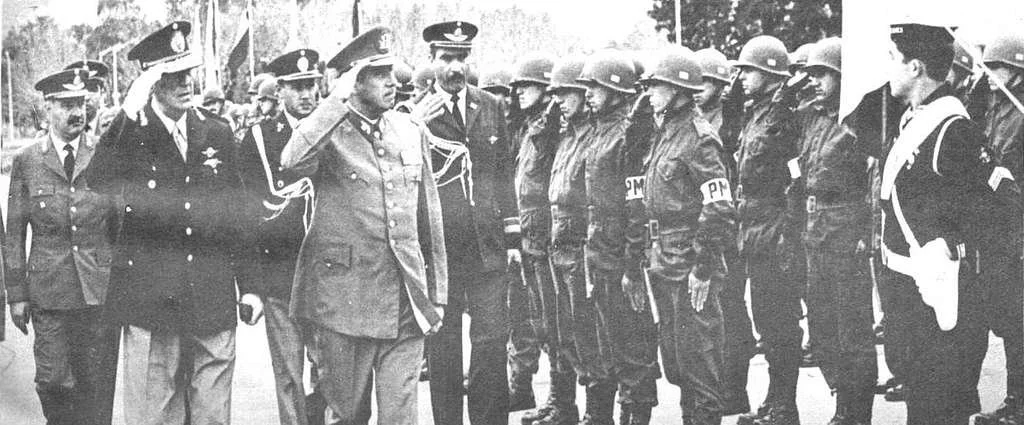
Juan Domingo Perón and Augusto Pinochet inspect troops in Argentina, 1974. Image credit Wikimedia Commons.
The post-war arrivals came to communities that had existed for a century, that spoke their language, maintained their culture, ran their children's schools in German or Italian, and in some cases shared their politics. Mussolini had spent the 1920s and 1930s actively cultivating the Italian diaspora in Argentina, operating fascist cells through the same cultural societies that had built the Dante Alighieri School and the Italian Hospital. Germany pursued a parallel Nazification of the German-Chilean community from 1933 onward, treating the established diaspora as a vehicle for extending ideological reach. The Catholic Church — the most durable thread connecting European diaspora communities to the world they had left — maintained that connection without discrimination between those who had left honourably and those who had not. The infrastructure of belonging that legitimate settlers had built over generations became, for a smaller and very different group of arrivals, the infrastructure of concealment.
The routes that brought them — the ratlines, running through Spain and Italy — were organised with the active assistance of Catholic clergy and a Red Cross that issued travel documents on forged signatures. The motivation was less religious solidarity than anti-communist calculation: former Nazis and fascists were considered potential assets in the struggle against leftist movements — a struggle whose urgency, in the southern cone at least, owed more to the anxieties of landowners, military establishments and the Catholic hierarchy than to any external threat.
The particular techniques brought by this wave of fugitive immigrants facilitated the disappearances and systematic terror that defined the repressive Pinochét regime in Chile and Argentina’s Guerra sucia, the state terror campaign conducted by the military junta between 1976 and 1983. Argentina and Chile did not simply receive fascism from Europe, they embraced it — resulting in a cross-pollination of violence. The immigration story and the political story of both nations are entangled.
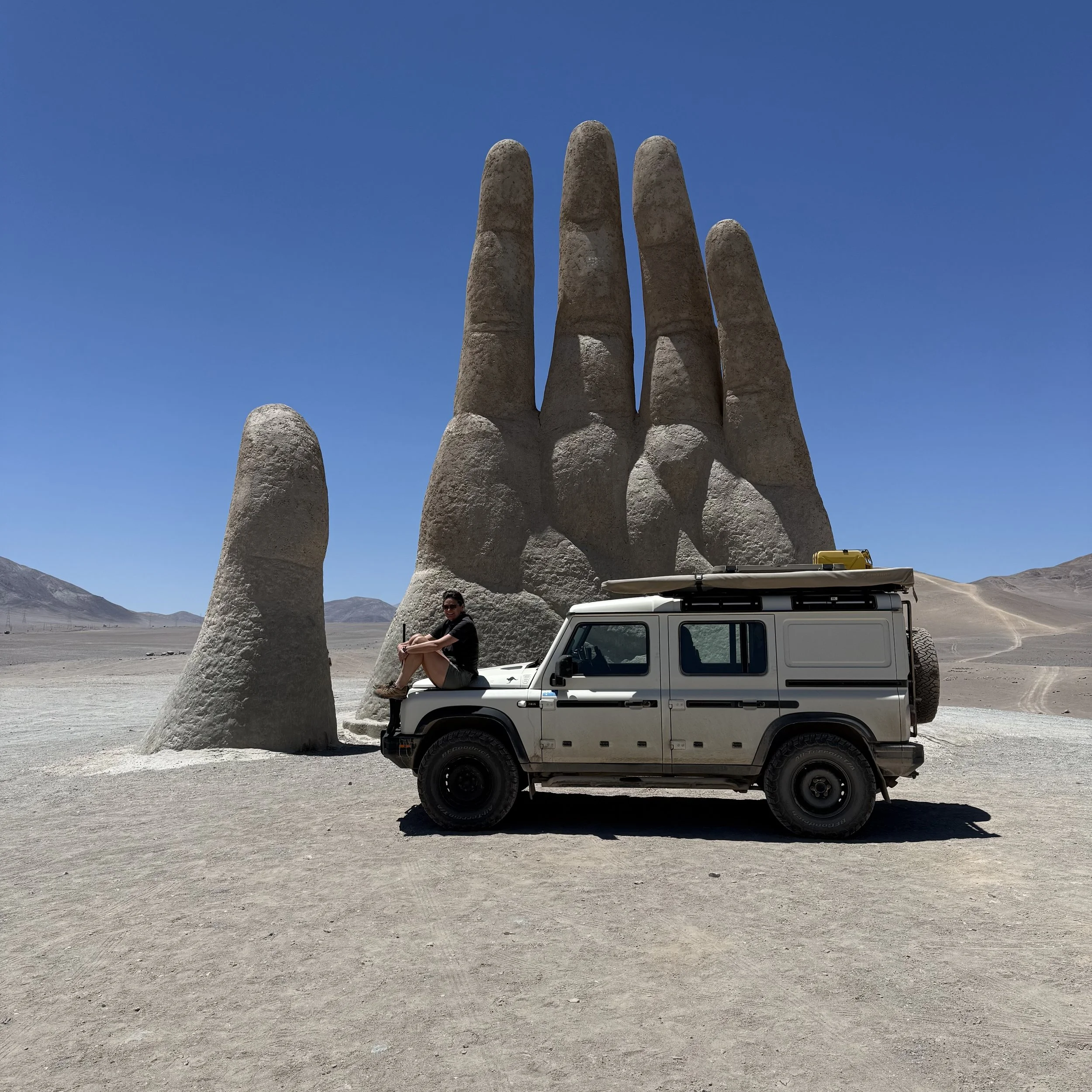
Mario Irarrázabal’s Hand of the Desert in Chile commemorates the disappeared, victims of human rights violations during the Pinochét regime.
For most visitors, the experience of this landscape is aesthetic — the wine, the beer, the chocolate, the architecture, the extraordinary light on the Andes in late afternoon. That experience is not wrong, it is simply incomplete. Hannah Arendt, in The Origins of Totalitarianism, argued that the collapse of political decency does not require uniquely evil societies. It requires ordinary ones that allow their institutions to be captured by a logic that places the defence of a particular civilisational project above the rights of those outside it — the stateless, the displaced, the person without papers. That logic is a structural possibility latent in every modern political order, available whenever the institutional constraints that normally contain it are set aside in the name of something larger.
The artisanal products that remain — the wine, the beer, the chocolate — embody the very best of what the legitimate immigration wave produced: tradition, care, and the stubborn fidelity of people who know what they are doing and why. The shadow exists alongside them, unresolved and not readily resolvable. Both are part of what this landscape is.
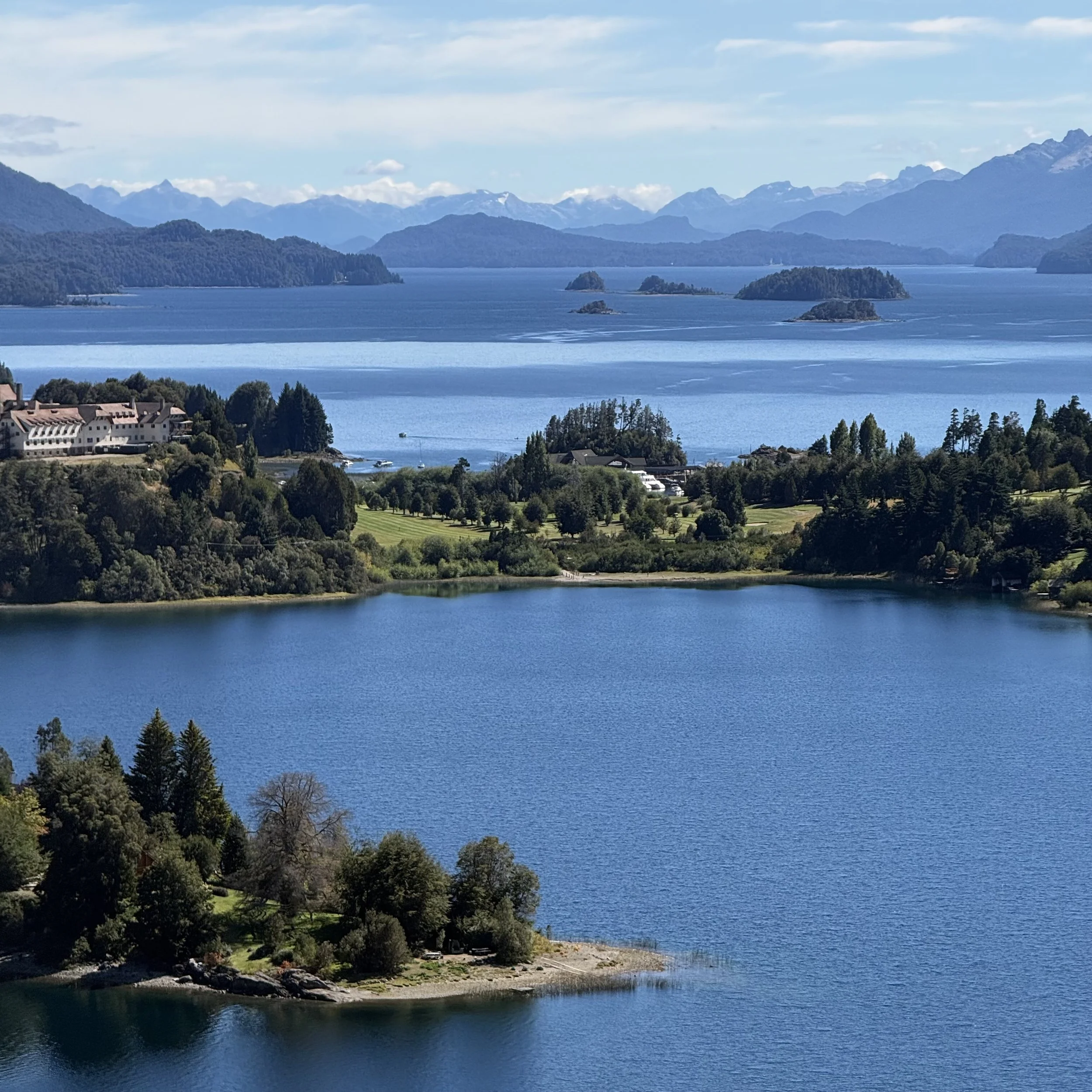
The Llao Llao Resort, Golf & Spa at Bariloche has welcomed guests since 1940.
The wine is excellent. The Malbec from Paraje Altamira, fermented in the concrete that Sebastian Zuccardi reclaimed from his grandfather’s generation, is among the more precise and elegant things we drank on this journey. The Kunstmann in Valdivia tastes of the lake district in the way that certain beers do — cold and clean, brewed with the fidelity of a tradition that survived an earthquake and a century of industrialisation. The Rutini and Catena labels carry their Italian surnames as straightforwardly as the Dante Alighieri School in Mendoza carries its. The history behind all of it is a history of labour and skill and the specific courage it takes to trade everything you have for a vine — or a brewery, or a farm on a forested lake — in a country you have never seen.
