Ruta del Desierto and the long dry road
Chile has two great driving routes. This is the first: the Ruta del Desierto, from the Peruvian border south through the Atacama to Santiago. One strips the landscape to its geological bones; the other descends into terrain that is still being made, through country whose roads carry more history than their surfaces suggest. More on that later, for now this is the northern leg.
Iquique
We crossed from Peru at Tacna in mid-December, reaching Iquique the same day. The transition is abrupt — the Peruvian south and Chilean north share the same Atacama geology, but the infrastructure shifts immediately. Iquique is a duty-free port with a seafront that punches above its weight. We resupplied, used the pool, and continued south.
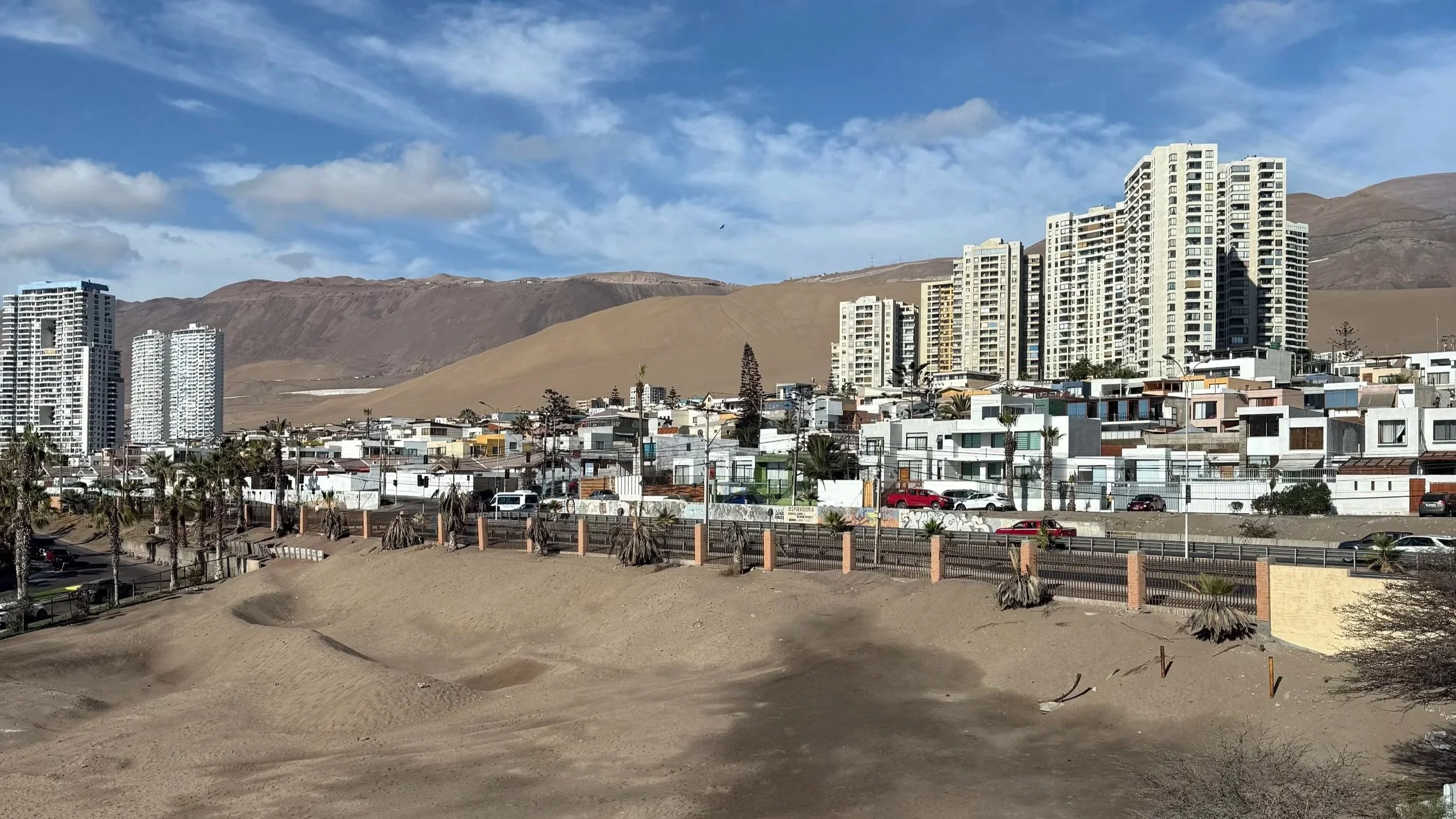
At Iquique the desert wants to push the city into the sea
“The abstraction of the desert landscape cleansed me, and rendered my mind vacant with its superfluous greatness.”
T.E. Lawrence, Seven Pillars of Wisdom (1926)
San Pedro de Atacama
The drive to San Pedro takes the better part of a day. The Atacama is the oldest desert on earth — in places measurably without rain for millions of years — and the road across it has a corresponding quality of geological patience. There are no concessions to the traveller: no shade, no water, no softening of the terrain. What remains when everything contingent has been removed is salt, rock, and light that falls without interference. The desert is clean — indifferent to human presence, neither hostile nor welcoming, simply prior to all of that. I find this clarifying. The mind, relieved of the ambient noise that greener and more populated landscapes generate, settles into a different register.
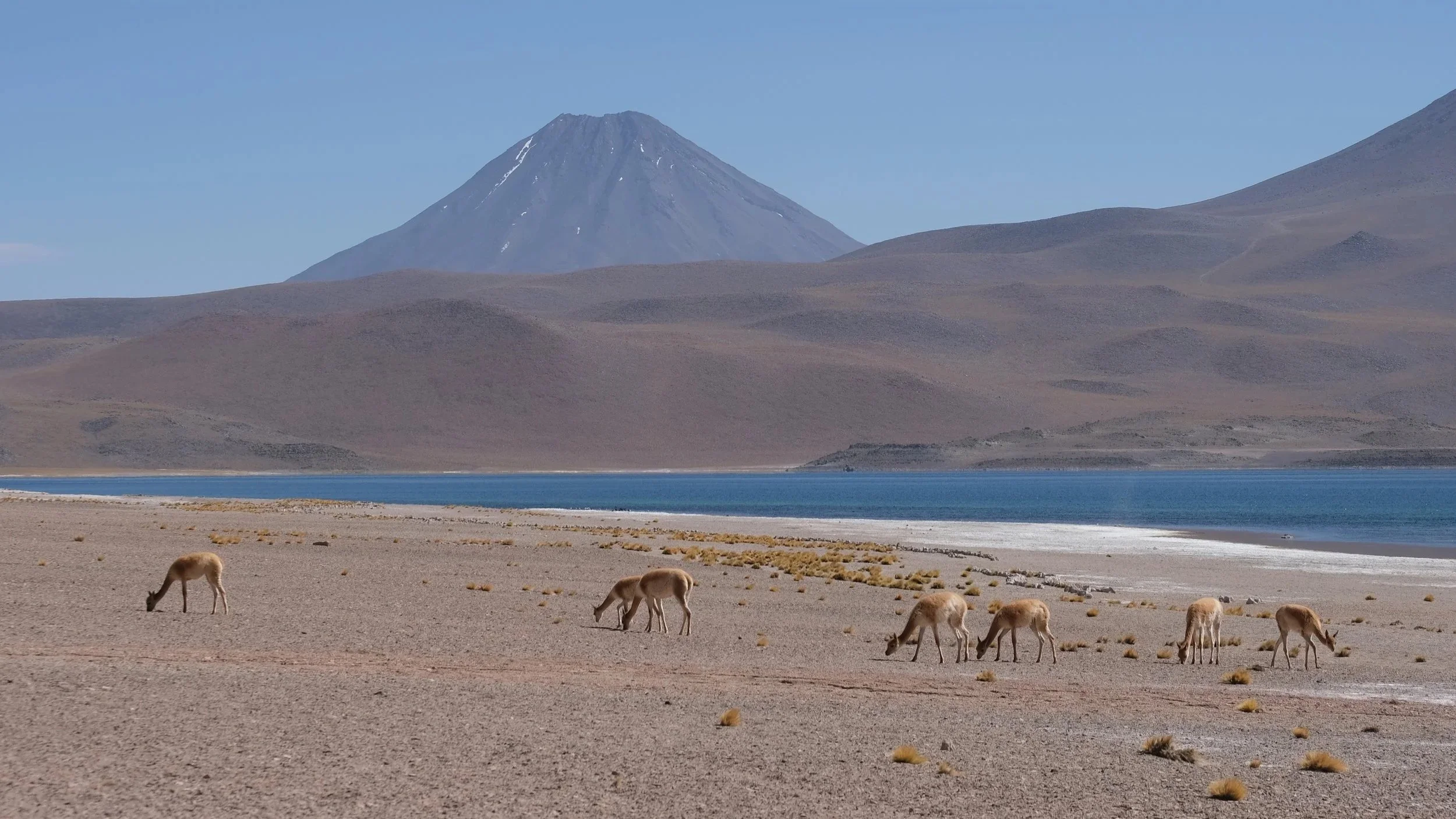
Vicuñas graze below Volcán Licancábur
San Pedro de Atacama sits at 2,400 metres, ringed by volcanoes, and has absorbed a considerable tourist industry without being entirely undone by it. We stayed four nights at Tiunur Lodge. The altiplano surrounding the town is the reason to be there: Laguna Baltinache at dawn, flamingos working salt-edged water in near-silence while the volcanoes caught the first light; Valle de Luna at dusk, where wind has carved the salt and clay into formations that change colour as the sun drops and resist straightforward description; geysers at 4,300 metres before sunrise, the cold absolute and the steam columns rising into a sky that at that altitude is a shade darker than it has any right to be; the Salar de Atacama, where the scale of the salt flat defeats the eye and the horizon becomes a matter of inference rather than observation.
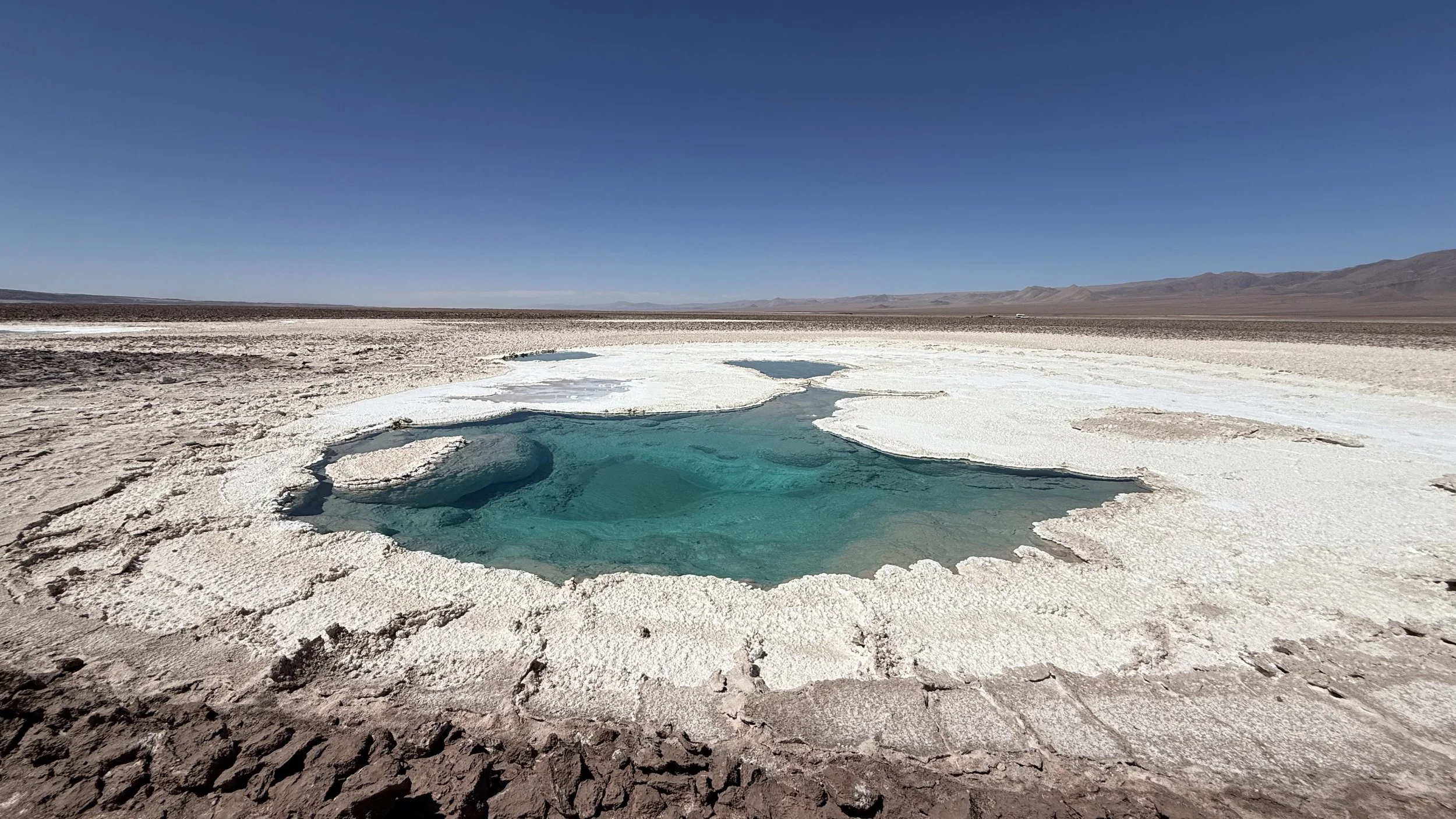
Crystal water on the Salar de Atacama
The Hand of the Desert
South of San Pedro, on the Pan-American, Irrarázabal’s Hand of the Desert emerges from the sand floor — a concrete and iron hand, eleven metres tall, reaching upward out of the desert surface. It was inaugurated in 1992 as a memorial to the victims of torture and injustice under the Pinochet regime: human vulnerability and suffering given monumental, isolated form. The desert receives it without comment. The indifference of the landscape to the weight of what the sculpture carries is not a diminishment — it is, in its way, the most honest possible setting for a work about suffering that went largely unacknowledged. The hand reaches. The Atacama continues in every direction, unchanged.
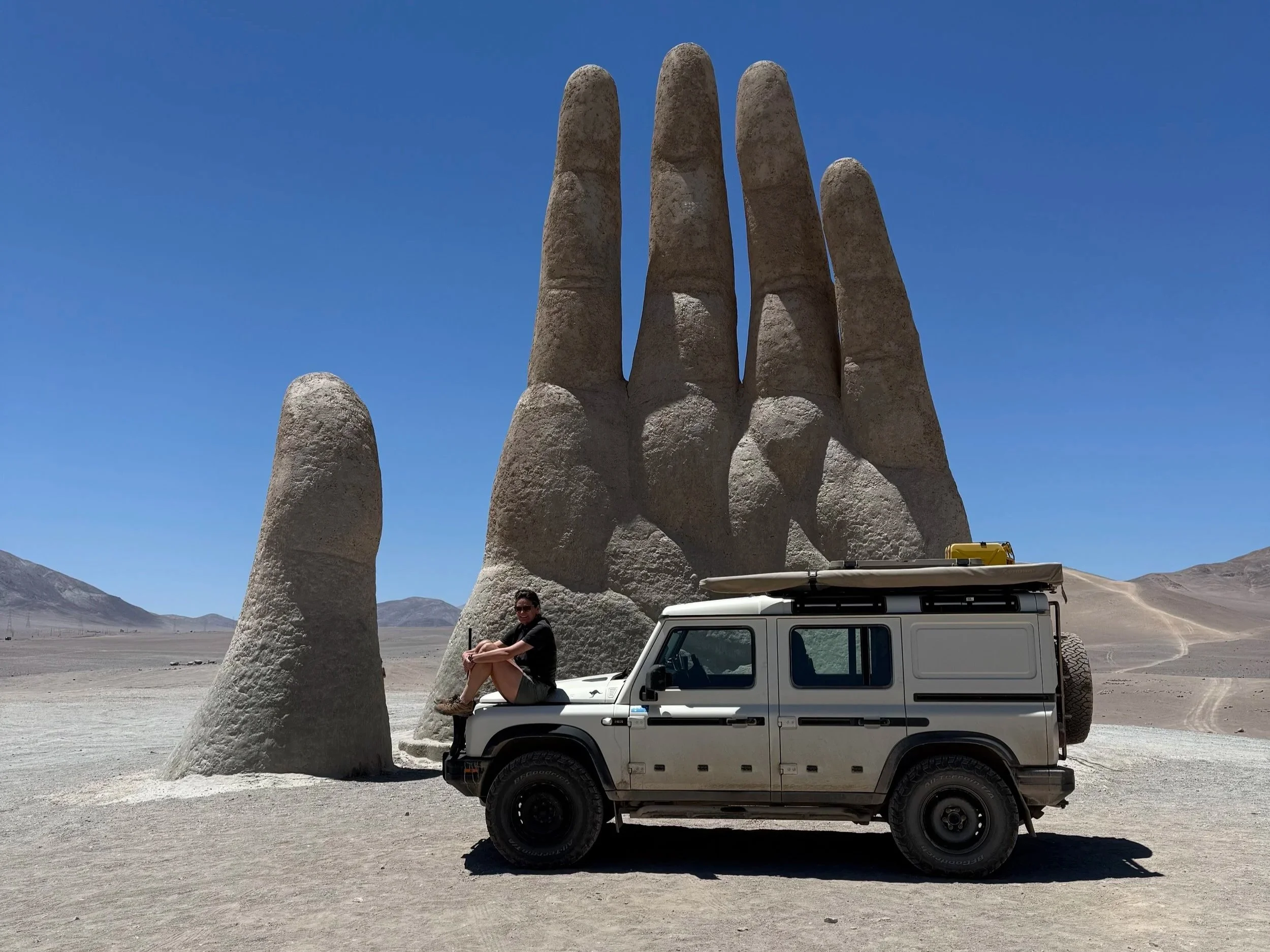
The Hand of the Desert, somewhat of a pilgrimage spot for Panamericanos
South to Santiago
From San Pedro the Pan-American runs south through Taltal and Vallenar to La Serena, where we stopped for four nights over Christmas. A cabin compound outside town, turkey dinner, no agenda. La Serena is a pleasant colonial city that asked nothing of us, which was the point.
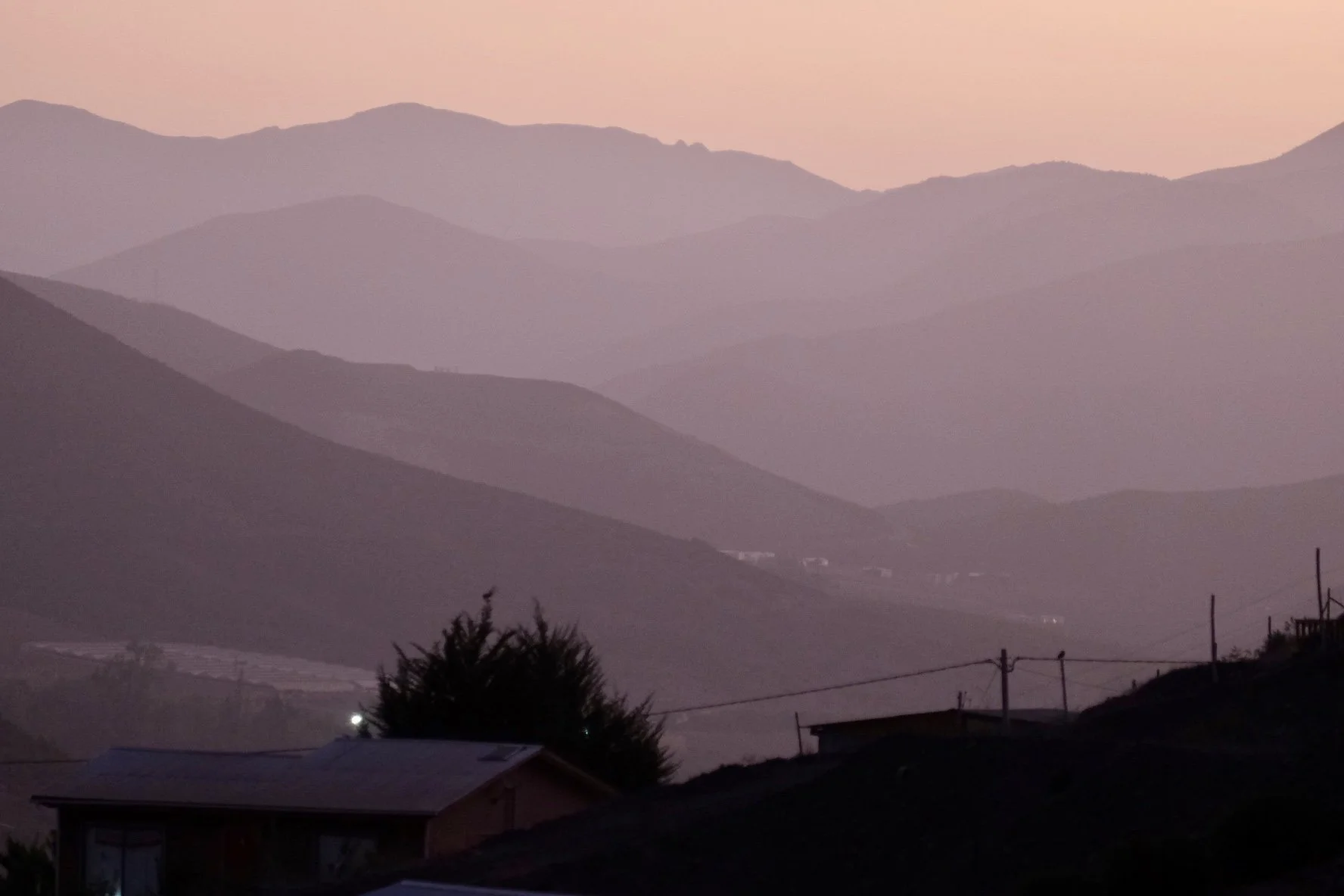
A Christmas pause
Santiago followed: eight nights in a Ñuñoa apartment. Dentist appointments, camera equipment, the Museo Precolombino, and a sufficiently long lunch with friends that the afternoon was written off. On the fourth of January we crossed the Andes via Paso Los Libertadores into Mendoza. The pass takes its name from the crossing that secured Chilean independence. In January 1817, the Argentine General José de San Martín led his Army of the Andes out of Mendoza — around 4,000 troops, crossing passes averaging 3,000 metres in the height of summer — and descended into Chile. Bernardo O’Higgins, the Chilean independence leader who had fled to Argentina after the royalist victory at the Battle of Rancagua in 1814, commanded the left wing. On 12 February they defeated the Spanish garrison at the Battle of Chacabuco, entered Santiago, and O’Higgins was elected the first Supreme Director of an independent Chile. The crossing has been compared to Hannibal’s passage of the Alps; we crossed in the opposite direction in considerably more comfort, and spent three days on Malbec and vineyard lunches at Tempus Alba and Casa Vigil before heading south down Ruta 3 toward Patagonia and Ushuaia.
