Southern Patagonia — land of ice and stone
“'Do we walk in legends or on the green earth in the daylight?' 'A man may do both,' said Aragorn. 'For not we but those who come after will make the legends of our time. The green earth, say you? That is a mighty matter of legend, though you tread it under the light of day.'”
J.R.R. Tolkien, The Two Towers (1954)
We disembarked in Ushuaia from our Antarctica expedition on 5 February and headed into southern Patagonia. What follows covers both sides of the border — Chilean and Argentine — because the landscape does not observe the frontier. The Southern Patagonian Ice Field spans both countries and the glaciers that descend from it flow into lakes on both sides. Torres del Paine is Chilean; El Calafate and El Chaltén are Argentine.
Tierra del Fuego — the king penguins
Driving west across Tierra del Fuego we stopped at Bahía Inútil — Useless Bay — home to the only continental king penguin colony in the world. We saw the colony twice, from either side of a legal boundary that has been contested for a decade. The first view was from the beach of Estancia Tres Hermanos, whose owner Jorge Robertson hosted us on his property. The second was from the fixed observation platform of Reserva Natural Pingüino Rey, the conservation operation run by the neighbouring Fernández-Durán family on their Estancia San Clemente. The two estancias share the Marazzi River as a boundary, and the colony nests at the river’s mouth. In 2015 Juan Robertson Stipicic — Jorge’s father — initiated a formal land claim against the reserve, arguing that the penguin habitat fell within Tres Hermanos’ boundary. After five years of litigation, the courts agreed: the Court of Appeals confirmed in 2020 that the colony sits on Robertson land. The Fernández-Durán reserve continues to operate; the legal position of the ground it occupies is now settled against it.
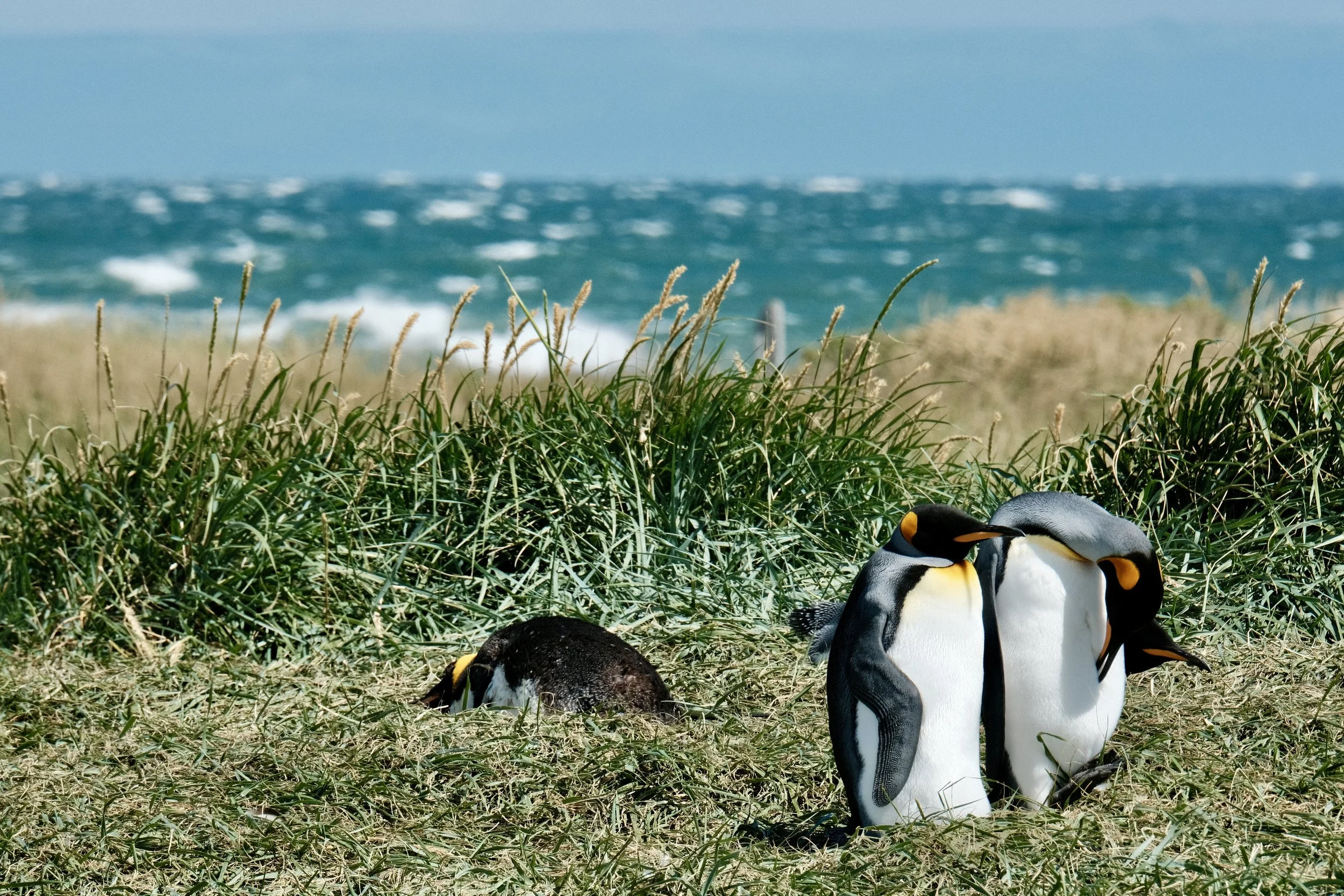
The King penguin colony numbers around 200 birds
The penguins themselves are indifferent to all of this. King penguins had been absent from the mainland since the 18th or 19th century, when conversion to sheep farming eliminated the habitat. They returned to Bahía Inútil in 2010, were quickly overwhelmed by unmanaged public interest — numbers collapsed to eight birds within a year — and the Fernández-Durán family responded by founding the reserve. The colony has since recovered to over a hundred individuals. From the Robertson beach the birds move freely; from the reserve platform at 25 metres, they are closer and the viewing is controlled. A metre tall, orange-throated, conducting their affairs with complete equanimity on both sides of the river. Tourist pressure and a boundary dispute are not the only threats. American mink — Neovison vison, introduced to Tierra del Fuego from North America in the late 1940s for the fur trade, escaped or released, now established across the entire archipelago — are a direct predator of ground-nesting birds. King penguins nest at exactly the kind of riverbank habitat mink favour. While we were on the Robertson property, Jorge tracked a small group of mink along the Marazzi riverbank and moved to intercept them. It was a routine part of managing the land. The colony’s recovery is not self-sustaining; it is the product of continuous active custodianship by the families on either side of the river, whatever their other disputes. We crossed to Punta Arenas by ferry from Porvenir on a very windy day.
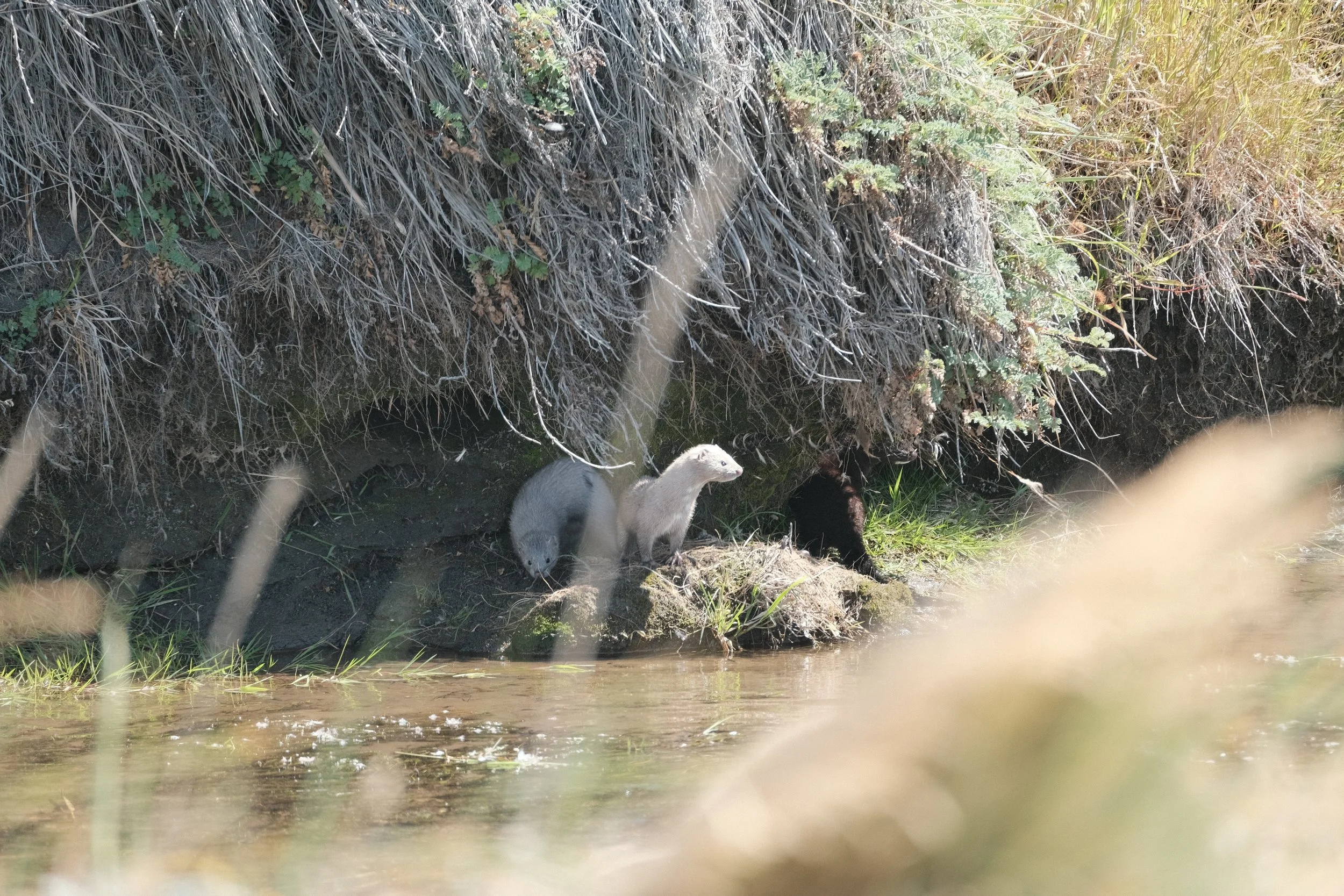
American minks are now an invasive threat to the colony
Torres del Paine
Two days north of Punta Arenas, after resupplying in Puerto Natales, we spent five nights on a private reserve adjacent to the park — a small house in forest above a river — which gave us time to cover Torres del Paine properly rather than in a single rushed pass. On the road north from Puerto Natales, 24 kilometres out, the Cueva del Milodón Natural Monument is a necessary stop.
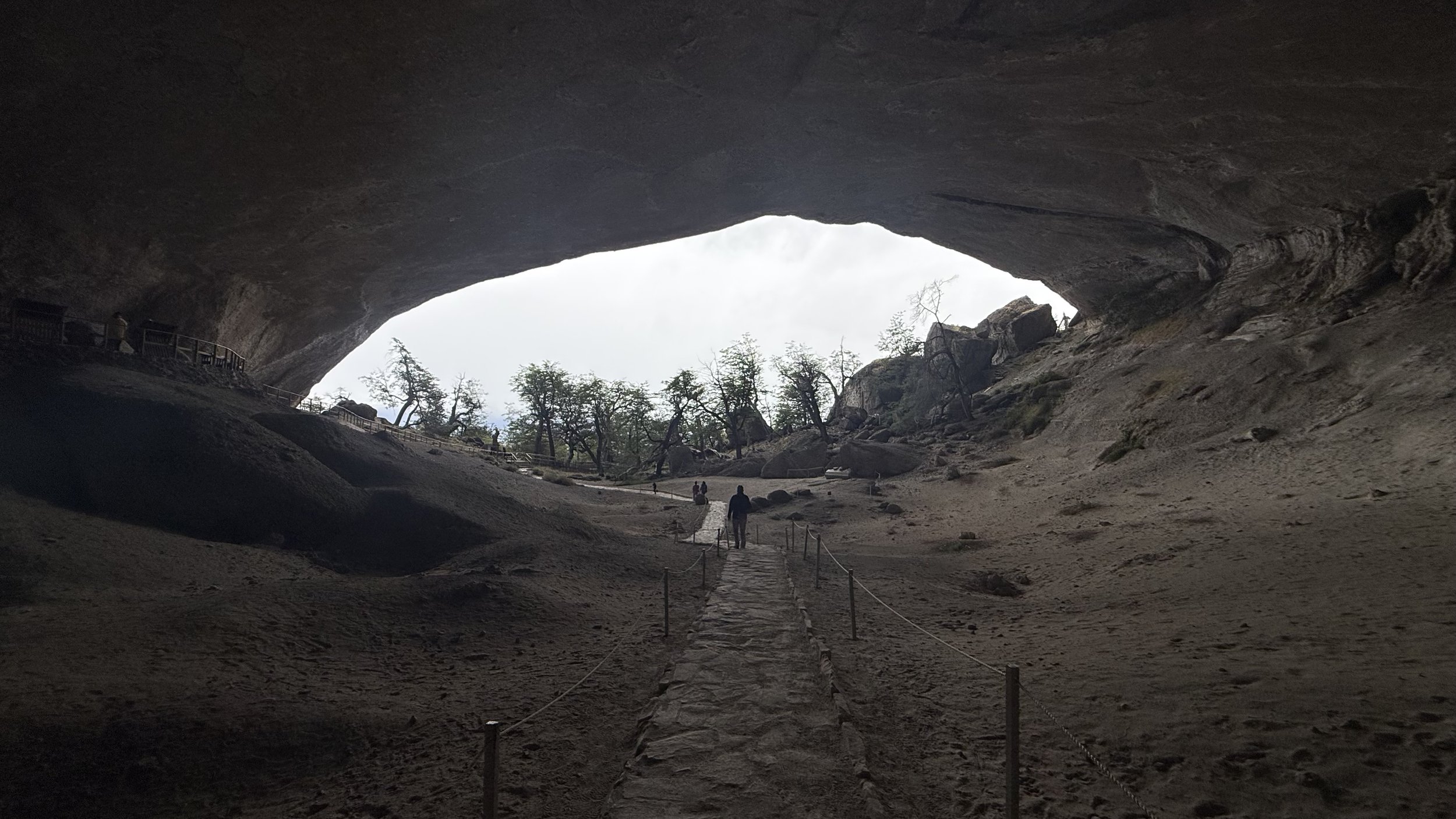
Cueva del Milodón
The cave was formed by glacial retreat 18,000 years ago, carved into the flank of Cerro Benítez by advancing and receding ice. Once the ice pulled back around 13,500 years ago and the lake levels dropped, Patagonia’s megafauna moved in. The cave sheltered a community of Pleistocene animals whose company would have been extraordinary: the Mylodon darwini, a giant ground sloth that stood twice the height of a person and weighed close to a tonne; the Hippidion, a dwarf horse; the Macrauchenia, a large camel-like ungulate with a prehensile snout; and the Smilodon, the sabre-toothed cat. The German explorer Hermann Eberhard discovered a piece of preserved Mylodon skin in 1895 and thought for a moment the animal might still be alive — it was that well preserved. It was not. Radiocarbon dating eventually placed the skin at between 10,200 and 13,560 years old. What makes the cave archaeologically significant beyond its megafauna is that humans were there too: fire-fractured rock, lithic tools, and human remains have been found alongside the animal bones, with occupation dated to at least 6000 BC. Early Patagonian hunters and Pleistocene giants shared this space. The landscape outside the cave — steppe, condors, guanacos picking across the hills — would have been recognisable to both.
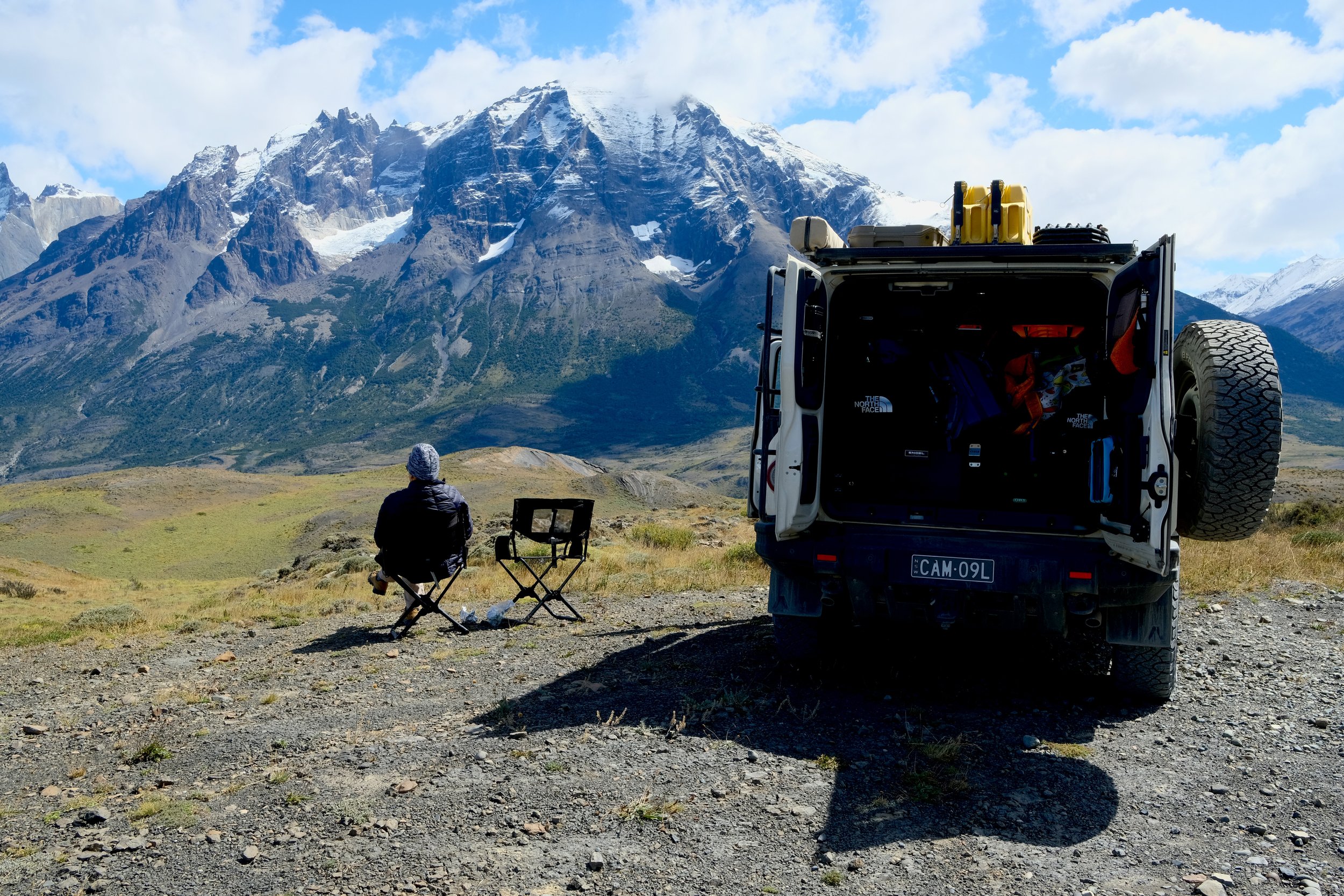
Lunch stop in Torres del Paine National Park
Day one: Guardía Gray, the ranger station, and the walk to Mirador Lago Grey. The glacier descends to the lake in sections that calve while you watch. Day two: Salto Grande waterfall and the Mirador Cuernos circuit, with the Paine massif filling the skyline for most of it. Day three was different — limestone caves on the reserve with Jorge, our host at Rupestre Patagonia, followed by a lamb asado cooked over an open fire. The name is apt: the reserve sits adjacent to ancient rupestre rock art sites, a further layer of human presence in a landscape already dense with it. Jorge has been on this land long enough to know it in detail. He showed us around the following morning. These were among the better hours of the Chilean journey.
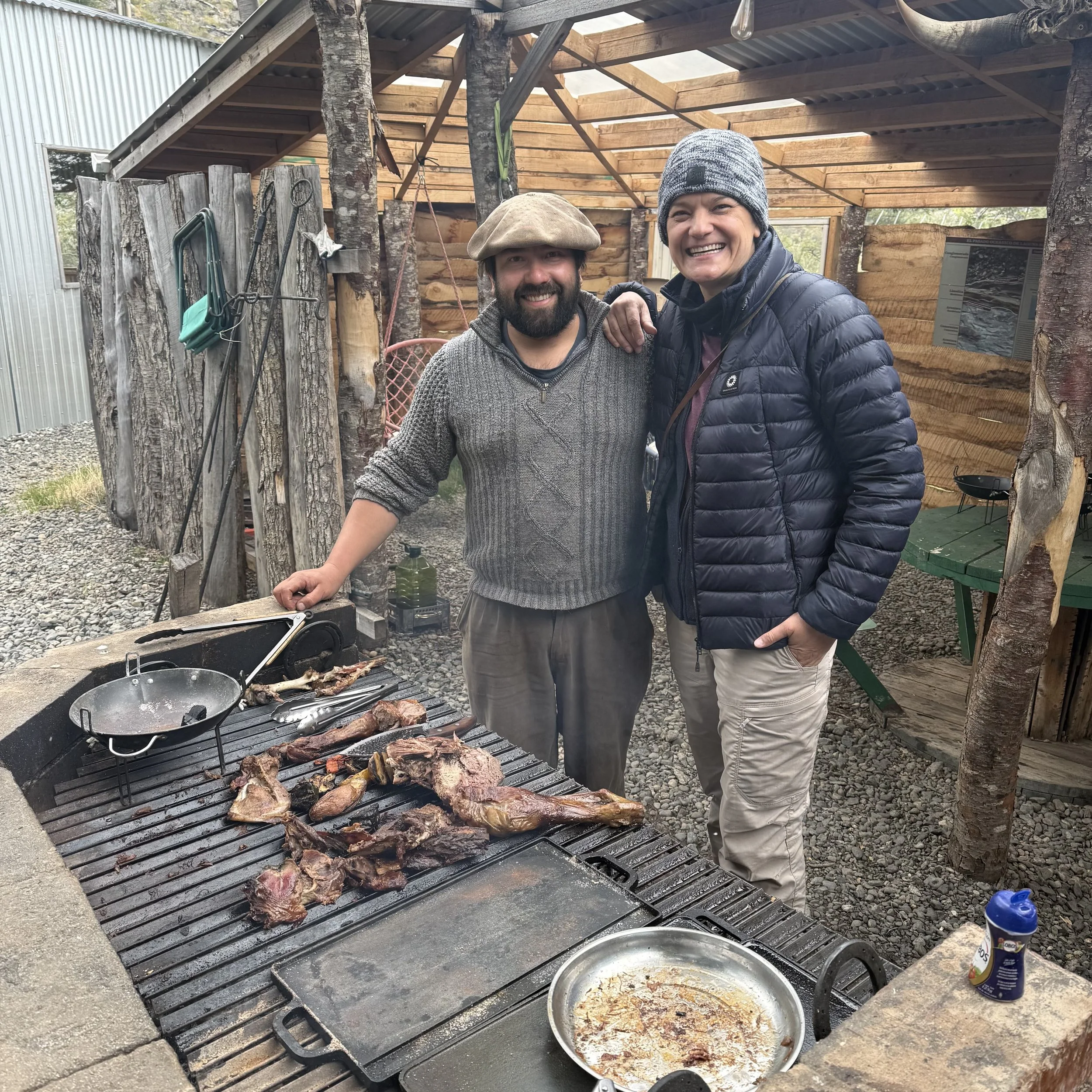
Cordero Patagonico with Jorge at Rupestre Patagonia
Torres del Paine is also reckoned to hold one of the highest densities of puma on earth. We did not see one, which is the most common outcome, but their presence was legible in the behaviour of the guanacos the large native camelids that roam the steppe in herds, with sentries posted on high ground and a distinctive alarm call that carries considerable distance. Andean condors were a constant overhead presence, their three-metre wingspan unmistakable against the massif; the healthy puma population means guanaco carrion, which sustains the condors in turn. The culpeo fox named from a Mapuche word for madness, which fairly describes its audacious hunting style appeared at close range on several occasions, apparently unbothered. In the Magellanic beech forest we searched unsuccessfully for the Magellanic woodpecker: South America’s largest woodpecker, jet-black with a scarlet head, classified as endangered and heard before it was seen, its hammering carrying through the trees well ahead of the bird itself. The huemul, the critically endangered South Andean deer that appears on Chile’s coat of arms, with an estimated 99% reduction in its historic population, inhabits the forested sections of the park but was not spotted. A sighting is considered genuinely exceptional.
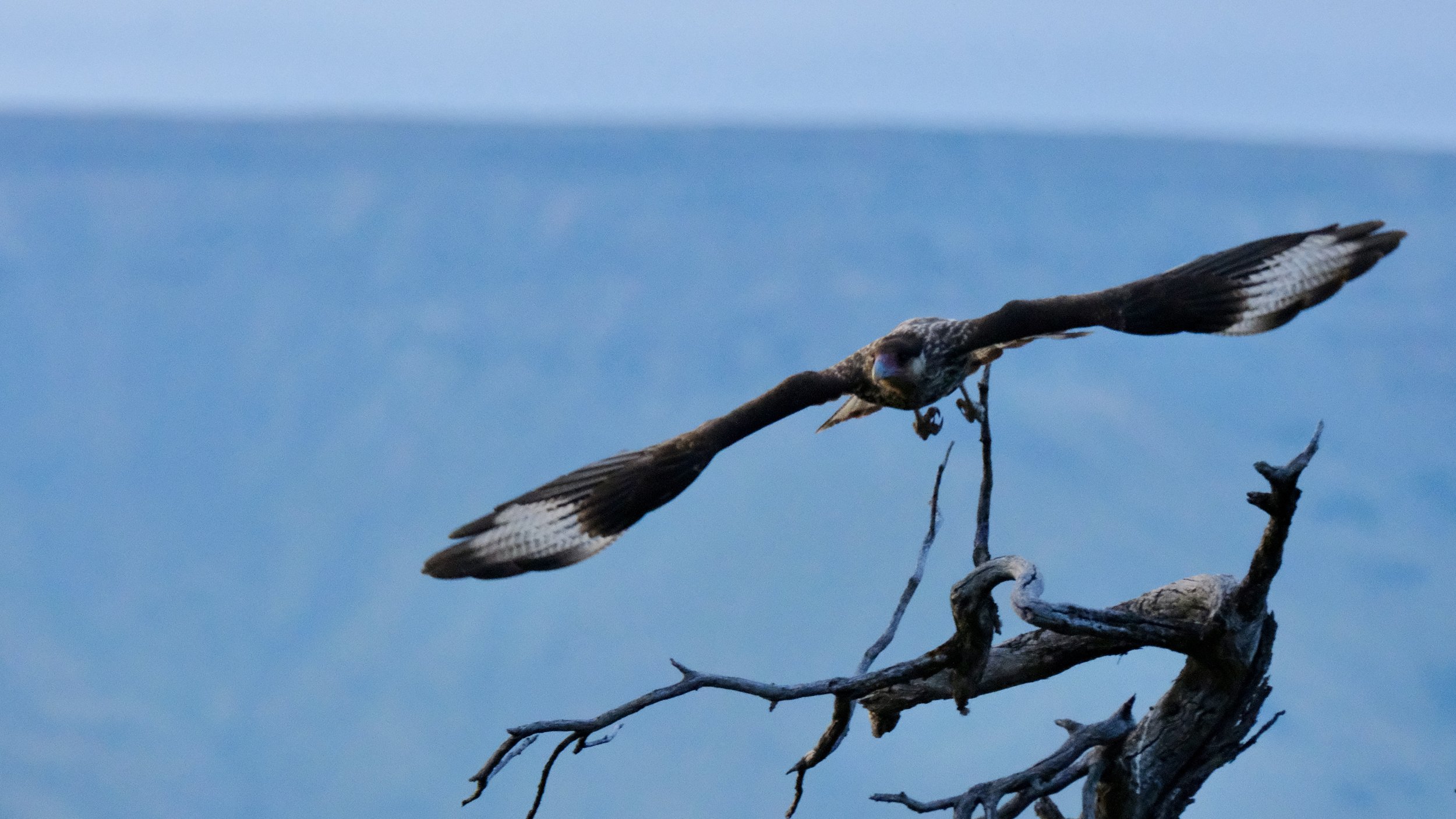
A Crested Caracara takes flight
El Calafate and Perito Moreno
We crossed into Argentina via Paso Río Dorotea to El Calafate, base for the Perito Moreno Glacier in Los Glaciares National Park. Perito Moreno had long been cited as an anomaly — a stable glacier in a warming world, its frontal position largely unchanged while neighbours retreated. That argument has recently collapsed. Research published in 2025 found that its surface lowering rate accelerated from 34 centimetres per year between 2000 and 2019, to 5.5 metres per year between 2019 and 2024, with some sections retreating over 800 metres in five years. The glacier’s apparent stability was a delayed response to climatic changes already locked in; what is now visible is the accumulated effect catching up. The broader picture across Patagonia is severe: 90% of glaciers have retreated since 1870, and the Southern Patagonian Ice Field — the largest temperate icefield in the Southern Hemisphere outside Antarctica — was losing nearly 40 cubic kilometres of ice per year by the late 1990s.
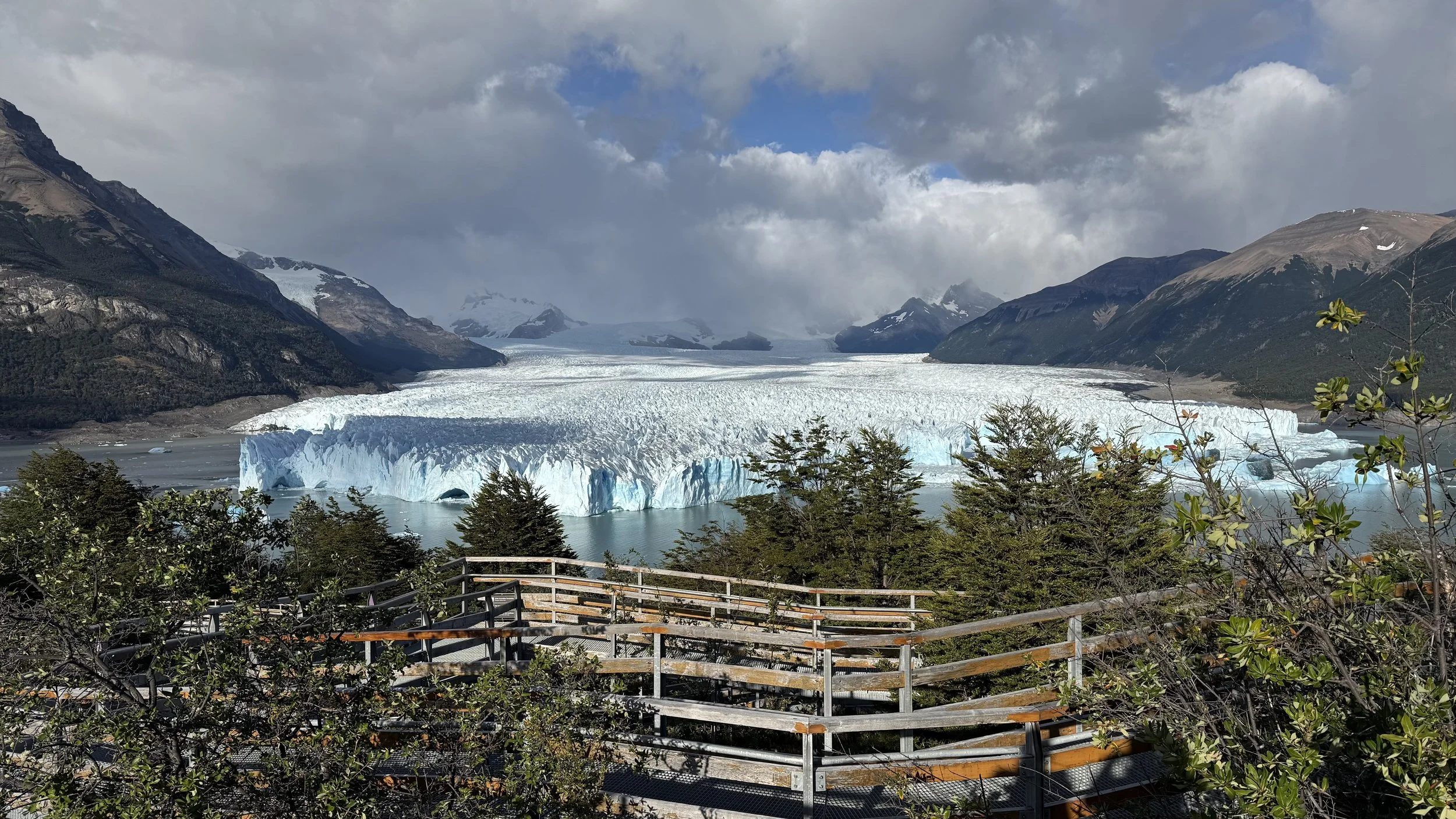
The Perito Moreno ice field
Perito Moreno is still extraordinary to stand beside. The scale of the ice front — five kilometres wide, 70 metres above the lake surface — has not yet been diminished to the point where the spectacle fails. Calving events occur continuously; the sound carries across the water before the ice falls. What the research adds is context: you are watching something that is actively, measurably leaving.
El Chaltén and the Ice Field
El Chaltén sits at the northern end of Los Glaciares National Park, below the Fitzroy massif — the granite towers whose profile is the logo of the Patagonia clothing brand, first climbed by Douglas Tompkins and Yvon Chouinard in 1968 on their legendary road trip south. We spent four nights, walking the Laguna Torre circuit (20 kilometres, mostly flat, emphatically hard on the toenails) and the Lago del Desierto boat trip to the Chilean border. The mountains here have a different character to Torres del Paine — sharper, more vertical, less approachable. The weather cycles rapidly and unpredictably. The day we walked to Laguna Torre the peak was clear for twenty minutes at dawn and then gone for the rest of the day, which is apparently considered good fortune.
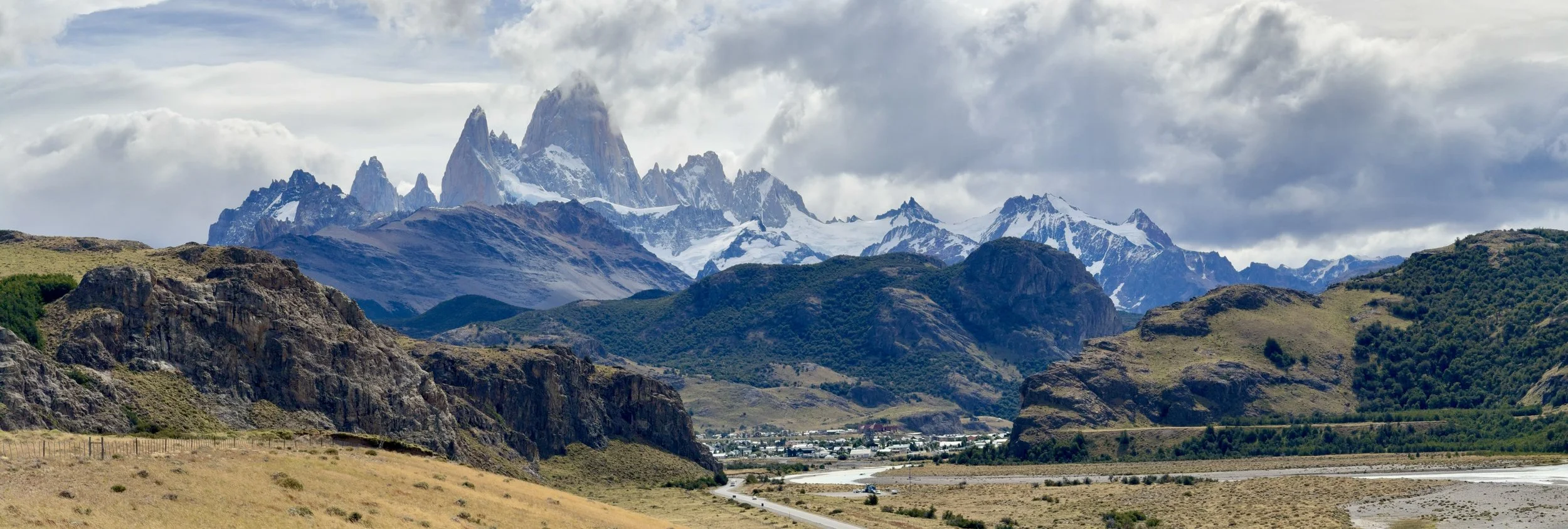
Fitz Roy rises above El Chaltén
Driving north on Ruta 40, the road passes within reach of Cueva de las Manos — the Cave of the Hands — in the canyon of the Río Pinturas in Santa Cruz province. It is the oldest known cave art in South America, dated from around 7,300 BC and painted continuously until approximately AD 700: over eight thousand years of human occupation recorded on a single rock wall. The site is named for its most striking feature — more than 2,000 stencilled handprints in black, white, red, and ochre, created by pressing a hand to the rock and blowing pigment through a hollow bone. Most are left hands: the artist held the pipe in the right. The other subjects are hunting scenes, and guanacos. The guanacos are still there. The same animals that Patagonian hunters depicted on these walls nine thousand years ago cross the road in front of you on the drive north, unbothered by the intervening millennia. The Tolkien observation applies here more directly than anywhere: you are walking on a matter of legend, under the light of day, and the legend is still moving.
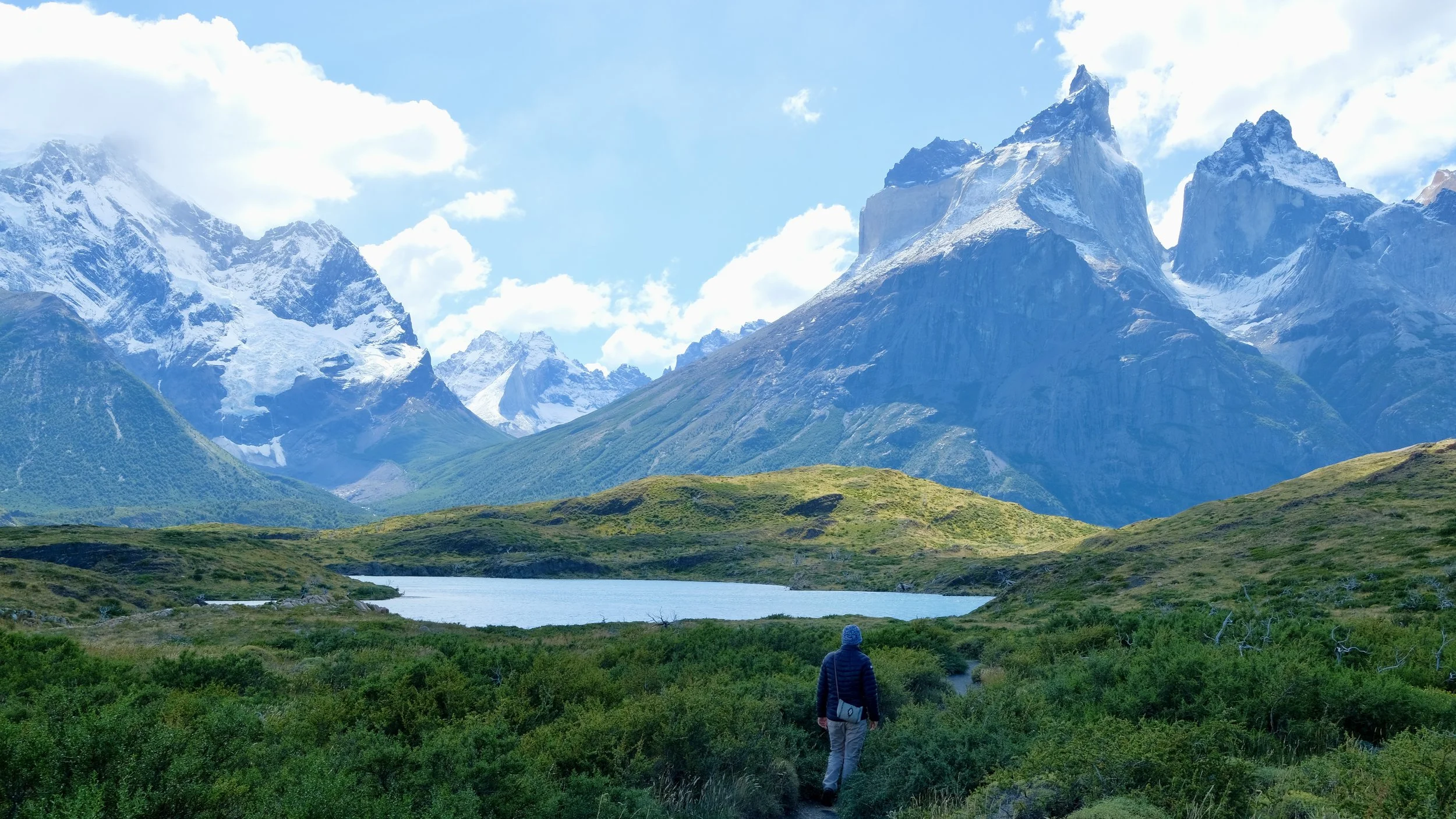
Another day, another spectacular hike
