The grid and the spiral
Buenos Aires is perhaps the most determinedly European city in the Americas. The grid runs nine blocks to the kilometre in every direction across a pampa so flat that the horizon is unobstructed for thirty kilometres. The facades along the major boulevards are often decidedly Parisian: limestone and ironwork and mansard roofs, the visual grammar of a city that has decided what it is and built that decision in stone. Standing on Avenida de Mayo and looking toward Congress, you could be in any of a dozen European capitals, and that resemblance is not accidental. Buenos Aires in the late nineteenth and early twentieth century was an affluent city in the business of becoming itself.
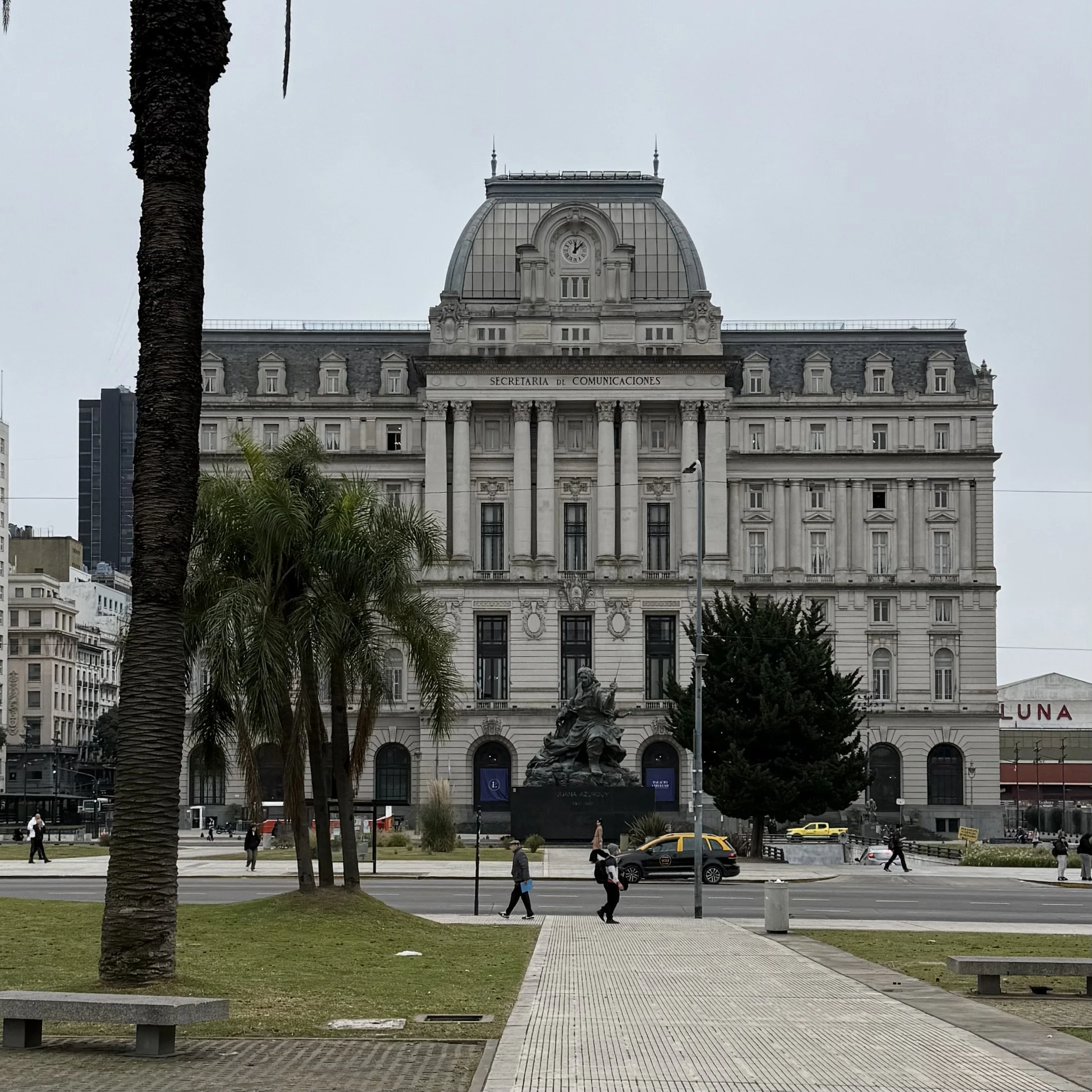
Buenos Aires, architecturally the most European of South American cities.
Which makes it stranger, and more interesting, that scattered through this fabric, in Recoleta, in Retiro, on Avenida de Mayo itself, there are buildings that subvert the European grammar. They do not look like anomalies from the outside, but once inside some remarkable influences emerge.
Cross the threshold of the Casa Ricardo Rojas on Charcas 2837, and Buenos Aires disappears. You are three metres from the street. You are also, at some level that is difficult to specify, in Arequipa, in Cusco, in Tucumán: in the Andes, in the colonial cities that grew out of the Andes, in the long history of a continent that the building on the street outside has been trying to forget. The patio opens before you with columns carrying bas-reliefs of sun, maize, flower and star. Sirens and Inca figures inhabit the loggia. At the mezzanine level, a Cusco-style balcony looks down into a cloister modelled on the Dominican Convent in Arequipa. In the library, the walls carry figures from the Moche and Aguada cultures, not generic indigenous ornament but deliberate citations of specific pre-Columbian traditions. In the salon, the Sun of Tiahuanaco looks out from the wall: a motif from a civilisation that preceded the Inca by five centuries and Columbus by a thousand years.
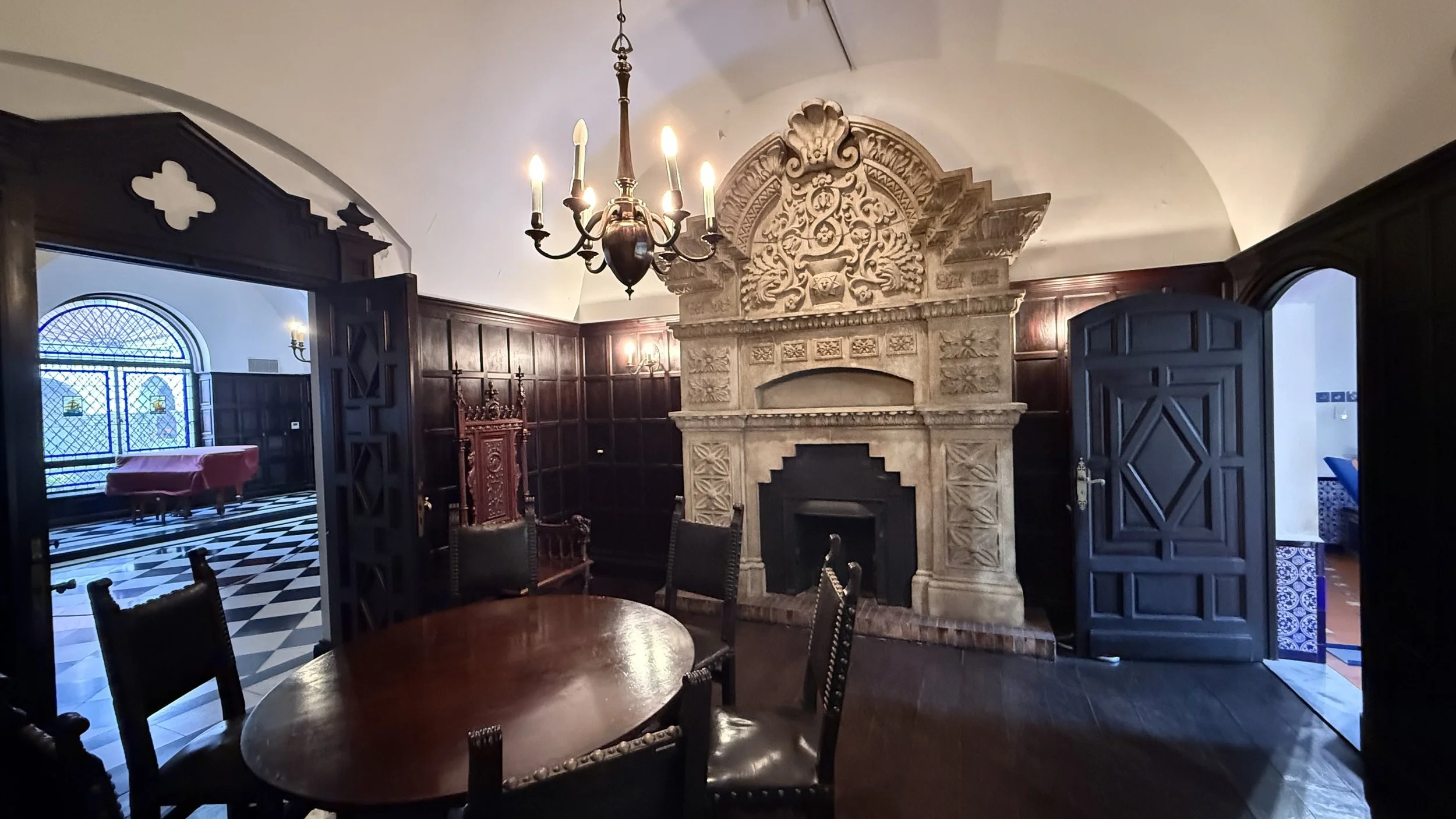
Dining room, Casa Rojas.
The Argentine writer and theorist Ricardo Rojas commissioned this house in 1927 from his student and disciple Ángel Guido, with the explicit instruction that it embody the aesthetic argument of his 1924 essay Eurindia, a word he coined by combining Europe and India, the latter carrying the colonial mislabelling of the Americas that Columbus bequeathed to every subsequent century. Rojas supervised every design decision personally. The house is not a residence with indigenous decorative accents. It is a manifesto in stone, each room representing one of the four phases Rojas identified in Argentine cultural history: the Hispanic, the independent, the cosmopolitan, and the indigenous.
The argument was this: Argentine cultural identity could not be resolved by choosing between its European inheritance and its Andean one, because the choice was false. The synthesis had already happened in the colonial cities of Peru and Bolivia, where Spanish baroque craftsmen and indigenous Andean labourers had produced, across two centuries of material encounter, an architecture that belonged to neither tradition exclusively and to both simultaneously. What Rojas wanted was for Buenos Aires to acknowledge that synthesis rather than paper it over with Haussmann facades.
His architect Guido had a precise theoretical account of what the synthesis involved. The Spanish baroque, he argued, was fundamentally a curvilinear system: dynamic, moving across surfaces, the volute and the acanthus and the twisted column expressing time passing through matter, the Counter-Reformation's insistence that the world is in motion toward redemption. The Andean tradition, specifically Inca and Tiwanaku, was its geometric opposite: planar, rectilinear, symmetric, the stepped form and the flat carved surface expressing something entirely different about how the world is organised. The colonial baroque of Cusco and Lima had forced these two systems together without intending to, and the result was an architecture that the rest of the world had never produced. Guido and Rojas proposed to make that collision conscious, deliberate, and Argentinian.
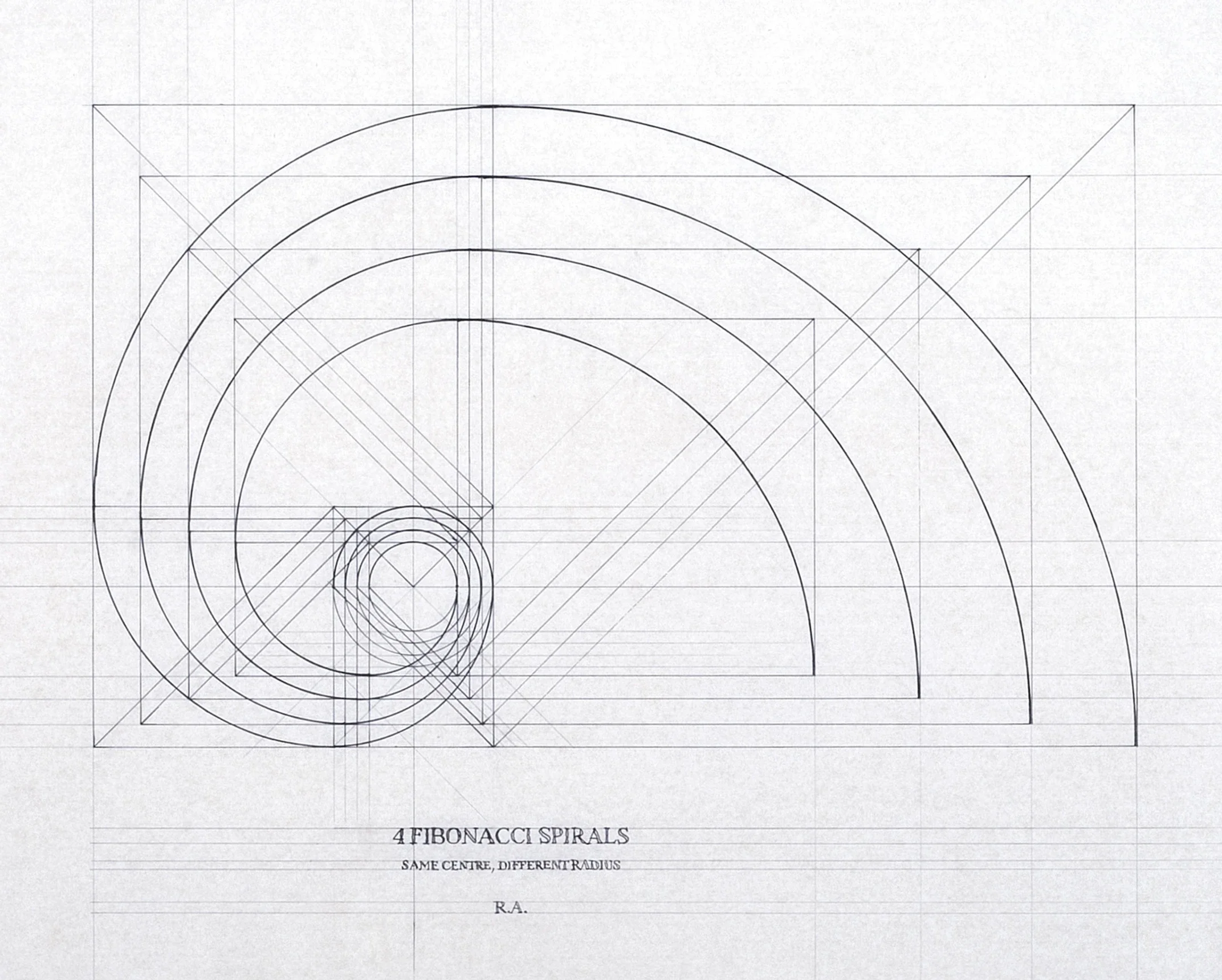
Divine geometry, crucial to the European architectural tradition.
Stand at the column in the Casa Rojas patio and you can see the seam. The column is European in proportion and structural function: it holds up the roof, it is tapered, it addresses the courtyard in the manner of ten thousand classical courtyards. The bas-relief on its surface is Andean: the sun, the maize, the geometric flower. The column holds the building up in one visual language and names the world in another. That is not decoration. It is the argument made physical.
But Guido's formulation, precise as it is, describes the surface. It does not reach the ground. The question is what underlies the geometry, and whether the difference between these two systems runs deeper than ornamental preference.
Consider the spiral.
At Caral, in the coastal desert of Peru, 180 kilometres north of Lima, the oldest known complex civilisation in the Americas was building monumental architecture five thousand years ago. Caral is contemporary with early dynastic Egypt. It has pyramids, plazas, sunken circular amphitheatres, and standing stones called huancas, some carved with the spiral motif that recurs throughout Andean art for the next five millennia. The same spiral appears at Chavín de Huántar, at Nazca, at Tiwanaku, in Inca textiles, in the vernacular weaving of the Calchaquí Valley. It persists across cultures separated by thousands of years with a consistency that suggests it is not decorative preference but encoded meaning.
The spiral is the most economical visual representation of a specific conception of time. It is not a circle: a circle returns to exactly where it started, time repeating without change. It is not a line: a line moves forward uniformly, each unit equivalent to the last, without return. A spiral returns to the same angular position but at a different radius. Each cycle has the same structure but different content. Time repeats its form but not its substance. The agricultural year returns with planting, growing, harvest and dormancy, but each year is not the same year. The sun completes its cycle, but the people who watch it are a year older. The spiral holds both truths simultaneously: return and change, sameness and difference, the cyclic and the progressive in a single form.
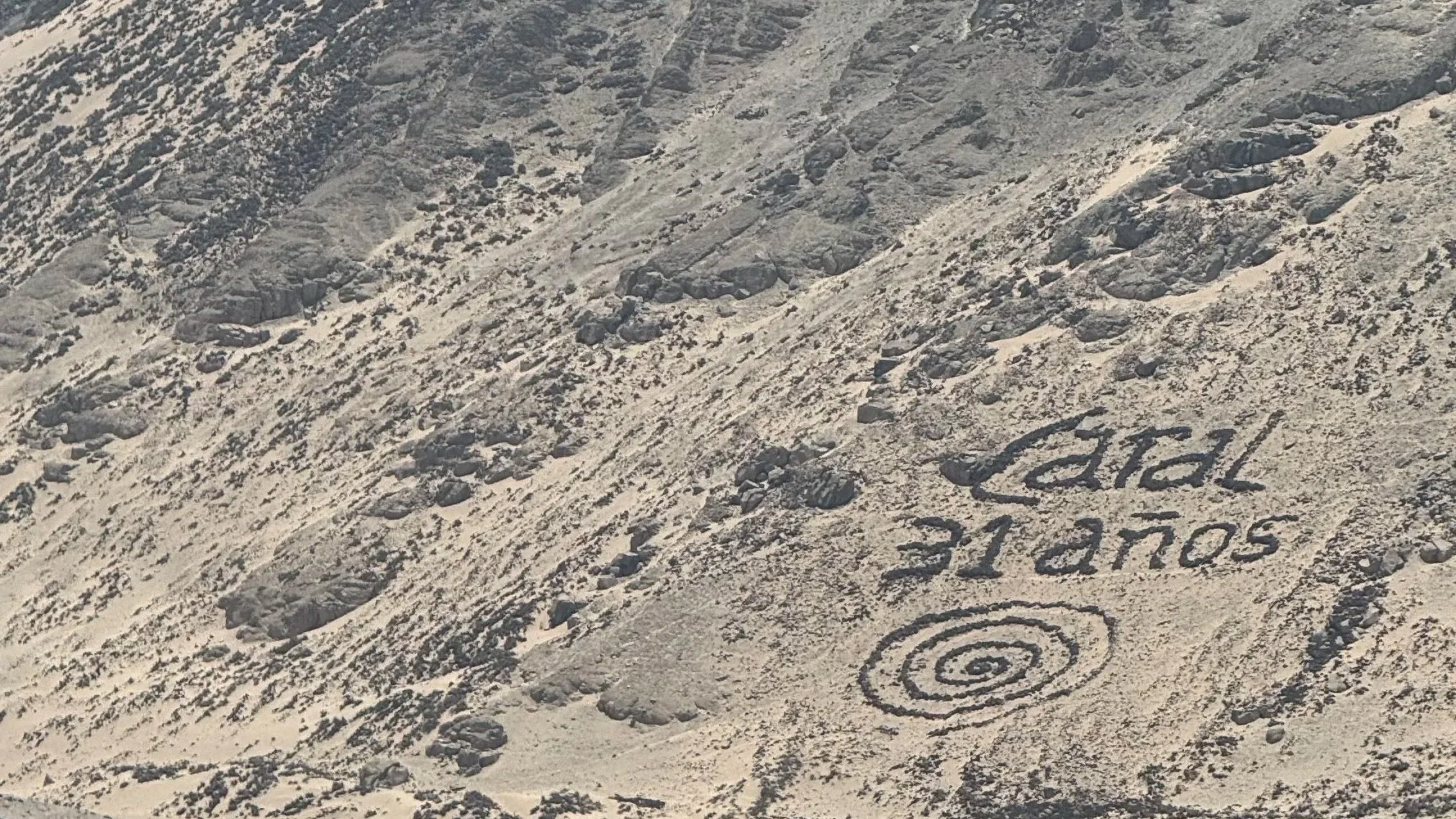
Caral, oldest urbanisation in the Americas, and the spiral representation of time.
The puquios at Nazca make the same argument in stone. These spiral shafts, cut into the desert floor around 1,500 years ago, descend in a helix to the water table below. In Andean cosmology the interior of the earth is the ukhu pacha, the originary world from which all creation and renewal emerge. In a desert where rain may not fall for decades, water brought up in this spiral from the earth is life itself, drawn up from the place where life begins.
In the Quechua language the word pacha means both time and space simultaneously. It does not distinguish between them because in the Andean worldview they are not distinct. And the spatial metaphor for time is the inverse of the European one: the past is in front of you, because you can see it. The future is behind you, because you cannot. Ñawpa pacha, the ancient time, literally means the time in front. You walk forward into the past and backward into the future. Time is not a line you travel along but a landscape you are situated within, visible in every direction, oriented by what you can see.
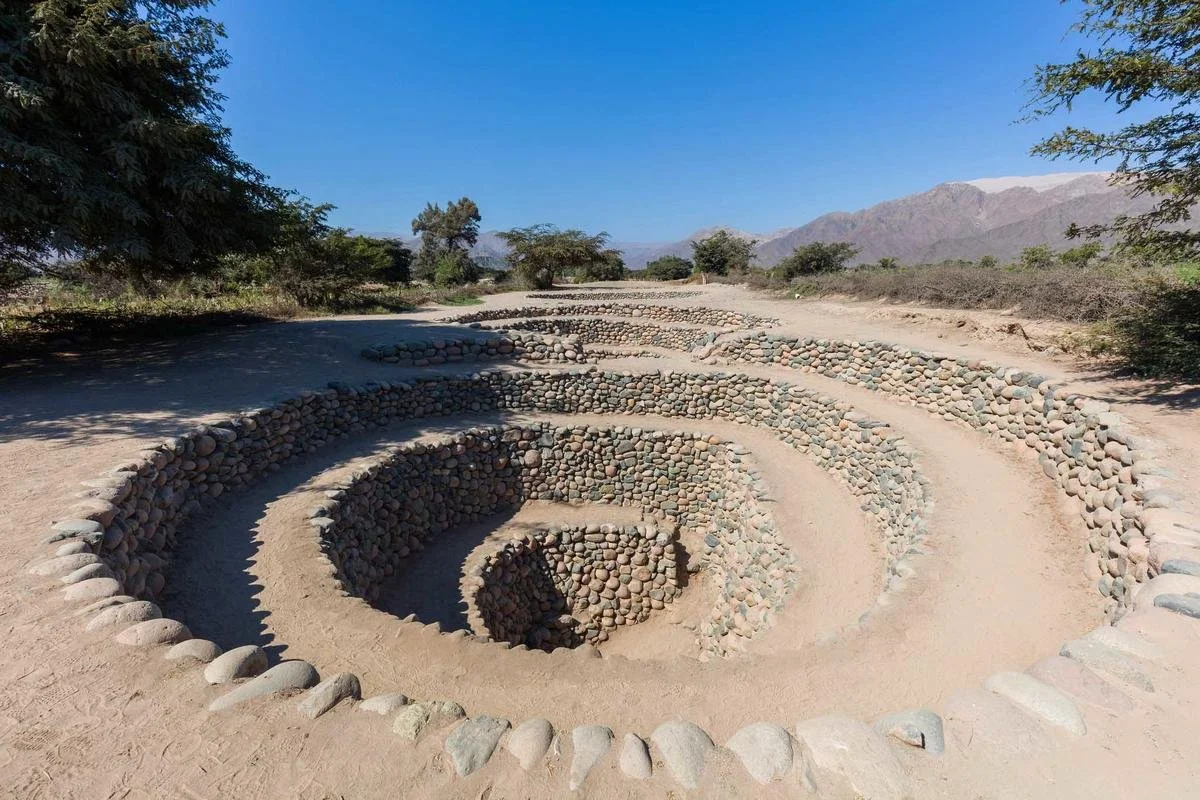
The puquios at Nazca.
The European conception runs in the other direction. Time is linear, progressive and directional: from creation to apocalypse in the Christian version, from ignorance to enlightenment in the secular one. The grid is its spatial expression, uniform and subdivisible, extending in every direction without privileging any particular feature of the landscape it covers. The Laws of the Indies, which mandated the grid plan for every Spanish colonial city in the Americas, did not consult the terrain. They imposed a standard spatial order on whatever landscape they encountered. Buenos Aires, built on a flat pampa with no topographic constraint, is the grid's purest expression: a city that owes nothing to the landscape it occupies.
The Andean city was different in its foundations. The ceque system of Cusco organised space through lines radiating outward from the Coricancha, the Temple of the Sun, into the surrounding landscape, encoding both spatial relationships and the agricultural ritual calendar simultaneously. You cannot separate the map from the calendar in Cusco because they are the same document. Space and time are pacha: one thing.
In Iruya, in the quebradas of Salta province, where the post road dissolves into a canyon and the village sits at 2,780 metres with no traffic and earthenware pots on every stove, the vernacular art carries something that took time to read. The geometric motifs in the weavings and the painted walls are square and rectangular rather than curvilinear. But they are not taxonomic in the way European vernacular motifs tend to be. A European folk art wheat sheaf means harvest, a rose means love: the motif represents a category, an abstract concept that the image stands in for. The geometric forms in Iruya vernacular art represent specific ridge lines. Not ridges in general, not a symbolic mountain, but the particular profiles of the particular sierras that frame the particular valley where the particular weaver lives. The art is cartographic rather than metaphoric. It encodes places rather than concepts.
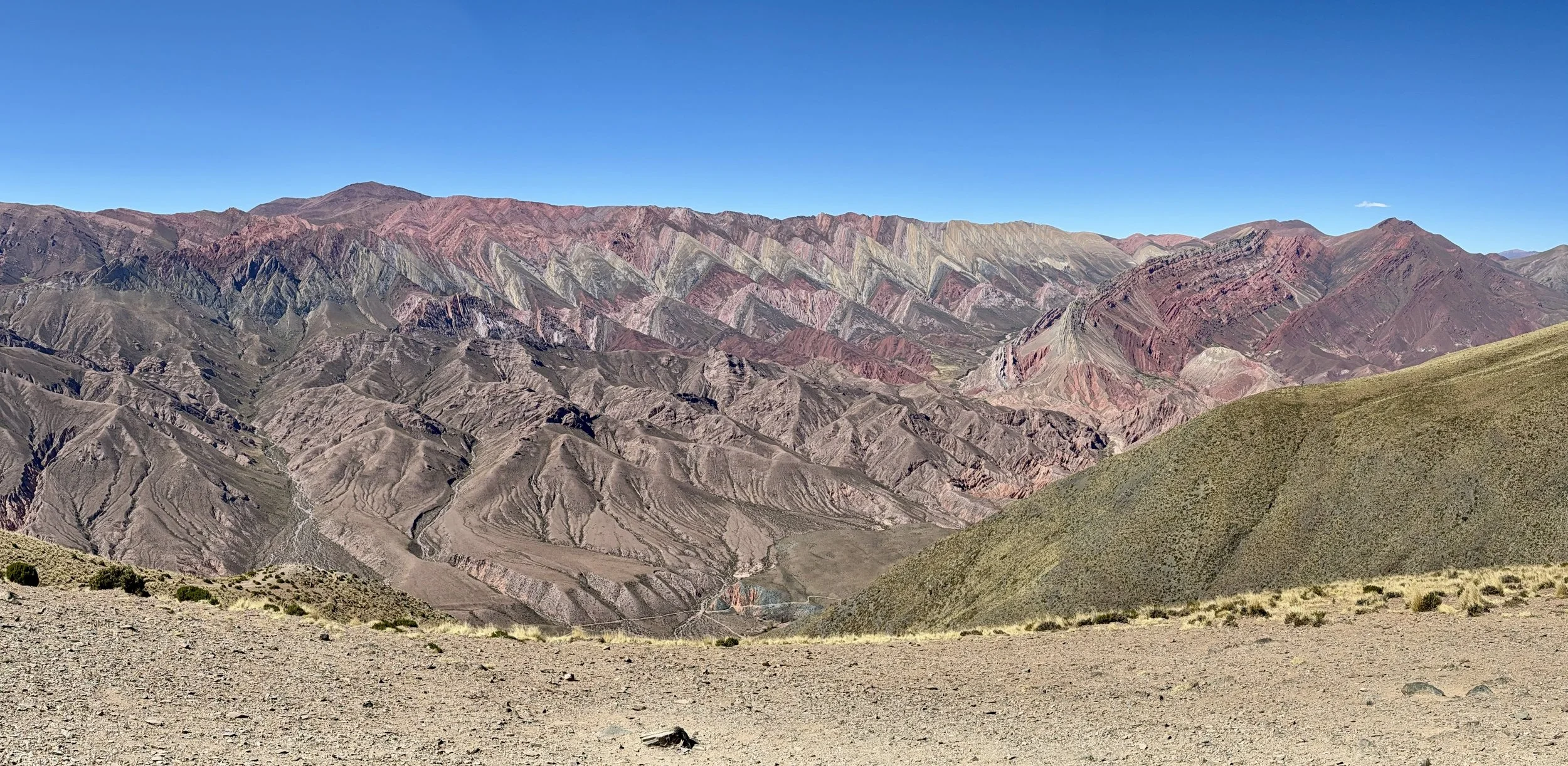
The geometry of Andean land forms finds it’s way into traditional art, crafts and iconography.
This distinction is not decorative. If time is cyclic and agricultural, then the specific topographic features of the landscape you inhabit are the primary coordinates of your existence. The ridge line matters because the sun rises over it at the moment that marks the planting season. The mountain matters because it captures the rain that feeds the terraces. The specific geometry of the horizon is not background to human activity: it is the structure within which time itself is organised. Of course you encode it in your art. It is more important than any abstract category. The grid, which covers the landscape uniformly regardless of its features, cannot think in these terms. The spiral, which returns to the same point at a different distance, can.
The Eurindia movement was attempting, in the buildings of Buenos Aires in the 1920s, to bring this submerged spatial epistemology back to the surface of the city. The three principal buildings of the movement each do this differently.
The Casa Rojas does it through the interior: a grid building on the outside, a different spatial logic within. The patio imposes nothing on the street. It simply waits for you to cross the threshold and encounter the Tiwanaku sun, the Cusco balcony, the Moche figures in the library: the accumulated presence of a pre-Columbian temporal order that the street outside has agreed to ignore.
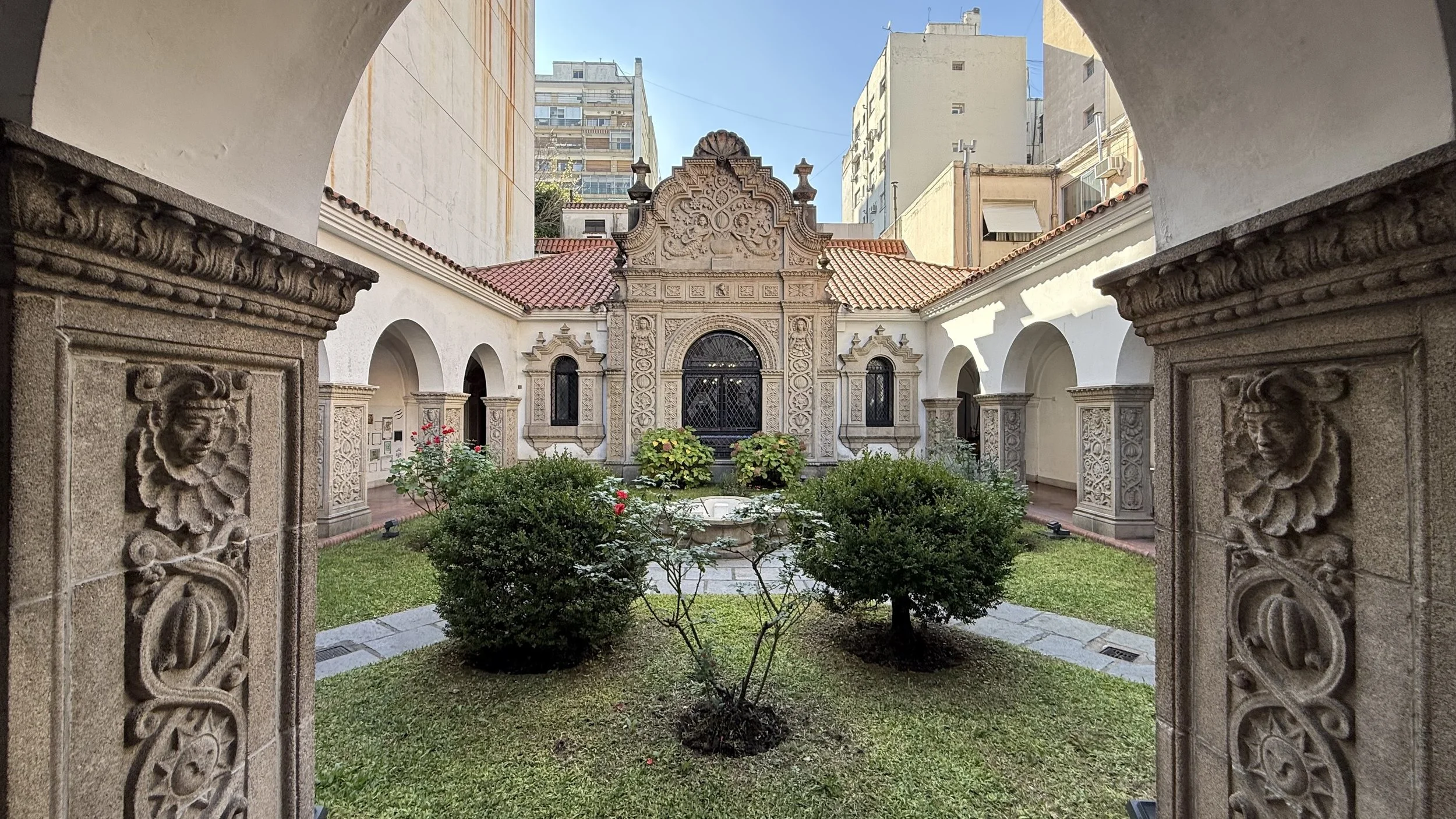
Courtyard, Casa Roja.
The Palacio Noel on Suipacha 1422 does it through the facade and the garden. Martín Noel, trained at the École Spéciale d'Architecture in Paris, a Beaux-Arts architect by formation, came back to Buenos Aires and built himself a house in the retablo style of colonial Peru, the facade treated as an altarpiece, dense with sculptural decoration in vertical registers, the whole surface alive with meaning in the manner of Cusco cathedral or the Church of San Francisco in Lima. The mashrabiya balconies, screened carved wooden screens of Arab origin carried to Spain by the Moors and carried to Peru by Spanish colonists, have made a round trip across three continents. In the garden, Talavera de la Reina ceramic tiles from Toledo sit alongside Lima-style observation balconies and a colonial well whose form traces back to the Arab world. Three traditions in one courtyard, all of them legacy of the same colonial synthesis that produced the Andean baroque Noel was citing.
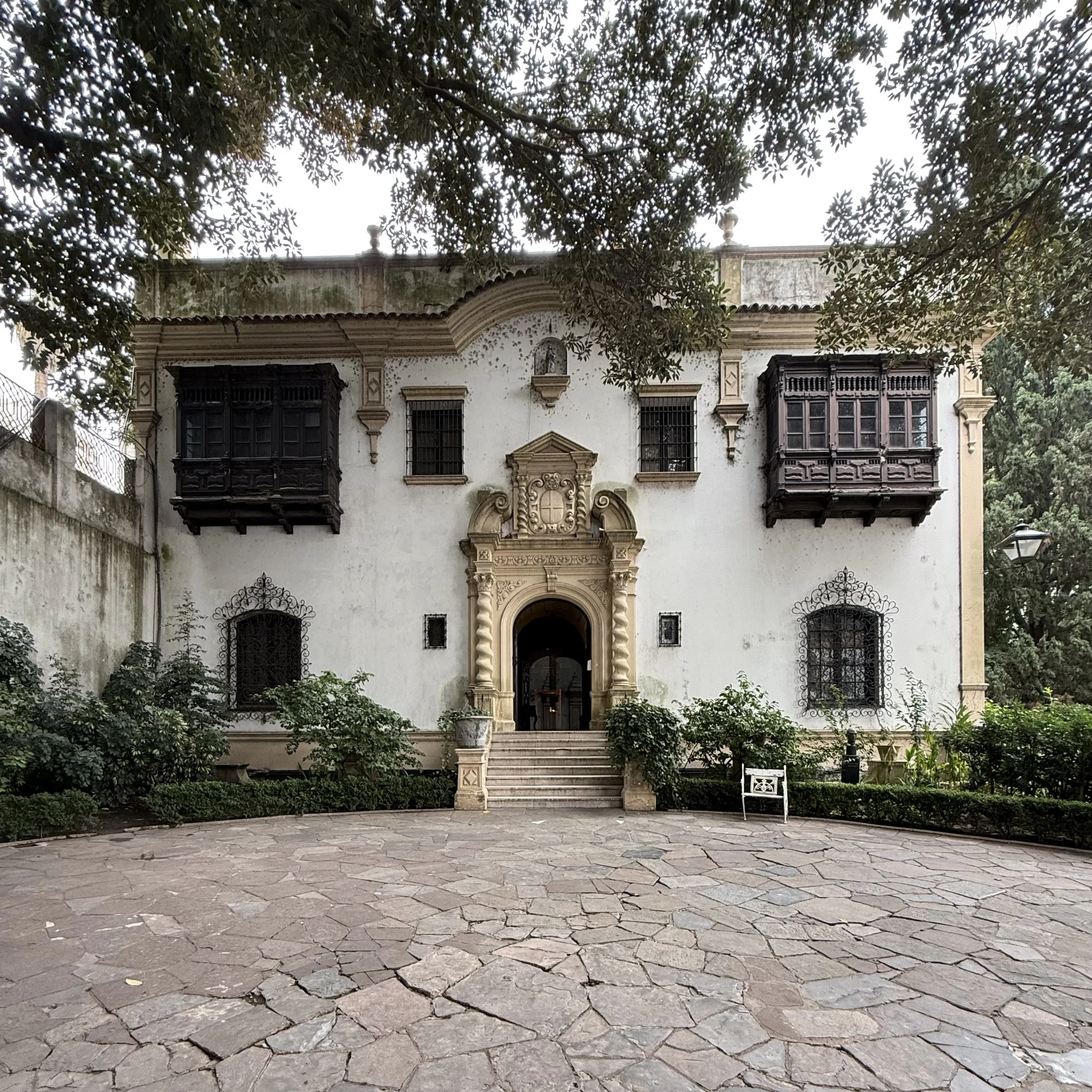
Grand facade, Palacio Noel.
The Palacio Barolo on Avenida de Mayo 1370 is not strictly an Eurindia building. It was completed in 1923, before Rojas published his text, and its synthesis is different in character: Italian baroque structure organised according to the cosmology of Dante's Divine Comedy, crowned with a dome modelled specifically on the Hawa Mahal in Jaipur and the Rajarani temple in Bhubaneswar in Odisha. Its architect Mario Palanti was not engaged with the Andean question. He was engaged with a different but parallel one: whether European civilisation, which he believed was collapsing, could be housed in South America in a form that acknowledged the world was larger than Europe. The building was designed to receive Dante's ashes, which never arrived. Its foundations conform to the golden ratio. Its 100 metres correspond to the 100 cantos of the Divine Comedy. In June, the Southern Cross can be seen directly above the lighthouse on its roof.
What connects the Barolo to the Eurindia buildings is not the specific synthesis but the impulse. Multiple architects in Buenos Aires in the 1910s and 1920s were independently reaching for non-European systems to organise their buildings: a Vedic dome in Monserrat, an Inca sun motif in Recoleta, Peruvian retablo facades in Retiro. The city was briefly a laboratory for the question of what architecture looks like when it stops pretending that Europe is the only source of spatial intelligence.
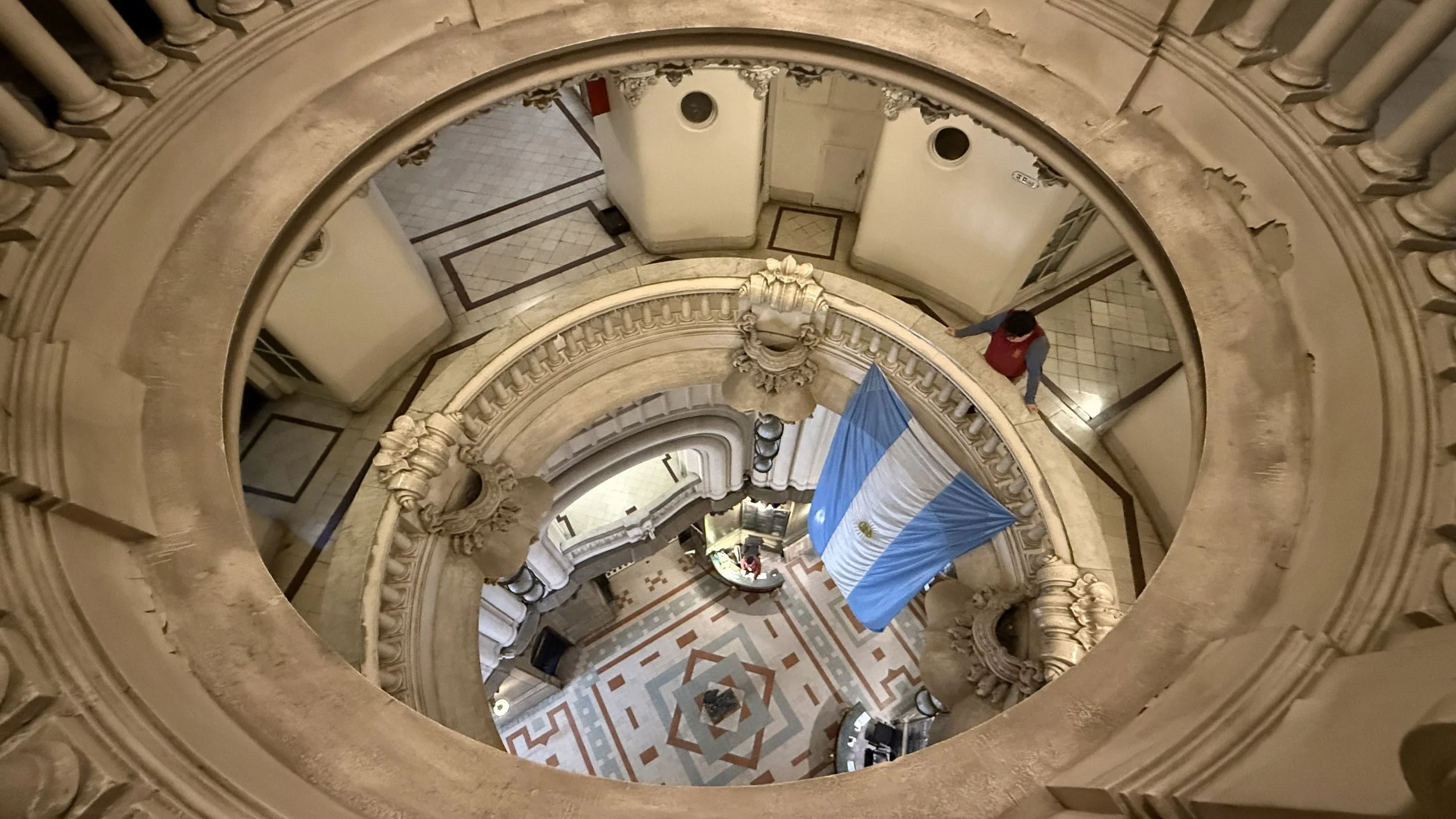
Interior, Palacio Barolo.
The answer, in each case, involves a different relationship to time. The Hindu dome on the Barolo encodes a cyclic cosmology as foreign to the Christian linear narrative as the Andean spiral. The Tiwanaku sun in the Casa Rojas salon is older than the Inca, older than Cusco, a motif encoding the agricultural solar cycle for five thousand years. The retablo facade of the Palacio Noel is a surface that insists on being read in registers, like a calendar: not the linear text of a European architectural treatise but a vertical sequence of meanings, each level related to the others by something other than chronological progression.
Borges, who knew Buenos Aires as well as anyone has known a city, called the neocolonial buildings isolated monsters. He meant it partly as criticism, since they do not fit the European fabric that surrounds them, and partly as acknowledgement that they exist, that they have survived, that the city has not been able to absorb them into its preferred self-image. They stand in the urban grid like stones in a current.
But they are memories rather than monsters. The spiral at Caral, the ridge line encoded in the Iruya weaving, the Tiwanaku sun on the Recoleta column: these are expressions of a single epistemology that has been present in this part of the world for five thousand years, suppressed by the grid and the Laws of the Indies and the Haussmann facades and the official story of a European Argentina, surfacing here and there in the buildings of a few architects who understood that the synthesis had always already happened, inside the baroque itself, in the colonial cities of the Andes, in the bodies and memories of the mestizo population that built and inhabited everything.
The grid is a way of forgetting the landscape. The spiral is a way of remembering it. Buenos Aires built the grid and scattered the spiral through it, and the two have been in conversation ever since.
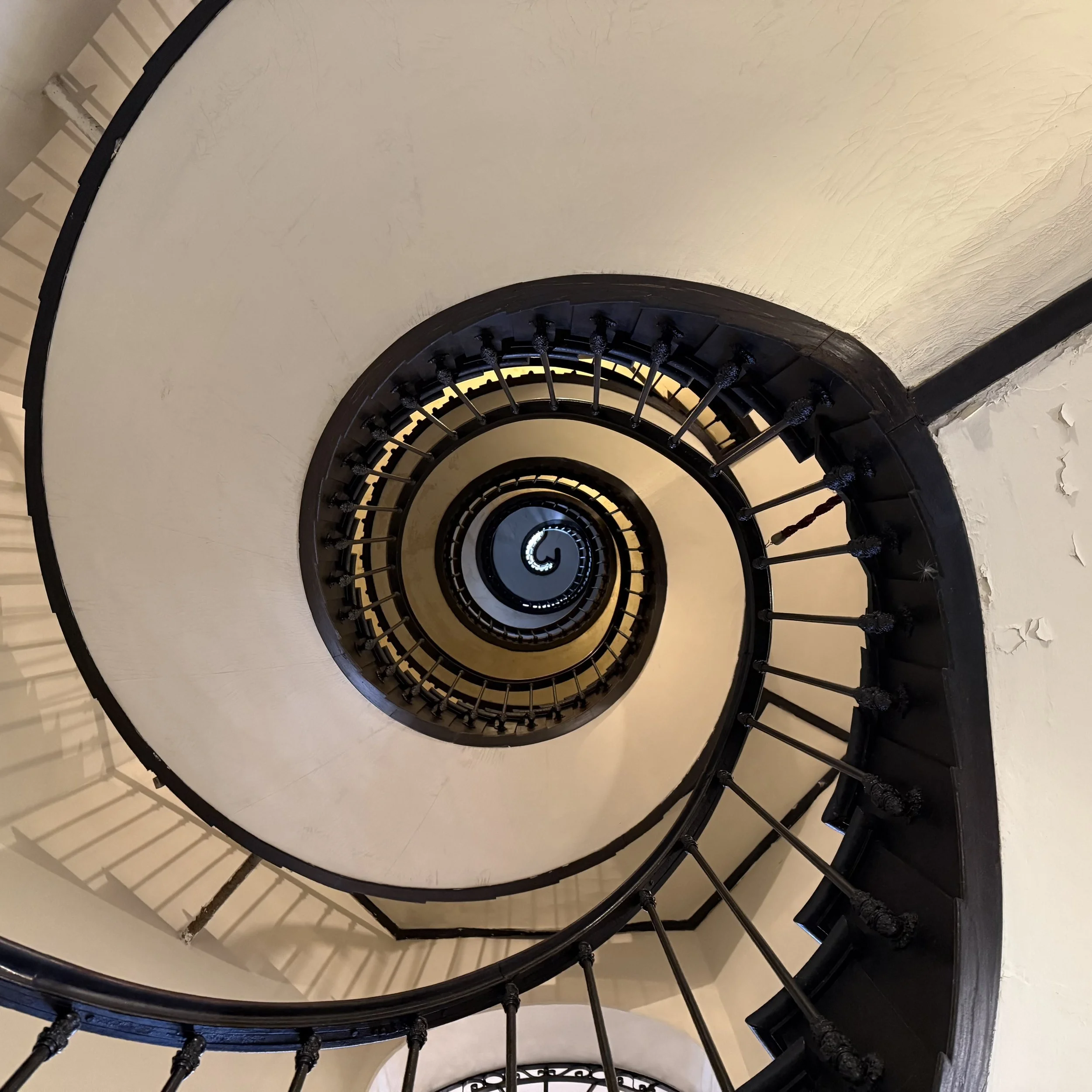
The grid and the spiral: a self-guided tour
Buenos Aires scattered a handful of buildings through its European grid that refuse its logic entirely. They are the work of architects who believed, in the 1910s and 1920s, that Argentine identity could not be built from Haussmann facades alone, that a deeper synthesis was available, one that reached back through the colonial baroque of Cusco and Lima to the Andean civilisations that had organised space and time differently from any European tradition. The theorist behind the movement was Ricardo Rojas, who called it Eurindia: Europe and the indigenous Americas, forced into a single form. This tour visits three buildings that express that argument, each in a different register. Allow a full day. Book the Palacio Barolo in advance.
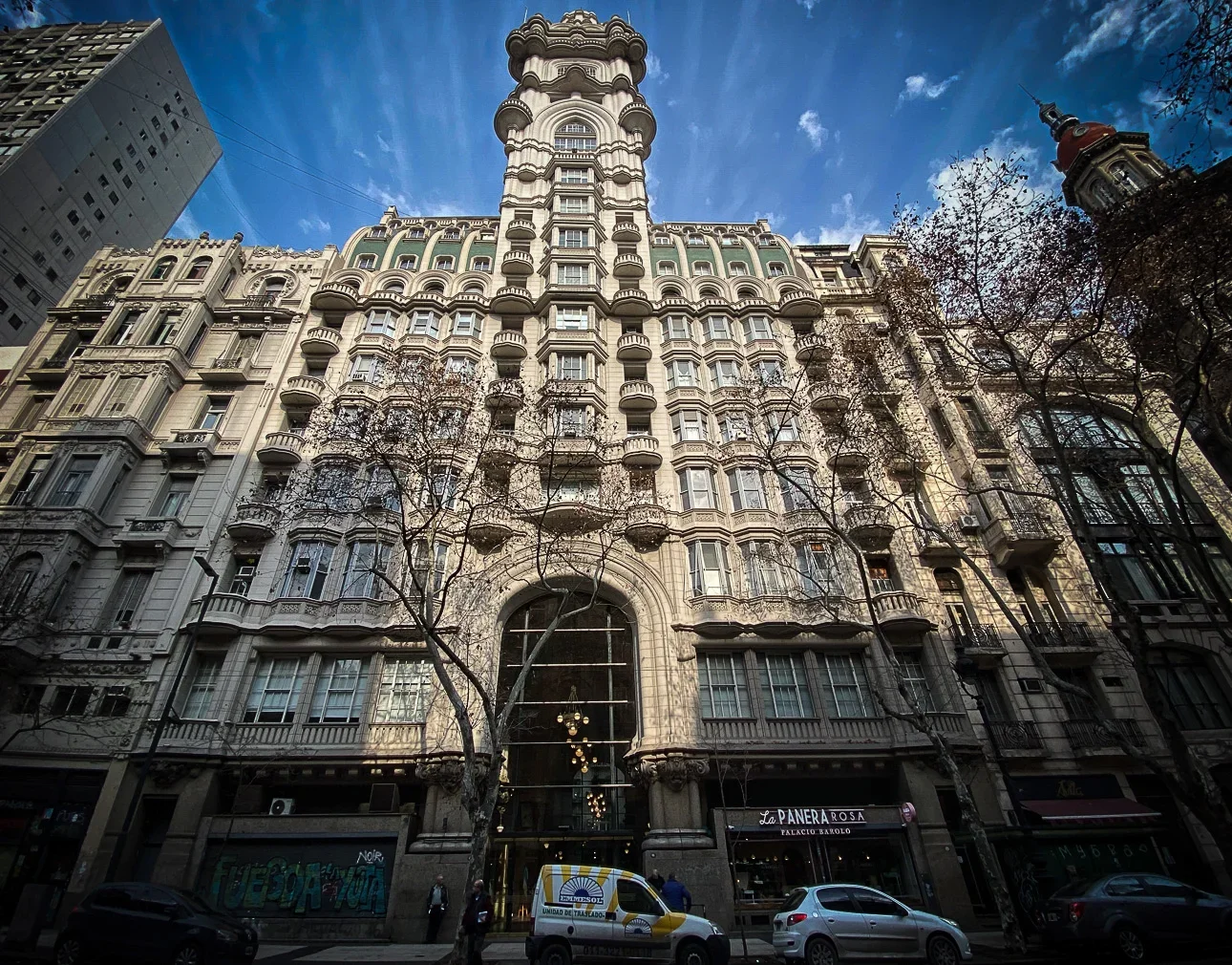
Stop 1: Palacio Barolo
ADDRESS
Avenida de Mayo 1370, Monserrat
Subte: Line A, Saenz Pena station (5 minutes on foot)
PRACTICAL
Guided tours only. No independent access to the upper floors.
Daytime tours: Monday, Wednesday, Thursday, Friday at 10am and 3pm. Duration 90 minutes.
Evening tours: Monday, Wednesday through Saturday. Duration 2 hours.
Book in advance at palaciobarolotours.com.ar or via GetYourGuide. Tours sell out, particularly evenings.
Bilingual: Spanish and English.
Note: the final 8 floors to the lighthouse are by stairs through progressively narrow spaces. Not wheelchair accessible.
The Palacio Barolo is not strictly an Eurindia building. It was completed in 1923, before Rojas published his text, and its architect Mario Palanti was engaged with a different synthesis: Italian baroque structure organised according to the cosmology of Dante's Divine Comedy, crowned with a dome drawn from two specific Hindu temples. But it belongs at the start of this tour because it establishes the central question. Multiple architects in Buenos Aires at the same historical moment were independently reaching for non-European spatial systems to organise their buildings. The Barolo asks why.
Palanti believed European civilisation was collapsing. The building was designed to receive Dante's ashes, which never arrived. It was intended as a vault as much as an office block, a custodianship of cultural memory on the far side of an anticipated catastrophe. Whether or not you share the eschatology, the building takes its argument seriously, and the argument repays attention.
What to look for
The lobby: nine vaulted archways radiating from a central dome, each representing one of Dante's nine circles of hell. The patterned medallions on the floor simulate fire. Dragon statues flank the passage, female and smaller on the east side, male and larger on the west.
The dome: modelled specifically on the Hawa Mahal in Jaipur and the Rajarani temple in Bhubaneswar in Odisha. These are not generic Hindu references. Palanti identified specific buildings. Look at it from the lobby and again from the street outside.
The floors as cosmology: the basement and ground floor are Hell, floors 1 to 14 Purgatory, floors 15 to 22 Heaven. The building is 100 metres tall, one metre per canto of the Divine Comedy. Hold the structure in mind as you ascend.
The lighthouse: at the summit, the original lamp rotates in a glass dome. On a clear day you can see across the Rio de la Plata to Montevideo, where Palanti built the twin building, the Palacio Salvo. The two lighthouses were designed to face each other across the estuary. In early June, the Southern Cross is visible directly above.
The view down Avenida de Mayo to Congress: from the upper terraces, the grid of Buenos Aires is visible in its full extent. This is the city the Eurindia buildings were built inside. Hold that image for the next two stops.
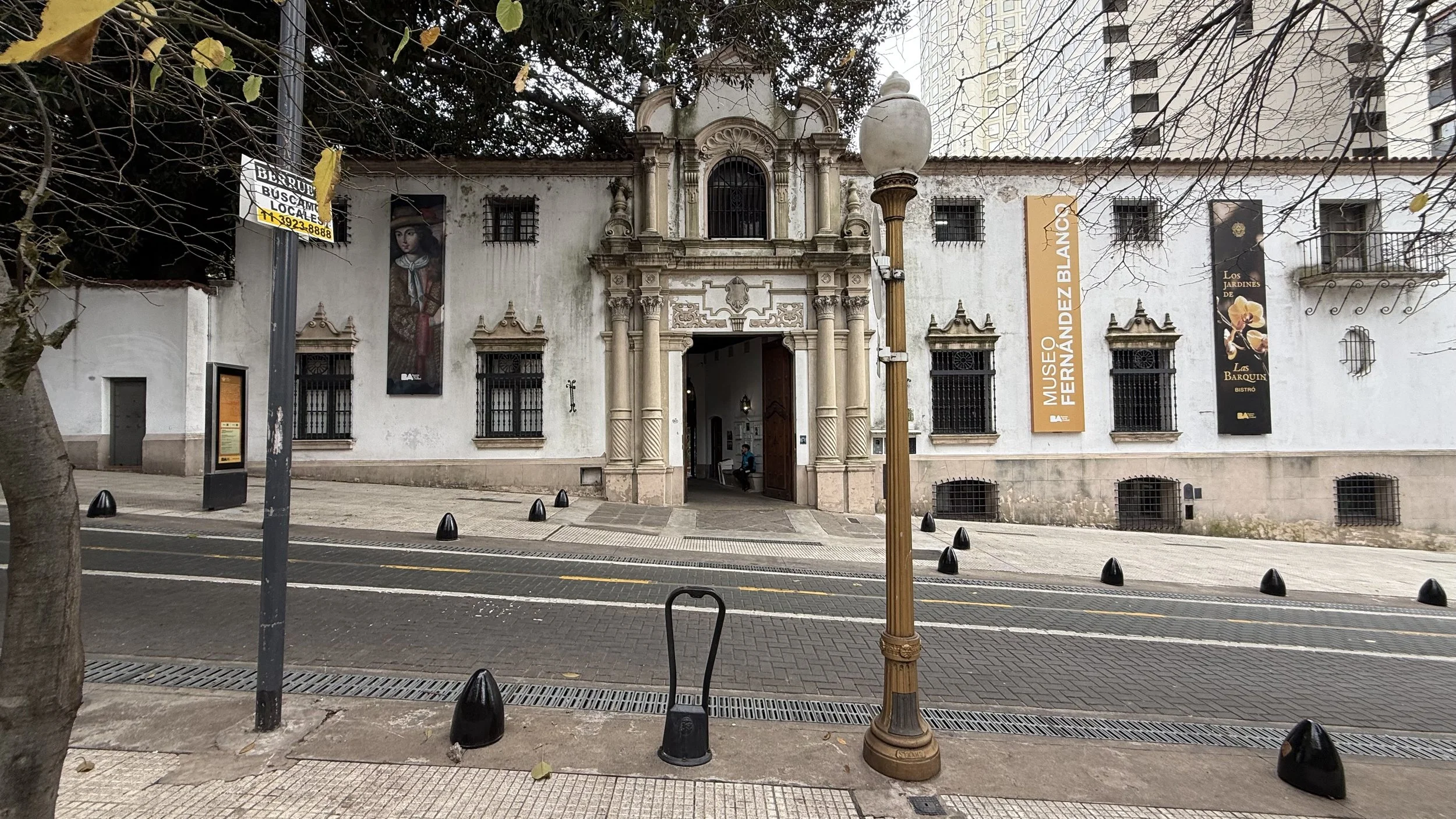
Stop 2: Palacio Noel / Museo Isaac Fernandez Blanco
ADDRESS
Suipacha 1422, Retiro
15 minutes on foot from Palacio Barolo, or take the Subte to San Martin station (Line C)
PRACTICAL
Tuesday to Friday 1pm to 6pm. Saturday, Sunday and public holidays 1pm to 5pm. Closed Monday.
Paid entry for the collection. The garden may be visited separately and is free.
The garden is the primary architectural experience for the purposes of this tour. Allow 45 minutes minimum.
The collection inside, focused on colonial Spanish-American art including Cusco School paintings and Alto Peru silverwork, is directly continuous with the building's argument. Worth an hour if time allows.
Martin Noel trained at the Ecole Speciale d'Architecture in Paris. He returned to Buenos Aires and built himself a house in the retablo style of colonial Peru: the facade treated as an altarpiece, dense with sculptural decoration arranged in registers, the whole surface alive with meaning in the manner of Cusco cathedral. He was a Beaux-Arts architect by training who spent his career arguing against the Beaux-Arts tendency of his city.
The building embodies the first synthesis, the one that happened without being planned. The colonial baroque of Lima and Cusco was itself a product of two centuries of material encounter between Spanish craftsmen and Andean labourers. It was already a hybrid before Noel cited it. What you are looking at in the Palacio Noel is a deliberate citation of an accidental synthesis, transplanted to a Buenos Aires street and asked to make an argument about what the city is and where it comes from.
What to look for
The facade: read it as an altarpiece, in vertical registers from base to cornice. The organisation of a retablo is theological, not chronological: it arranges meanings in a hierarchy from earth to heaven rather than telling a story from left to right. This is a different relationship between surface and time than the European facade, which reads horizontally.
The mashrabiya balconies: screened carved wooden screens of Arab origin, brought to Spain by the Moors, carried to Peru by Spanish colonists, now on a street in Retiro. They have crossed three continents. The surface they present to the street is both open and closed simultaneously, admitting light and air while maintaining privacy.
The garden: Talavera de la Reina ceramic tiles from Toledo on the walls and benches, Lima-style observation balconies on the upper level, and a colonial well whose form traces back to the Arab world. Three traditions in one courtyard. The ombu trees and palos borrachos are native South American species growing alongside olive trees and orange trees from the Mediterranean. The synthesis extends into the planting.
The single frame: stand in the garden and find a position where a Lima balcony, a Talavera tile, and the Buenos Aires street beyond the wall are all visible simultaneously. This is the image the building is trying to produce. It asks you to hold three geographies in one view.
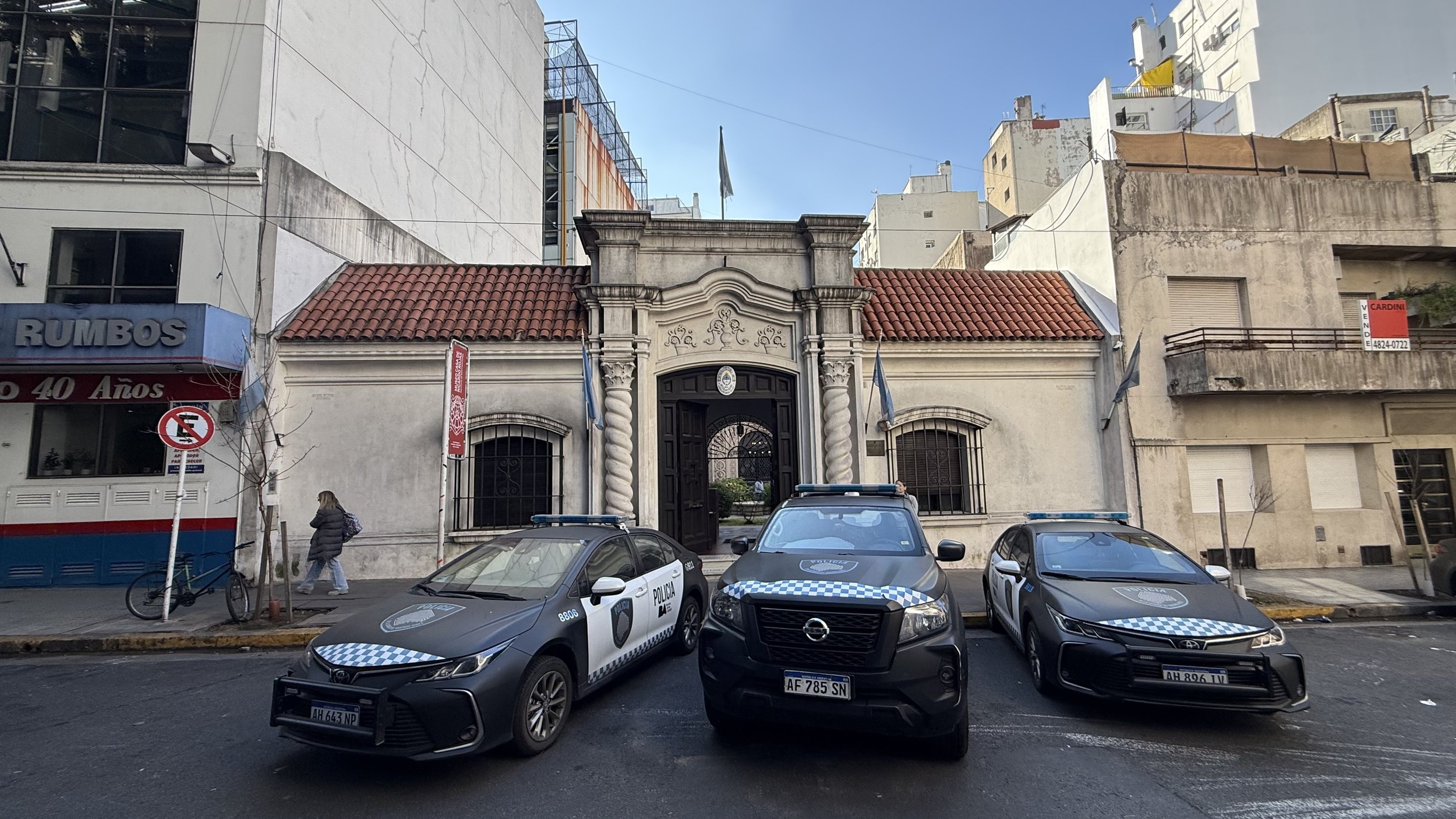
Stop 3: Casa Ricardo Rojas / Museo Casa de Ricardo Rojas
ADDRESS
Charcas 2837, Recoleta
20 minutes on foot from Palacio Noel, or take a taxi
PRACTICAL
Tuesday to Saturday and public holidays, 11am to 7pm. Closed Sunday and Monday.
Free entry.
A self-guided audio tour (Voces de la casa) is available from the museum website in Spanish and English. Download before arriving.
Guided tours run on Wednesdays at 4pm and are strongly recommended: the guide demonstrates precisely how Rojas's philosophy is encoded in the architecture and decoration of each space.
This is the building to end on. The Palacio Barolo asks the question from the outside in: a European structure absorbing non-European cosmologies. The Palacio Noel asks it through the skin of the building: surfaces that remember other geographies. The Casa Rojas asks it from the inside out: a grid building on a Recoleta street that contains, behind a facade that gives nothing away, a complete and considered alternative to the spatial logic of the city around it.
Ricardo Rojas supervised every design decision. The house was a manifesto before it was a residence. Each room represents one of the four phases he identified in Argentine cultural history, the Hispanic, the independent, the cosmopolitan, and the indigenous, and the sequence of rooms is an argument about how those phases relate to each other. You are not visiting a house. You are walking through a theory.
What to look for
The facade: it reproduces the Casa Historica de la Independencia in Tucuman, the building where Argentine independence was declared. From the street it looks colonial and quiet. It gives nothing away.
The threshold: the moment of crossing from the street into the first patio. Buenos Aires disappears. Note what changes and what produces the change. It is not primarily the decoration. It is the spatial organisation: the proportions of the courtyard, the relationship between the covered loggia and the open centre, the light. This is a different spatial logic from the European city outside.
The patio columns: the European column in proportion and structural function, carrying bas-reliefs of sun, maize, flower and star. The column holds the building up in one visual language and names the world in another. Look at where the classical capital ends and the Andean relief begins. This is the seam the post this tour accompanies is describing.
The Cusco-style balcony at the mezzanine level: a Lima and Cusco colonial form, the screened interior balcony looking down into the courtyard, inserted into a Recoleta townhouse. It is the same form as the mashrabiya in the Palacio Noel garden, arrived at through a different colonial tradition.
The salon and the Sun of Tiahuanaco: the Tiwanaku civilisation preceded the Inca by five centuries and Columbus by a thousand years. Rojas and Guido were reaching back past the Inca to an older Andean tradition, one whose spiral motifs and solar iconography encode a conception of time that the post this tour accompanies tries to describe. The sun on this wall is five thousand years old as an idea.
The library: decorated with figures from the Moche and Aguada cultures. These are specific pre-Columbian citations, not generic indigenous ornament. Rojas knew the difference between Moche, Aguada, Tiwanaku and Inca. The house is archaeologically precise and rewards the same precision in the visitor.
The spatial sequence as a whole: walk through all the rooms in order before doubling back to look at individual elements. The argument the house makes is cumulative. It is designed to be experienced as a progression, not as a collection of interesting details.
The three buildings together make a case that Buenos Aires has been conducting, mostly with itself and mostly without acknowledging it, for a century. The grid is a way of forgetting the landscape. These buildings are a way of remembering it. Borges called them isolated monsters, meaning they do not fit the European fabric around them. They are not monsters. They are memories, placed at intervals in a city that has spent considerable effort trying to look like somewhere else.
